The Common Law
1911
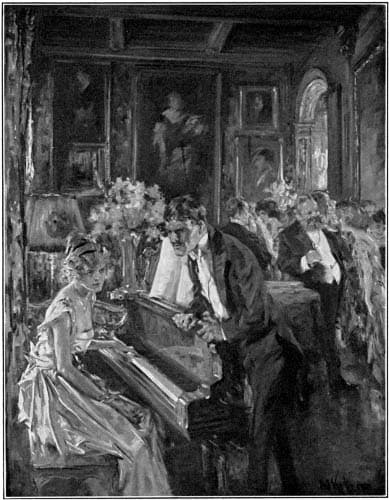
In 1911, when a young woman named Valerie West walks into artist Louis Neville's studio seeking work as a model, she steps into a world of dangerous possibility. New York pulses with ambition, desire, and the intoxicating belief that art can transform life. Valerie has nothing but her willingness and her dreams. What follows is a story of artistic awakening, of the complex power dynamics between creator and muse, and of a woman's struggle to define herself on her own terms in a world that views her primarily as material. Chambers renders the bohemian milieu with sharp observation: the studios thick with creative energy, the tangled relationships between artists and models, the economics of beauty and talent. Valerie's journey from nervous newcomer to confident presence is both a personal transformation and a subtle rebellion against the constraints placed on women of her era. Louis Neville must reckon with what it means to create art from another person's vulnerability. The Common Law endures not as a simple romance but as a nuanced examination of how we use each other, and how we might, occasionally, truly see each other.
Editions
X-Ray
“Even a dog distinguishes between being stumbled over and being kicked.””
— Robert W. Chambers
“The first requirement of a sound body of law is, that it should correspond with the actual feelings and demands of the community, whether right or wrong.””
— Robert W. Chambers
“Law, being a practical thing, must found itself on actual forces. It is quite enough, therefore, for the law, that man, by an instinct which he shares with the domestic dog, and of which the seal gives a most striking example, will not allow himself to be dispossessed, either by force or fraud, of what he olds, without trying to get it back again. Philosophy may find a hundred reasons to justify the instinct, but it would be totally immaterial if it should condemn it and bid us surrender without a murmur.””
— Robert W. Chambers
“The life of the law has not been logic: it has been experience. The felt necessities of the time, the prevalent moral and political theories, intuitions of public policy, avowed or unconscious, even the prejudices which judges share with their fellow-men, have had a good deal more to do than the syllogism in determining the rules by which men should be governed.””
— Robert W. Chambers
“Law, being a practical thing, must found itself onactual forces. It is quite enough, therefore, for the law, that man, by an instinct which he shares with the domestic dog, and of which the seal gives a most striking example, will not allow himself to bedispossessed, either by force or fraud, of what he holds, without trying to get it back again.Philosophy may find a hundred reasons to justify the instinct, but it would be totally immaterial if itshould condemn it and bid us surrender without a murmur.””
— Robert W. Chambers
“a preliminary sketch. Your experience tells you that. But””
— Robert W. Chambers
“Many things which we take for granted have had to be laboriously fought out or thought out in past times.””
— Robert W. Chambers
“The law embodies the story of a nation’s development through many centuries, and it cannot be dealt with as if it contained only the axioms and corollaries of a book of mathematics.””
— Robert W. Chambers
“State interference is an evil, where it cannot be shown to be a good.””
— Robert W. Chambers
Link to this book
Add a free, dofollow link to Lex on your blog, forum, syllabus, or reading list.

<a href="https://lex-books.com/book/the-common-law-0a73b060-d795-422a-952a-0138f31e8c7a"><img src="https://lex-books.com/badges/read-on-lex.svg" alt="Read The Common Law by Robert W. Chambers free on Lex" width="160" height="40"></a>[](https://lex-books.com/book/the-common-law-0a73b060-d795-422a-952a-0138f31e8c7a)[url=https://lex-books.com/book/the-common-law-0a73b060-d795-422a-952a-0138f31e8c7a][img]https://lex-books.com/badges/read-on-lex.svg[/img][/url]Read The Common Law by Robert W. Chambers free on Lex: https://lex-books.com/book/the-common-law-0a73b060-d795-422a-952a-0138f31e8c7aCite this book
Reading this edition for a paper or guide? Copy a citation.
Chambers, Robert W.. The Common Law. Lex, lex-books.com/book/the-common-law-0a73b060-d795-422a-952a-0138f31e8c7a.Chambers, R. W. (1911). The Common Law. Lex. https://lex-books.com/book/the-common-law-0a73b060-d795-422a-952a-0138f31e8c7aChambers, Robert W.. The Common Law. Lex. https://lex-books.com/book/the-common-law-0a73b060-d795-422a-952a-0138f31e8c7a.