The Cloister and the Hearth
1861
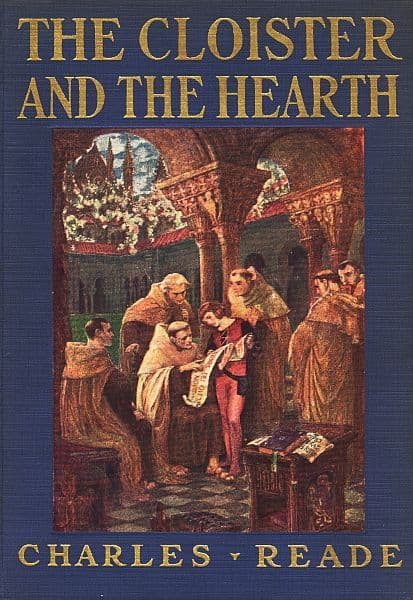
A young scribe and illuminator in 15th century Holland must choose between thecloister and the hearth. Gerard Eliassoen possesses extraordinary artistic talent and a spiritual calling that pulls him toward the priesthood, but he falls in love with Catherine, a woman whose dark secret makes their union impossible in the eyes of the Church. His father Elias, a struggling cloth merchant with a houseful of children, represents another kind of claim - the weight of family obligation, of bread to be earned, of roots in the cold but living earth. Gerard's journey takes him across medieval Europe - through the flourishing cities of Burgundy, the dangerous roads of France, the monasteries and courts where his talents might flourish or perish. Reade paints the period in astonishing detail: the texture of vellum, the smell of tanneries, the hierarchy of guilds, the first printing presses beginning to transform knowledge. The novel crackles with the energy of a writer who fought his publishers over a heroine's unmarried pregnancy - then published anyway. It endures because it captures an ache that never ages: the impossible arithmetic of choosing between duty to God and duty to the heart, between the sacred stillness of the cloister and the desperate, beautiful chaos of love at the hearth.
Editions
X-Ray
“Christians live 'for ever,' and love 'for ever,' but they never part 'for ever. They part, as part the earth and sun, to meet more brightly in a little while. You and I part here for life. And what is our life? One line in the great story of the Church, whose son and daughter we are; one handful in the sand of time, one drop in the ocean of 'For ever.' Adieu”
— Charles Reade
Link to this book
Add a free, dofollow link to Lex on your blog, forum, syllabus, or reading list.

<a href="https://lex-books.com/book/the-cloister-and-the-hearth-3f2df2ae-48d9-4ed3-89ee-71ad4d5fae3c"><img src="https://lex-books.com/badges/read-on-lex.svg" alt="Read The Cloister and the Hearth by Charles Reade free on Lex" width="160" height="40"></a>[](https://lex-books.com/book/the-cloister-and-the-hearth-3f2df2ae-48d9-4ed3-89ee-71ad4d5fae3c)[url=https://lex-books.com/book/the-cloister-and-the-hearth-3f2df2ae-48d9-4ed3-89ee-71ad4d5fae3c][img]https://lex-books.com/badges/read-on-lex.svg[/img][/url]Read The Cloister and the Hearth by Charles Reade free on Lex: https://lex-books.com/book/the-cloister-and-the-hearth-3f2df2ae-48d9-4ed3-89ee-71ad4d5fae3cCite this book
Reading this edition for a paper or guide? Copy a citation.
Reade, Charles. The Cloister and the Hearth. Lex, lex-books.com/book/the-cloister-and-the-hearth-3f2df2ae-48d9-4ed3-89ee-71ad4d5fae3c.Reade, C. (1861). The Cloister and the Hearth. Lex. https://lex-books.com/book/the-cloister-and-the-hearth-3f2df2ae-48d9-4ed3-89ee-71ad4d5fae3cReade, Charles. The Cloister and the Hearth. Lex. https://lex-books.com/book/the-cloister-and-the-hearth-3f2df2ae-48d9-4ed3-89ee-71ad4d5fae3c.