The Awakening of the Soul
1907
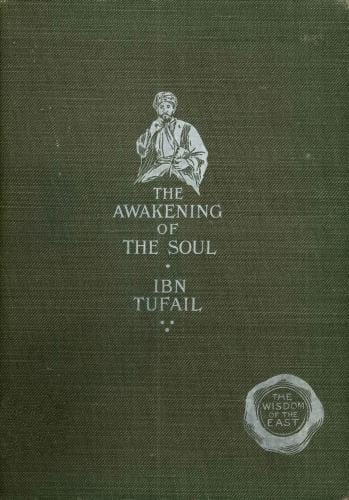
The Awakening of the Soul
Muhammad ibn 'Abd al-Malik Ibn Tufayl
1907
Translated by Paul, 1867- Brönnle
Long before Robinson Crusoe cast his castaway, a 12th-century Muslim philosopher imagined something bolder: a child raised by a wild doe on an empty island, armed with nothing but reason and observation, discovering the architecture of existence through sheer intellectual force. Hayy Ibn Yokdhan has no language, no scripture, no teacher. Yet through meticulous study of the natural world, he arrives at profound truths about creation, the divine, and the nature of the soul. His solitary philosophizing represents one of the most daring thought experiments in medieval literature: what would pure reason uncover if unshaped by tradition? When a wandering ascetic named Asal finally reaches the island, the two engage in a legendary dialogue that pits rational philosophy against religious wisdom, each recognizing truths the other possesses. Ibn Tufayl's masterpiece is not merely a story of survival but an allegory of the mind's awakening, asking whether the philosopher and the believer can ever truly meet. It endures because it refuses easy answers, offering instead a radiant vision of human curiosity reaching toward the infinite.
Editions

X-Ray
“فأصخ الآن بسمع قلبك وحدق ببصر عقلك إلى ما أشير به إليه لعلك أن تجد منه هدياً يلقيك على جادة الطريق وشرطي عليك أن لا تطالب مني في هذا الوقت مزيد بيان بالمشافهة على ما أودعه هذه الأوراق، فإن المجال ضيق والتحكم بالألفاظ على أمر ليس من شأنه أن يلفظ به خطر.””
— Muhammad ibn 'Abd al-Malik Ibn Tufayl
“Now do not set your heart on a description of what has never been represented in a human heart. For many things that are articulate in the heart cannot be described. How then can I formularize something that cannot possibly be projected in the heart, belonging to a different world, a different order of being?””
— Muhammad ibn 'Abd al-Malik Ibn Tufayl
“Yet [134] even though the sense world mimics the divine like a shadow, and the divine world is self-sufficient and totally independent, still it is impossible to postulate complete nonexistence for the sensory world, for the very reason that it does reflect the world of the divine. The destruction of the world, then, can mean only that it is transformed, not that it goes out of existence altogether. The Holy Book speaks clearly to this effect in describing how the mountains will be set in motion and become like tufts of wool, and men like moths, the sun and moon cast down, the seas split open and spilled out, on the Day when the earth turns to what is no longer earth, and the heavens to what is no longer heaven.””
— Muhammad ibn 'Abd al-Malik Ibn Tufayl
“If there is a Being Whose perfection is infinite, Whose splendor [95] and goodness know no bounds, Who is beyond perfection, goodness, and beauty, a Being such that no perfection, no goodness, no beauty, no splendor does not flow from Him, then to lose hold of such a Being, and having known Him to be unable to find Him must mean infinite torture as long as He is not found. Likewise to preserve constant awareness of Him is to know joy without lapse, unending bliss, infinite rapture and delight.””
— Muhammad ibn 'Abd al-Malik Ibn Tufayl
“It is because he is so aware of the impact of social forces that he seeks to abstract from them, in search of the inner core of human identity and the truths one would discover, given the freedom to explore and the capacity to penetrate na- ture’s workings and the meanings of the messages nature seems silently but insis- tently to signal.””
— Muhammad ibn 'Abd al-Malik Ibn Tufayl
“It has been proved with scientific certainty that the sun is spherical, as is the earth, and that the sun is much bigger than the earth. Thus somewhat more than half the earth’s surface is perpetually lit by the sun, and of the sector of the earth illuminated at any given moment, the most brilliantly lit portion [23] is the center, since it is furthest from the darkness and faces most directly into the sun.””
— Muhammad ibn 'Abd al-Malik Ibn Tufayl
Link to this book
Add a free, dofollow link to Lex on your blog, forum, syllabus, or reading list.

<a href="https://lex-books.com/book/the-awakening-of-the-soul-3f509192-6932-4633-8903-b6e9ce80cd4b"><img src="https://lex-books.com/badges/read-on-lex.svg" alt="Read The Awakening of the Soul by Muhammad ibn 'Abd al-Malik Ibn Tufayl free on Lex" width="160" height="40"></a>[](https://lex-books.com/book/the-awakening-of-the-soul-3f509192-6932-4633-8903-b6e9ce80cd4b)[url=https://lex-books.com/book/the-awakening-of-the-soul-3f509192-6932-4633-8903-b6e9ce80cd4b][img]https://lex-books.com/badges/read-on-lex.svg[/img][/url]Read The Awakening of the Soul by Muhammad ibn 'Abd al-Malik Ibn Tufayl free on Lex: https://lex-books.com/book/the-awakening-of-the-soul-3f509192-6932-4633-8903-b6e9ce80cd4bCite this book
Reading this edition for a paper or guide? Copy a citation.
Tufayl, Muhammad ibn 'Abd al-Malik Ibn. The Awakening of the Soul. Lex, lex-books.com/book/the-awakening-of-the-soul-3f509192-6932-4633-8903-b6e9ce80cd4b.Tufayl, M. I. '. A. I. (1907). The Awakening of the Soul. Lex. https://lex-books.com/book/the-awakening-of-the-soul-3f509192-6932-4633-8903-b6e9ce80cd4bTufayl, Muhammad ibn 'Abd al-Malik Ibn. The Awakening of the Soul. Lex. https://lex-books.com/book/the-awakening-of-the-soul-3f509192-6932-4633-8903-b6e9ce80cd4b.