Salammbo
1862
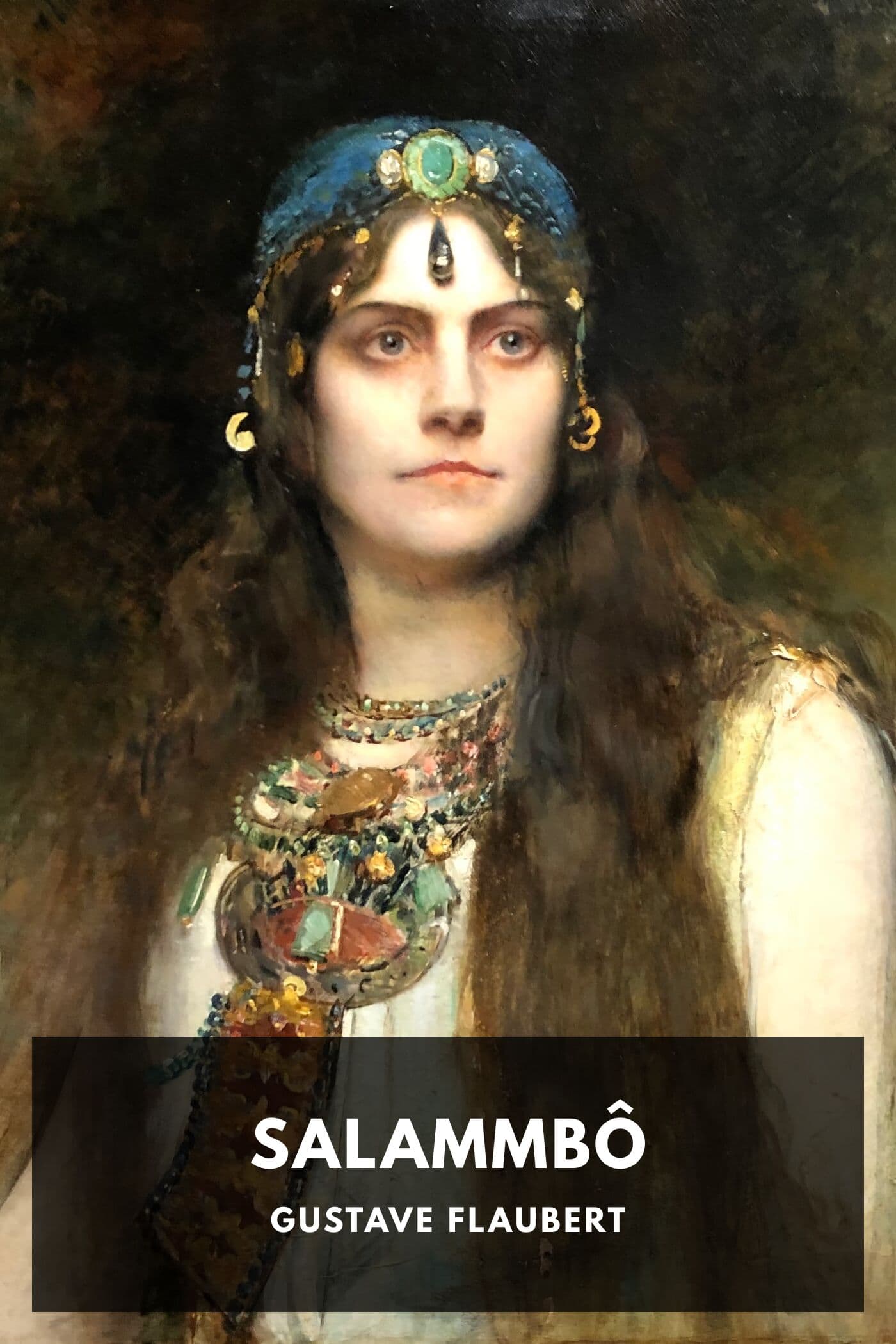
Salammbo conjures ancient Carthage as a fever dream: opulent, violent, suffused with the incense of a thousand sacrifices. Flaubert, who spent years researching the smallest details of Carthaginian life, renders a world where snakes coil around temple pillars and the moon bleeds over sacred stones. At its heart stands the priestess Salammbô, daughter of the general Hamilcar, whose reverence for the goddess Tanit becomes intertwined with the mercenary revolt tearing her city apart. The soldiers who once fought for Carthage now demand their wages, and as the siege tightens, Salammbô is drawn into a dangerous negotiation where her body and her faith become instruments of state. What follows is a descent into ritual, lust, and sacrifice that builds toward an ending as brutal as anything in Flaubert. This is historical fiction as pure sensation: readers don't just learn about Carthage, they taste its salt, smell its pyres, and feel the sandstorm in their throats. For those who have ever wanted to lose themselves in a vanished world, this novel is an doorway.
Editions

X-Ray
“Through the forest he pursued the she-monster whose tail coiled over the dead leaves like a silver stream; and he came to a meadow where women, with the hindquarters of dragons, stood around a great fire, raised on the tips of their tails. The moon shone red as blood in a pale circle and their scarlet tongues, formed like fishing harpoons, stretched out, curling to the edge of the flame.””
— Gustave Flaubert
“C'était à Mégara, faubourg de Carthage, dans les jardins d'Hamilcar.””
— Gustave Flaubert
“Les âmes des morts, disait-il, se résolvent dans la lune comme les cadavres dans la terre. Leurs larmes composent son humidité: c’est un séjour obscur plein de fange, de débris et de tempêtes.””
— Gustave Flaubert
“Les Grecs alignèrent sur des rangs parallèles leurs tentes de peaux; les Ibériens disposèrent en cercle leurs pavillons de toile; les Gaulois se firent des baraques de planches; les Libyens des cabanes de pierres sèches, et les Nègres creusèrent dans le sable avec leurs ongles des fosses pour dormir. Beaucoup, ne sachant où se mettre, erraient au milieu des bagages [...]””
— Gustave Flaubert
“Her hair, which was powdered with violet sand, and combined into the form of a tower, after the fashion of the Chanaanite maidens, added to her height. Tresses of pearls were fastened to her temples, and fell to the corners of her mouth, which was as rosy as a half-open pomegranate. On her breast was a collection of luminous stones, their variegation imitating the scales of the murena. Her arms were adorned with diamonds, and issued naked from her sleeveless tunic, which was starred with red flowers on a perfectly black ground. Between her ankles she wore a golden chainlet to regulate her steps, and her large dark purple mantle, cut of an unknown material, trailed behind her, making, as it were, at each step, a broad wave which followed her.””
— Gustave Flaubert
Link to this book
Add a free, dofollow link to Lex on your blog, forum, syllabus, or reading list.

<a href="https://lex-books.com/book/salammbo-1b140c53-e66f-4bd7-a444-80088c925ea5"><img src="https://lex-books.com/badges/read-on-lex.svg" alt="Read Salammbo by Gustave Flaubert free on Lex" width="160" height="40"></a>[](https://lex-books.com/book/salammbo-1b140c53-e66f-4bd7-a444-80088c925ea5)[url=https://lex-books.com/book/salammbo-1b140c53-e66f-4bd7-a444-80088c925ea5][img]https://lex-books.com/badges/read-on-lex.svg[/img][/url]Read Salammbo by Gustave Flaubert free on Lex: https://lex-books.com/book/salammbo-1b140c53-e66f-4bd7-a444-80088c925ea5Cite this book
Reading this edition for a paper or guide? Copy a citation.
Flaubert, Gustave. Salammbo. Lex, lex-books.com/book/salammbo-1b140c53-e66f-4bd7-a444-80088c925ea5.Flaubert, G. (1862). Salammbo. Lex. https://lex-books.com/book/salammbo-1b140c53-e66f-4bd7-a444-80088c925ea5Flaubert, Gustave. Salammbo. Lex. https://lex-books.com/book/salammbo-1b140c53-e66f-4bd7-a444-80088c925ea5.