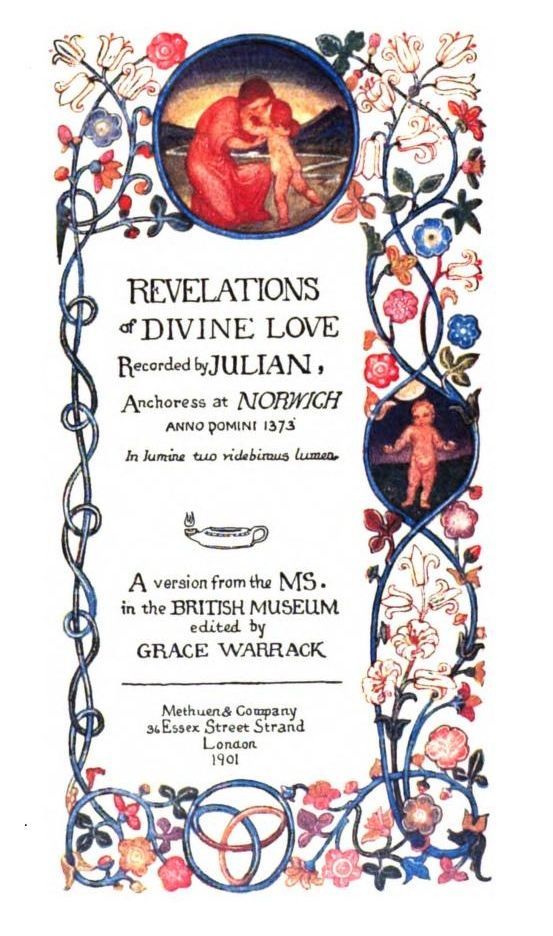
Revelations of Divine Love
1395
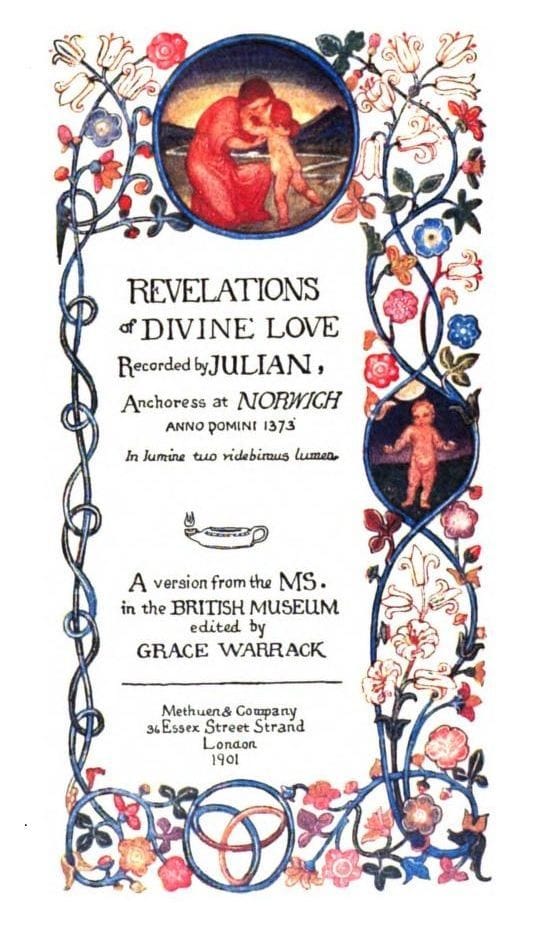
In 1373, a woman in Norwich lay dying. She was thirty or perhaps thirty-one, an anchorite封闭 in a small cell attached to a church, and she had begged God for a deeper understanding of Christ's suffering. What came that night would become the earliest surviving book written by a woman in the English language. Through sixteen visions of extraordinary intensity, Julian of Norwich witnessed Christ's Passion, and found not wrath, but an almost unbearable tenderness. She saw sin as necessary to understanding grace, suffering as woven into love itself. Yet above all, she encountered a God whose nature is mercy. Her famous declaration:*all shall be well, and all shall be well, and all manner of things shall be well*:has echoed for six centuries. Written in vigorous Middle English by an unlearned woman who called herself a «simple creature,» this work moves from visionary experience to daring speculation in its longer form. It stands alongside The Cloud of Unknowing and Piers Plowman as a masterpiece of medieval English mysticism, yet it remains utterly singular: a work of profound theology authored by a woman who claimed no authority except what heaven had given her in her darkest hour.
Editions
X-Ray
“He said not 'Thou shalt not be tempested, thou shalt not be travailed, thou shalt not be dis-eased'; but he said, 'Thou shalt not be overcome.””
— Unknown
“And in this he showed me a little thing, the quantity of a hazel nut, lying in the palm of my hand, as it seemed. And it was as round as any ball. I looked upon it with the eye of my understanding, and thought, ‘What may this be?’ And it was answered generally thus, ‘It is all that is made.’ I marveled how it might last, for I thought it might suddenly have fallen to nothing for littleness. And I was answered in my understanding: It lasts and ever shall, for God loves it. And so have all things their beginning by the love of God.In this little thing I saw three properties. The first is that God made it. The second that God loves it. And the third, that God keeps it.””
— Unknown
“Truth sees God, and wisdom contemplates God, and from these two comes a third, a holy and wonderful delight in God, who is love.””
— Unknown
“...we need to fall, and we need to be aware of it; for if we did not fall, we should not know how weak and wretched we are of ourselves, nor should we know our Maker's marvellous love so fully...””
— Unknown
“...deeds are done which appear so evil to us and people suffer such terrible evils that it does not seem as though any good will ever come of them; and we consider this, sorrowing and grieving over it so that we cannot find peace in the blessed contemplation of God as we should do; and this is why: our reasoning powers are so blind now, so humble and so simple, that we cannot know the high, marvelous wisdom, the might and the goodness of the Holy Trinity. And this is what he means where he says, 'You shall see for yourself that all manner of things shall be well', as if he said, 'Pay attention to this now, faithfully and confidently, and at the end of time you will truly see it in the fullness of joy.””
— Unknown
“... so our customary practice of prayer was brought to mind: how through our ignorance and inexperience in the ways of love we spend so much time on petition. I saw that it is indeed more worthy of God and more truly pleasing to him that through his goodness we should pray with full confidence, and by his grace cling to him with real understanding and unshakeable love, than that we should go on making as many petitions as our souls are capable of.””
— Unknown
“But for I am a woman should I therefore live that I should not tell you the goodness of God?””
— Unknown
“God, of your goodness, give me yourself; you are enough for me, and anything less that I could ask for would not do you full honor. And if I ask anything that is less, I shall always lack something, but in you alone I have everything'.””
— Unknown
“And I saw that truly nothing happens by accident or luck, but everything by God's wise providence. If it seems to be accident or luck from our point of view, our blindness and lack of foreknowledge is the cause; for matters that have been in God's foreseeing wisdom since before time began befall us suddenly, all unawares; and so in our blindness and ignorance we say that this is accident or luck, but to our Lord God it is not so.””
— Unknown
Link to this book
Add a free, dofollow link to Lex on your blog, forum, syllabus, or reading list.

<a href="https://lex-books.com/book/revelations-of-divine-love-75f42474-8717-4629-9123-8b8452aa93ad"><img src="https://lex-books.com/badges/read-on-lex.svg" alt="Read Revelations of Divine Love by Unknown free on Lex" width="160" height="40"></a>[](https://lex-books.com/book/revelations-of-divine-love-75f42474-8717-4629-9123-8b8452aa93ad)[url=https://lex-books.com/book/revelations-of-divine-love-75f42474-8717-4629-9123-8b8452aa93ad][img]https://lex-books.com/badges/read-on-lex.svg[/img][/url]Read Revelations of Divine Love by Unknown free on Lex: https://lex-books.com/book/revelations-of-divine-love-75f42474-8717-4629-9123-8b8452aa93adCite this book
Reading this edition for a paper or guide? Copy a citation.
Unknown. Revelations of Divine Love. Lex, lex-books.com/book/revelations-of-divine-love-75f42474-8717-4629-9123-8b8452aa93ad.Unknown (1395). Revelations of Divine Love. Lex. https://lex-books.com/book/revelations-of-divine-love-75f42474-8717-4629-9123-8b8452aa93adUnknown. Revelations of Divine Love. Lex. https://lex-books.com/book/revelations-of-divine-love-75f42474-8717-4629-9123-8b8452aa93ad.