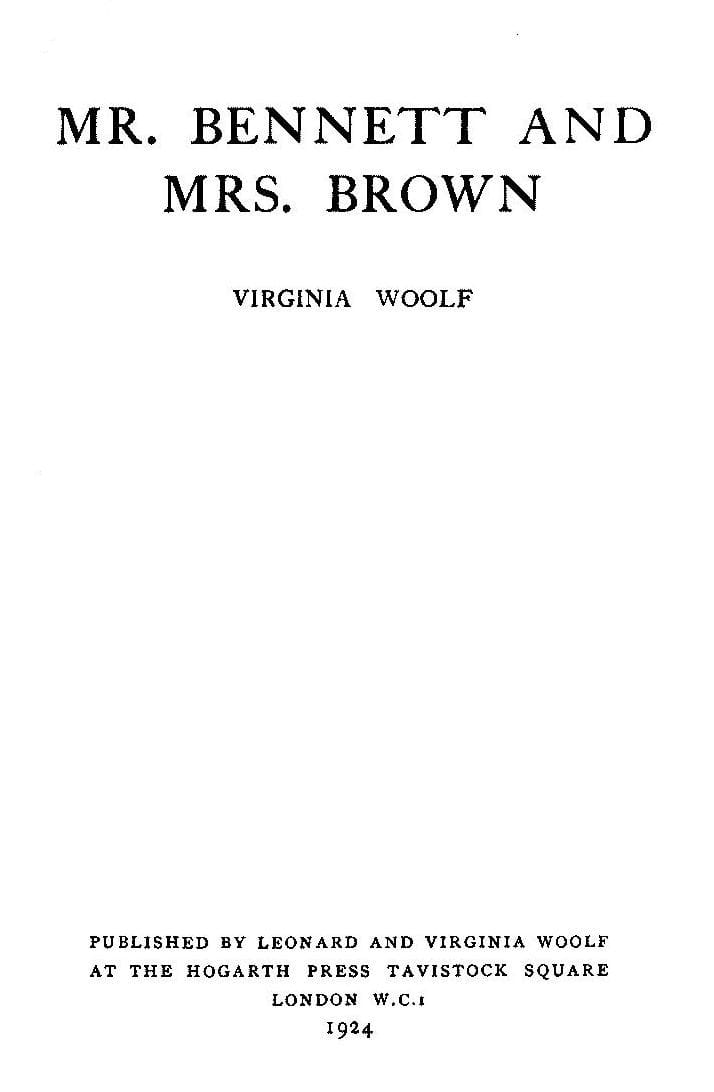
Mr. Bennett and Mrs. Brown
In 1924, Virginia Woolf fired a shot across the bow of English literature with this audacious essay. Written as a direct retort to critic Arnold Bennett, she argues that everything he valued in fiction has become extinct: the solid world of material detail, the belief in character as knowable entity, the trust in surfaces. On or about December 1910, she declares, human character changed and the Edwardian novel died. What emerged was something幽灵-like, interior, impossible to pin down. Woolf invents Mrs. Brown, an ordinary old woman glimpsed on a train, to demonstrate her point: traditional methods cannot capture her, cannot reach the life flickering behind her eyes. This is not merely literary squabbling but a founding document of modernism, a passionate argument for why art must reinvent itself when the world it describes has become unrecognizable. A slim, polemical masterpiece that every serious reader of fiction must encounter.
Editions
X-Ray
“In your modesty you seem to consider that writers are of different blood and bone from yourselves; that they know more of Mrs Brown than you do. Never was there a more fatal mistake. It is this division between reader and writer, this humility on your part, these professional airs and graces on ours, that corrupt and emasculate the books which should be the healthy offspring of a close and equal alliance between us.””
— Virginia Woolf
“There she sits in the corner of the carriage”
— Virginia Woolf
“The horrible domestic tradition which made it seemly for a woman of genius to spend her time chasing beetles, scouring saucepans, instead of writing books.””
— Virginia Woolf
“And now I will hazard a second assertion, which is more disputable perhaps, to the effect that on or about December 1910 human character changed. I am not saying that one went out, as one might into a garden, and there saw that a rose had flowered, or that a hen had laid an egg. The change was not sudden and definite like that. But a change there was, nevertheless; and, since one must be arbitrary, let us date it about the year 1910. The first signs of it are recorded in the books of Samuel Butler, in The Way of All Flesh in particular; the plays of Bernard Shaw continue to record it. In life one can see the change, if I may use a homely illustration, in the character of one's cook. The Victorian cook lived like a leviathan in the lower depths, formidable, silent, obscure, inscrutable; the Georgian cook is a creature of sunshine and fresh air; in and out of the drawing-room, now to borrow The Daily Herald, now to ask advice about a hat. Do you ask for more solemn instances of the power of the human race to change? Read the Agamemnon and see whether, in process of time, your sympathies are not almost entirely with Clytemnestra. Or consider the married life of the Carlyles, and bewail the waste, the futility, for him and for her, of the horrible domestic tradition which made it seemly for a woman of genius to spend her time chasing beetles, scouring saucepans, instead of writing books. All human relations have shifted”
— Virginia Woolf
“Thus I have tried, at tedious length, I fear, to answer some of the questions which I began by asking. I have given an account of some of the difficulties which in my view beset the Georgian writer in all his forms. I have sought to excuse him. May I end by venturing to remind you of the duties and responsibilities that are yours as partners in this business of writing books, as companions in the railway carriage, as fellow travellers with Mrs. Brown? For she is just as visible to you who remain silent as to us who tell stories about her. In the course of your daily life this past week you have had far stranger and more interesting experiences than the one I have tried to describe. You have overheard scraps of talk that filled you with amazement. You have gone to bed at night bewildered by the complexity of your feelings. In one day thousands of ideas have coursed through your brains; thousands of emotions have met, collided, and disappeared in astonishing disorder. Nevertheless, you allow the writers to palm off upon you a version of all this, an image of Mrs. Brown, which has no likeness to that surprising apparition whatsoever. In your modesty you seem to consider that writers are of different blood and bone from yourselves; that they know more of Mrs. Brown than you do. Never was there a more fatal mistake. It is this division between reader and writer, this humility on your part, these professional airs and graces on ours, that corrupt and emasculate the books which should be the healthy offspring of a close and equal alliance between us. Hence spring those sleek, smooth novels, those portentous and ridiculous biographies, that milk and watery criticism, those poems melodiously celebrating the innocence of roses and sheep which pass so plausibly for literature at the present time.””
— Virginia Woolf
“But if I had done that I should have escaped the appalling effort of saying what I meant. And to have got at what I meant I should have had to go back and back and back; to experiment with one thing and another; to try this sentence and that, referring each word to my vision, matching it as exactly as possible, and knowing that somehow I had to find a common ground between us, a convention which would not seem to you too odd, unreal, and far-fetched to believe in. I admit that I shirked that arduous undertaking. I let my Mrs. Brown slip through my fingers. I have told you nothing whatever about her. But that is partly the great Edwardians' fault. I asked them”
— Virginia Woolf
“Why, when October comes round, do the publishers always fail to supply us with a masterpiece?””
— Virginia Woolf
“At the present moment we are suffering, not from decay, but from having no code of manners which writers and readers accept as a prelude to the more exciting intercourse of friendship.””
— Virginia Woolf
Link to this book
Add a free, dofollow link to Lex on your blog, forum, syllabus, or reading list.

<a href="https://lex-books.com/book/mr-bennett-and-mrs-brown-b2d42a57-9abb-4a68-afbe-72d8817c478d"><img src="https://lex-books.com/badges/read-on-lex.svg" alt="Read Mr. Bennett and Mrs. Brown by Virginia Woolf free on Lex" width="160" height="40"></a>[](https://lex-books.com/book/mr-bennett-and-mrs-brown-b2d42a57-9abb-4a68-afbe-72d8817c478d)[url=https://lex-books.com/book/mr-bennett-and-mrs-brown-b2d42a57-9abb-4a68-afbe-72d8817c478d][img]https://lex-books.com/badges/read-on-lex.svg[/img][/url]Read Mr. Bennett and Mrs. Brown by Virginia Woolf free on Lex: https://lex-books.com/book/mr-bennett-and-mrs-brown-b2d42a57-9abb-4a68-afbe-72d8817c478dCite this book
Reading this edition for a paper or guide? Copy a citation.
Woolf, Virginia. Mr. Bennett and Mrs. Brown. Lex, lex-books.com/book/mr-bennett-and-mrs-brown-b2d42a57-9abb-4a68-afbe-72d8817c478d.Woolf, V. (n.d.). Mr. Bennett and Mrs. Brown. Lex. https://lex-books.com/book/mr-bennett-and-mrs-brown-b2d42a57-9abb-4a68-afbe-72d8817c478dWoolf, Virginia. Mr. Bennett and Mrs. Brown. Lex. https://lex-books.com/book/mr-bennett-and-mrs-brown-b2d42a57-9abb-4a68-afbe-72d8817c478d.