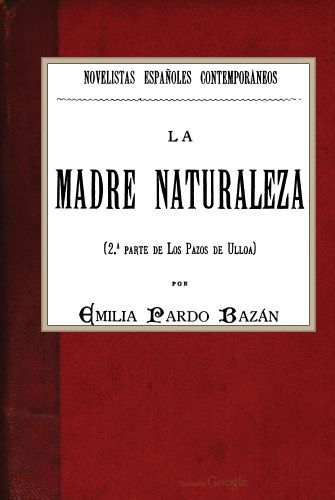
La Madre Naturaleza (2ª Parte De Los Pazos De Ulloa)
1887
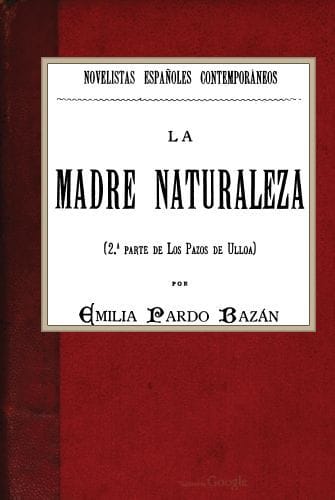
This sequel to "Los Pazos de Ulloa" finds Pardo Bazán at her most audacious. Pedro and Manuela, childhood friends in rural Galicia, take shelter from a relentless rainstorm beneath an ancient chestnut tree and then in a rustic cave. What begins as innocent play between companions gradually reveals itself as something more charged, their shared refuge from the storm becoming a crucible for desire, innocence, and the wild forces of nature. When the rain ceases, they emerge into a landscape transformed, captivated by a brilliant rainbow arcing over the wet countryside. The natural world here is no mere backdrop: it is an active, almost overwhelming presence that shapes human emotion and exposes the fragile boundary between virtue and instinct. Pardo Bazán, who had met Zola in Paris and absorbed his Naturalist theories, constructs a world both scientifically precise and poetically lush. The novel poses questions that remain uncomfortably contemporary: Is love ennobling or merely biological? Can happiness coexist with moral duty? What does it mean to be trapped between civilization's constraints and nature's raw demands? This is Spanish Naturalism at its most challenging and rewarding.
Editions
X-Ray
“-Yo no soy un chiflado -pensaba don Gabriel. -Yo soy víctima de mi época y del estado de mi nación, ni más ni menos.””
— Emilia, condesa de Pardo Bazán
Link to this book
Add a free, dofollow link to Lex on your blog, forum, syllabus, or reading list.

<a href="https://lex-books.com/book/la-madre-naturaleza-2-parte-de-los-pazos-de-ulloa-428cca96-ab07-49b7-9041-ef9f248b12f0"><img src="https://lex-books.com/badges/read-on-lex.svg" alt="Read La Madre Naturaleza (2ª Parte De Los Pazos De Ulloa) by Emilia, condesa de Pardo Bazán free on Lex" width="160" height="40"></a>[](https://lex-books.com/book/la-madre-naturaleza-2-parte-de-los-pazos-de-ulloa-428cca96-ab07-49b7-9041-ef9f248b12f0)[url=https://lex-books.com/book/la-madre-naturaleza-2-parte-de-los-pazos-de-ulloa-428cca96-ab07-49b7-9041-ef9f248b12f0][img]https://lex-books.com/badges/read-on-lex.svg[/img][/url]Read La Madre Naturaleza (2ª Parte De Los Pazos De Ulloa) by Emilia, condesa de Pardo Bazán free on Lex: https://lex-books.com/book/la-madre-naturaleza-2-parte-de-los-pazos-de-ulloa-428cca96-ab07-49b7-9041-ef9f248b12f0Cite this book
Reading this edition for a paper or guide? Copy a citation.
Emilia, condesa de Pardo Bazán. La Madre Naturaleza (2ª Parte De Los Pazos De Ulloa). Lex, lex-books.com/book/la-madre-naturaleza-2-parte-de-los-pazos-de-ulloa-428cca96-ab07-49b7-9041-ef9f248b12f0.Emilia, C. D. P. B. (1887). La Madre Naturaleza (2ª Parte De Los Pazos De Ulloa). Lex. https://lex-books.com/book/la-madre-naturaleza-2-parte-de-los-pazos-de-ulloa-428cca96-ab07-49b7-9041-ef9f248b12f0Emilia, condesa de Pardo Bazán. La Madre Naturaleza (2ª Parte De Los Pazos De Ulloa). Lex. https://lex-books.com/book/la-madre-naturaleza-2-parte-de-los-pazos-de-ulloa-428cca96-ab07-49b7-9041-ef9f248b12f0.