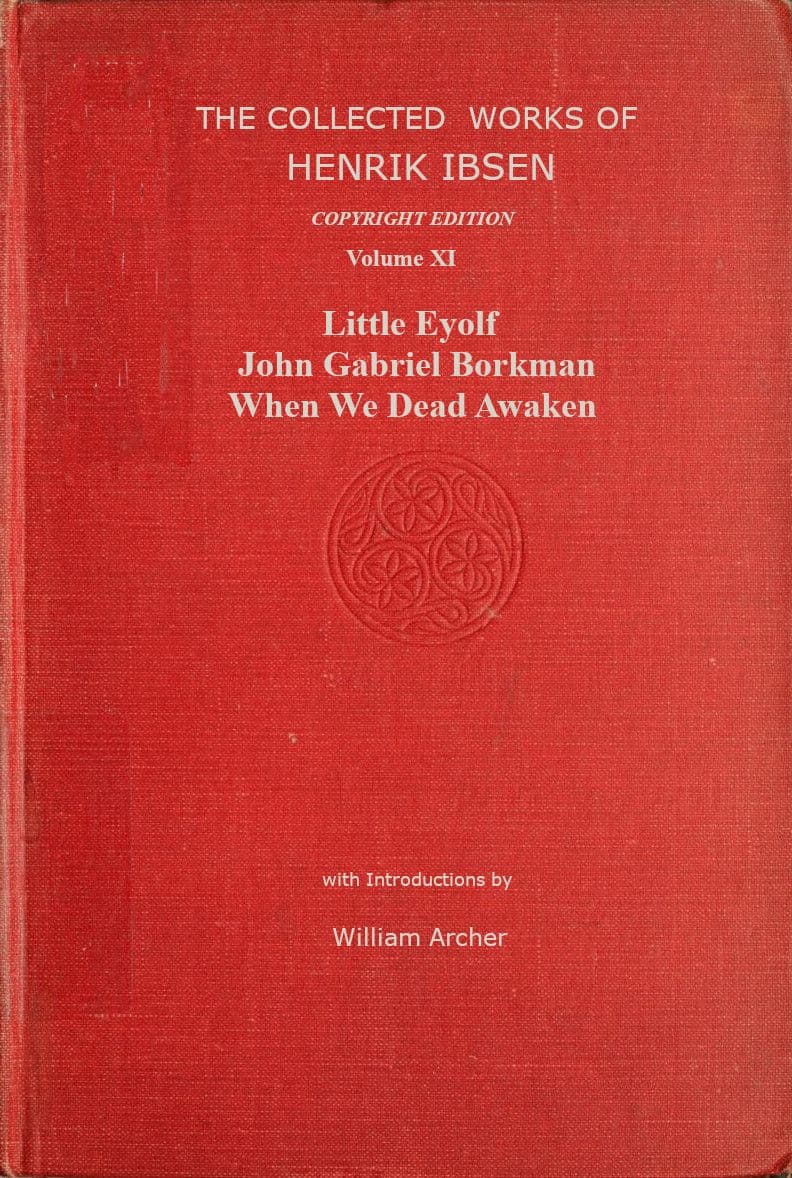
John Gabriel Borkman
John Gabriel Borkman is a four-act play written by Norwegian playwright Henrik Ibsen in 1896. The narrative follows John Gabriel Borkman, a disgraced former bank director whose financial scandal leads to his imprisonment and a profound fall from grace. The play explores themes of ambition, familial relationships, and the quest for redemption through Borkman's interactions with his wife Gunhild, his son Erhart, and his sister-in-law Ella. Notably, it is one of Ibsen's last works, reflecting his mastery of psychological drama and complex character dynamics.
Editions
X-Ray
“You are a murderer! You have committed theone mortal sin! You have killed the love-life in me. Doyou understand what that means? The Bible speaks of a mysterioussin for which there is no forgiveness. I have never understoodwhat it could be; but now I understand. The great, unpardonablesin is to murder the love-life in a human soul.””
— Henrik Ibsen
“Nicht Mord. Nicht Diebstahl, Raub oder nächtlicher Einbruch – auch Meineid nicht. Denn das alles sind ja Dinge, die man meist Leuten antut, die man haßt oder die einem gleichgültig sind und einen nichts angehen. […] Das Infamste von allem – das ist, wenn der Freund das Vertrauen des Freundes missbraucht.””
— Henrik Ibsen
“Pity! Ha, ha! I have never knownpity, since you deserted me. I was incapable of feeling it. Ifa poor starved child came into my kitchen, shivering, and crying,and begging for a morsel of food, I let the servants look to it.I never felt any desire to take the child to myself, to warm itat my own hearth, to have the pleasure of seeing it eat and besatisfied. And yet I was not like that when I was young; that Iremember clearly! It is you that have created an empty, barrendesert within me--and without me too!””
— Henrik Ibsen
“Oh, we are all of us run over, sometime or other in life. The thing is to jump up again, and let no one see you are hurt.””
— Henrik Ibsen
“I have skulked up there and wasted eight precious years of my life! The very day I was set free, I should have gone forth into the world”
— Henrik Ibsen
“Borkman: Dann haben wir uns gegenseitig etwas vorgemacht. Und uns selber haben wir vielleicht auch etwas vorgemacht – beide.Foldal: Ja, John Gabriel, aber ist das denn nicht im Grunde das Wesen der Freundschaft?Borkman (lächelt bitter): Doch, doch, lügen und betrügen – das ist Freundschaft. Da hast du recht. Diese Erfahrung habe ich schon einmal in meinem Leben gemacht.””
— Henrik Ibsen
“JOHN GABRIEL BORKMAN stands with his hands behind his back, beside the piano, listening to FRIDA FOLDAL, who is playing the last bars of the "Danse Macabre.BORKMAN. Can you guess where I first heard tones like these?FRIDA. [Looking up at him.] No, Mr. Borkman.BORKMAN. It was down in the mines.FRIDA. [Not understanding.] Indeed? Down in the mines?BORKMAN. I am a miner's son, you know. Or perhaps you did not know?FRIDA. No, Mr. Borkman.BORKMAN. A miner's son. And my father used sometimes to take me withhim into the mines. The metal sings down there.FRIDA. Really? Sings?BORKMAN. [Nodding.] When it is loosened. The hammer-strokes that loosenit are the midnight bell clanging to set it free; and that is whythe metal sings--in its own way--for gladness.FRIDA. Why does it do that, Mr. Borkman?BORKMAN. It wants to come up into the light of day and serve mankind.””
— Henrik Ibsen
“Frida. So after all, it is not for nothing that I was born a poet. For now she is going forth into the great wide world, that I once yearned so passionately to see. Little Frida sets out in a splendid covered sledge with silver bells on the harness”
— Henrik Ibsen
“You must not think, Mrs. Borkman, that I haven't said the same to him. I have laid my whole life before him. Again and again I have reminded him that I am seven years older than he”
— Henrik Ibsen
Link to this book
Add a free, dofollow link to Lex on your blog, forum, syllabus, or reading list.

<a href="https://lex-books.com/book/john-gabriel-borkman-81d8c9e7-77d0-4dc8-8625-67c36411f9ee"><img src="https://lex-books.com/badges/read-on-lex.svg" alt="Read John Gabriel Borkman by Henrik Ibsen free on Lex" width="160" height="40"></a>[](https://lex-books.com/book/john-gabriel-borkman-81d8c9e7-77d0-4dc8-8625-67c36411f9ee)[url=https://lex-books.com/book/john-gabriel-borkman-81d8c9e7-77d0-4dc8-8625-67c36411f9ee][img]https://lex-books.com/badges/read-on-lex.svg[/img][/url]Read John Gabriel Borkman by Henrik Ibsen free on Lex: https://lex-books.com/book/john-gabriel-borkman-81d8c9e7-77d0-4dc8-8625-67c36411f9eeCite this book
Reading this edition for a paper or guide? Copy a citation.
Ibsen, Henrik. John Gabriel Borkman. Lex, lex-books.com/book/john-gabriel-borkman-81d8c9e7-77d0-4dc8-8625-67c36411f9ee.Ibsen, H. (n.d.). John Gabriel Borkman. Lex. https://lex-books.com/book/john-gabriel-borkman-81d8c9e7-77d0-4dc8-8625-67c36411f9eeIbsen, Henrik. John Gabriel Borkman. Lex. https://lex-books.com/book/john-gabriel-borkman-81d8c9e7-77d0-4dc8-8625-67c36411f9ee.