IF
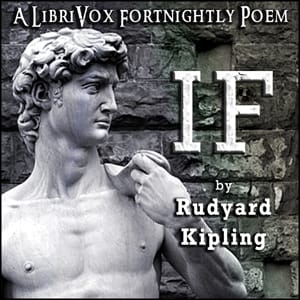
Written in 1909 as a father's counsel to the man his son might become, Kipling's poem distills the Victorian ideal of character into four stanzas of bracing, uncompromising advice. Each stanza opens with "If", that most dangerous of conditional words, building a portrait of moral fortitude: the patience to wait, the courage to act, the honesty to speak without lies, and the humility to accept loss without bitterness. The poem reaches its zenith in its most famous stanza, which instructs the reader to "meet with Triumph and Disaster / And treat those two impostors just the same", lines carved above the entrance to Wimbledon's Centre Court, where champions and losers pass beneath them equally. This is not gentle inspiration but stoic discipline, the armor of a gentleman facing an uncertain century. A century later, its directness either galvanizes or repels, but it never leaves one indifferent. For readers willing to be spoken to as a son by a father who demands much, it remains a provocation to personal excellence.
Editions


Read by
Group Narration
28 readers
April6090, Angelique G. Campbell, Bruce Kachuk, Beth Thomas (1974-2020) +24 more
Link to this book
Add a free, dofollow link to Lex on your blog, forum, syllabus, or reading list.

<a href="https://lex-books.com/book/if-57f52555-055f-4385-a4df-6d9c0f75bdc3"><img src="https://lex-books.com/badges/read-on-lex.svg" alt="Read IF by Rudyard Kipling free on Lex" width="160" height="40"></a>[](https://lex-books.com/book/if-57f52555-055f-4385-a4df-6d9c0f75bdc3)[url=https://lex-books.com/book/if-57f52555-055f-4385-a4df-6d9c0f75bdc3][img]https://lex-books.com/badges/read-on-lex.svg[/img][/url]Read IF by Rudyard Kipling free on Lex: https://lex-books.com/book/if-57f52555-055f-4385-a4df-6d9c0f75bdc3Cite this book
Reading this edition for a paper or guide? Copy a citation.
Kipling, Rudyard. IF. Lex, lex-books.com/book/if-57f52555-055f-4385-a4df-6d9c0f75bdc3.Kipling, R. (n.d.). IF. Lex. https://lex-books.com/book/if-57f52555-055f-4385-a4df-6d9c0f75bdc3Kipling, Rudyard. IF. Lex. https://lex-books.com/book/if-57f52555-055f-4385-a4df-6d9c0f75bdc3.




![Birds and Nature, Vol. 12 No. 1 [June 1902]illustrated by Color Photography](/_next/image?url=https%3A%2F%2Fd3b2n8gj62qnwr.cloudfront.net%2FCOVERS%2Fgutenberg_covers75k%2Febook-47881.png&w=3840&q=75)