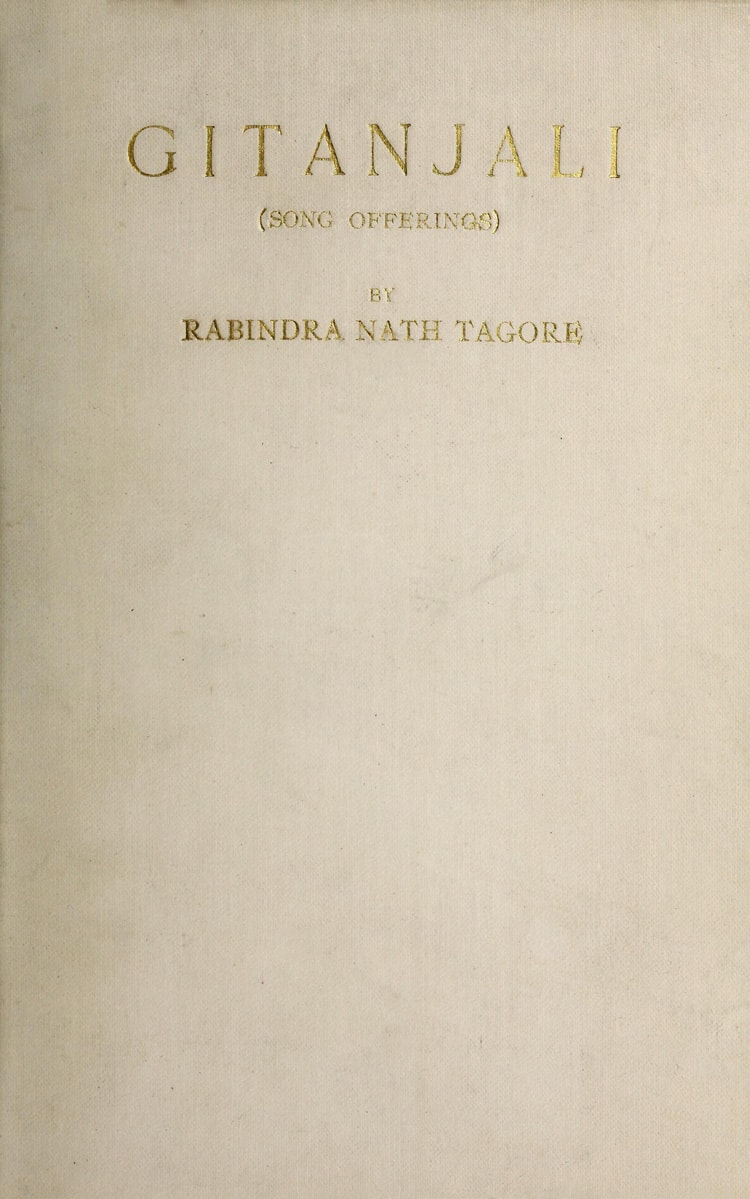
Gitanjali
1912
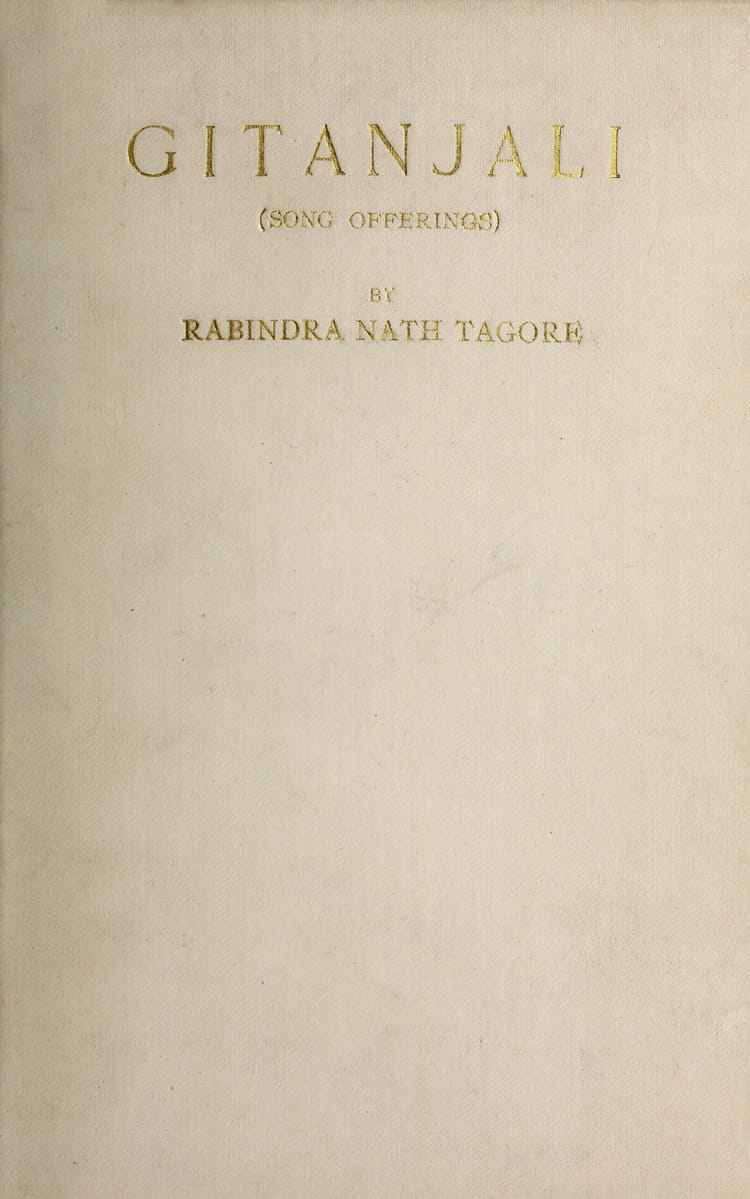
A luminous sequence of 103 poems that redefined what devotion could sound like in the modern age. Originally composed in Bengali and translated by Tagore himself, Gitanjali presents faith not as doctrine but as an intimate conversation between the soul and its beloved. God appears as tender friend, longing lover, and silent companion who waits at the threshold of the speaker's heart. The poetry moves through gardens and monsoon rains, through surrender and restless yearning, finding the sacred embedded in the smallest moments of ordinary life. Tagore's language is stripped to its essence: clear, direct, aching with clarity. These are poems to return to in different seasons of the spirit, each one a small door opening onto something vast. The collection won the Nobel Prize in 1913, making Tagore the first non-European and first Asian to receive the honor. A century later, these songs still hold their quiet power, inviting readers into a faith that feels less like belief and more like love.
Editions

X-Ray
“Where the mind is without fear and the head is held high;Where knowledge is free;Where the world has not been broken up into fragments by narrow domestic walls;Where words come out from the depth of truth;Where tireless striving stretches its arms toward perfection;Where the clear stream of reason has not lost its way into the dreary desert sand of dead habit;Where the mind is led forward by thee into ever-widening thought and action -Into that heaven of freedom, my Father, let my country awake.””
— Rabindranath Tagore
“On the seashore of endless worlds children meet.The infinite sky is motionless overhead and the restless water is boisterous. On the seashore of endless worlds the children meet with shouts and dances.They build their houses with sand, and they play with empty shells. With withered leaves they weave their boats and smilingly float them on the vast deep. Children have their play on the seashore of worlds.They know not how to swim, they know not how to cast nets. Pearl-fishers dive for pearls, merchants sail in their ships, while children gather pebbles and scatter them again. They seek not for hidden treasures, they know not how to cast nets.The sea surges up with laughter, and pale gleams the smile of the sea-beach. Death-dealing waves sing meaningless ballads to the children, even like a mother while rocking her baby’s cradle. The sea plays with children, and pale gleams the smile of the sea-beach.On the seashore of endless worlds children meet. Tempest roams in the pathless sky, ships are wrecked in the trackless water, death is abroad and children play. On the seashore of endless worlds is the great meeting of children.””
— Rabindranath Tagore
“This is my prayer to thee, my lord - strike, strike at the root of penury in my heart. Give me the strength lightly to bear my joys and sorrows. Give me the strength to make my love fruitful in service. Give me the strength never to disown the poor or bend my knees before insolent might. Give me the strength to raise my mind high above daily trifles. And give me the strength to surrender my strength to thy will with love.””
— Rabindranath Tagore
“Deliverance is not for me in renunciation. I feel the embrace of freedom in a thousand bonds of delight.””
— Rabindranath Tagore
“Light, my light, the world-filling light, the eye-kissing light, heart-sweetening light! Ah, the light dances, my darling, at the centre of my life; the light strikes, my darling, the chords of my love; the sky opens, the wind runs wild, laughter passes over the earth. The butterflies spread their sails on the sea of light. Lilies and jasmines surge up on the crest of the waves of light. The light is shattered into gold on every cloud, my darling, and it scatters gems in profusion. Mirth spreads from leaf to leaf, my darling, and gladness without measure. The heaven's river has drowned its banks and the flood of joy is abroad.””
— Rabindranath Tagore
“When I go from hence, let this be my parting word, that what I have seen is unsurpassable. I have tasted of the hidden honey of this lotus that expands on the ocean of light, and thus I am blessed”
— Rabindranath Tagore
“Oh my only friend, my best beloved, the gates are open in my house”
— Rabindranath Tagore
“And because I love this lifeI know I shall love death as well.The child cries out whenFrom the right breast the motherTakes it away, in the very next momentTo Find in the left oneIts consolation.””
— Rabindranath Tagore
“Alas, why are my nights all thus lost? Ah, why do I ever miss hissight whose breath touches my sleep?””
— Rabindranath Tagore
Link to this book
Add a free, dofollow link to Lex on your blog, forum, syllabus, or reading list.

<a href="https://lex-books.com/book/gitanjali-8dc6fff7-9314-4f5b-985f-45e696c8f8c9"><img src="https://lex-books.com/badges/read-on-lex.svg" alt="Read Gitanjali by Rabindranath Tagore free on Lex" width="160" height="40"></a>[](https://lex-books.com/book/gitanjali-8dc6fff7-9314-4f5b-985f-45e696c8f8c9)[url=https://lex-books.com/book/gitanjali-8dc6fff7-9314-4f5b-985f-45e696c8f8c9][img]https://lex-books.com/badges/read-on-lex.svg[/img][/url]Read Gitanjali by Rabindranath Tagore free on Lex: https://lex-books.com/book/gitanjali-8dc6fff7-9314-4f5b-985f-45e696c8f8c9Cite this book
Reading this edition for a paper or guide? Copy a citation.
Tagore, Rabindranath. Gitanjali. Lex, lex-books.com/book/gitanjali-8dc6fff7-9314-4f5b-985f-45e696c8f8c9.Tagore, R. (1912). Gitanjali. Lex. https://lex-books.com/book/gitanjali-8dc6fff7-9314-4f5b-985f-45e696c8f8c9Tagore, Rabindranath. Gitanjali. Lex. https://lex-books.com/book/gitanjali-8dc6fff7-9314-4f5b-985f-45e696c8f8c9.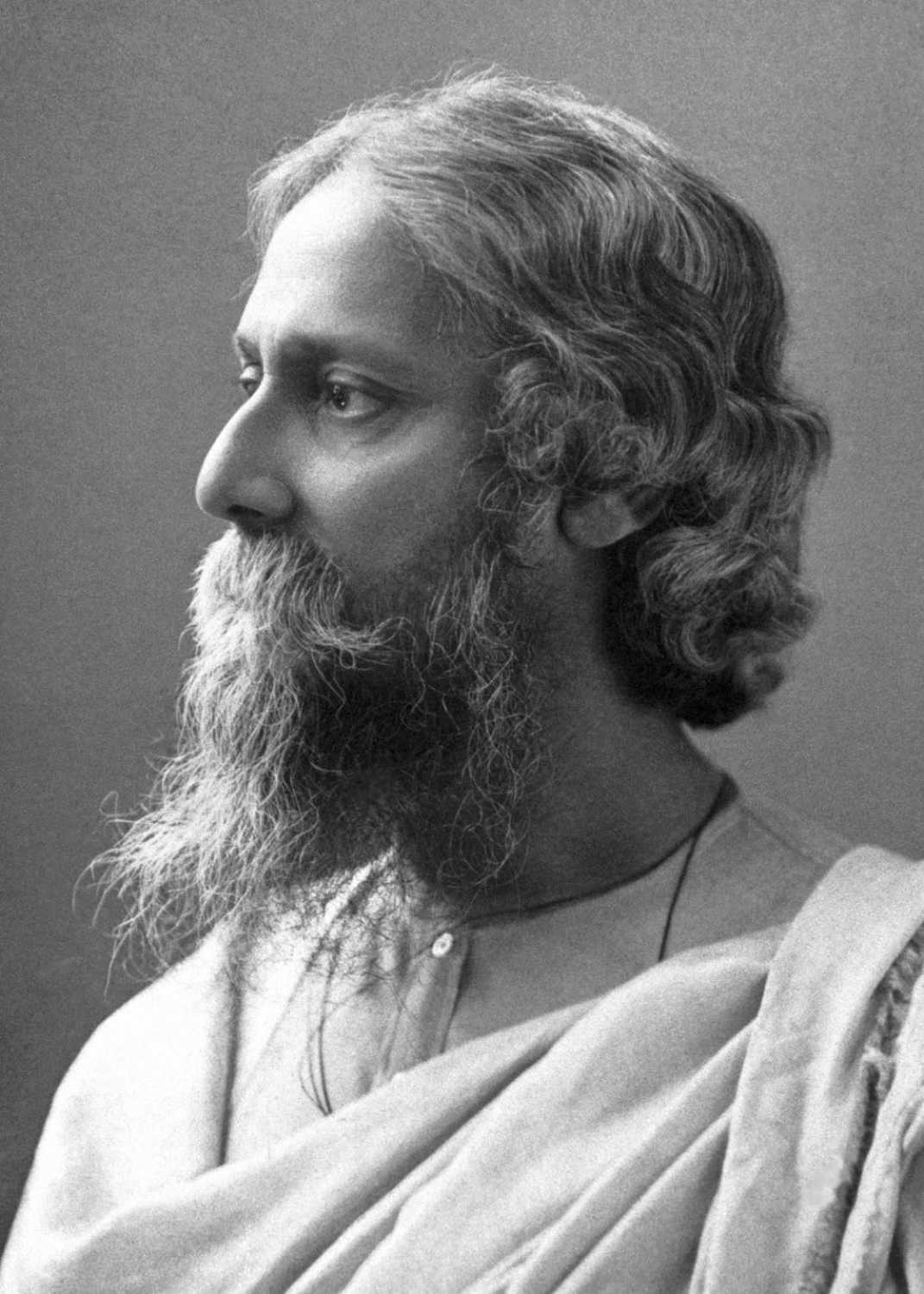








![Birds and Nature, Vol. 12 No. 1 [June 1902]illustrated by Color Photography](/_next/image?url=https%3A%2F%2Fd3b2n8gj62qnwr.cloudfront.net%2FCOVERS%2Fgutenberg_covers75k%2Febook-47881.png&w=3840&q=75)