Early Greek philosophy
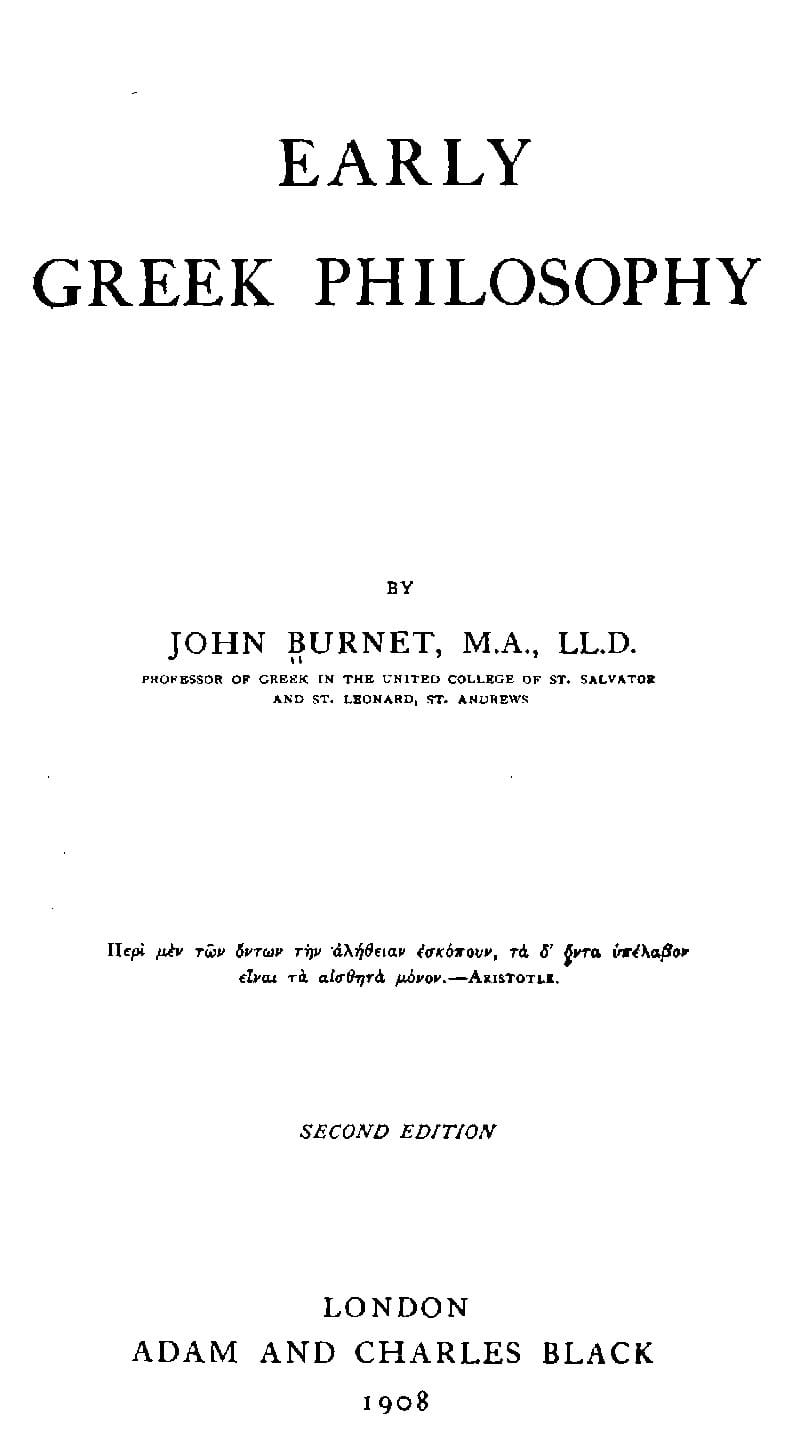
Burnet's 1892 masterpiece established the framework through which we still understand the pre-Socratic philosophers. Rather than treating them as failed scientists or primitive metaphysicians, Burnet recovered their revolutionary insight: that the world can be explained through rational principles, that physis (nature) underlies all apparent change, and that wondering 'why is there something rather than nothing?' changed everything. Beginning with Thales' audacious claim that water is the arche (first principle) of all things, Burnet guides readers through the Milesian school, Heraclitus' eternal fire, Parmenides' radical denial of change, and the pluralists who followed. This is not merely historical reconstruction; it is an argument about what philosophy is and why it began when and where it did. For anyone seeking to understand the intellectual origins of Western civilization, this remains the essential starting point.
Editions
X-Ray
“We are strangers in this world, and the body is the tomb of the soul, and yet we must not seek to escape by self-murder; for we are the chattels of God who is our herdsman, and without his command we have no right to make our escape. In this life, there are three kinds of men, just as there are three sorts of people who come to the Olympic Games. The lowest class is made up of those who come to buy and sell, the next above them are those who compete. Best of all, however, are those who come simply to look on. The greatest purification of all is, therefore, disinterested science, and it is the man who devotes himself to that, the true philosopher, who has most effectually released himself from the 'wheel of birth.””
— John Burnet
“It must, however, be remembered that the world was already very old when science and philosophy began.””
— John Burnet
“the All was alternately one and at peace through the power of Aphrodite,””
— John Burnet
Link to this book
Add a free, dofollow link to Lex on your blog, forum, syllabus, or reading list.

<a href="https://lex-books.com/book/early-greek-philosophy-bd58572e-6c20-4b0e-950b-26752b8c33c2"><img src="https://lex-books.com/badges/read-on-lex.svg" alt="Read Early Greek philosophy by John Burnet free on Lex" width="160" height="40"></a>[](https://lex-books.com/book/early-greek-philosophy-bd58572e-6c20-4b0e-950b-26752b8c33c2)[url=https://lex-books.com/book/early-greek-philosophy-bd58572e-6c20-4b0e-950b-26752b8c33c2][img]https://lex-books.com/badges/read-on-lex.svg[/img][/url]Read Early Greek philosophy by John Burnet free on Lex: https://lex-books.com/book/early-greek-philosophy-bd58572e-6c20-4b0e-950b-26752b8c33c2Cite this book
Reading this edition for a paper or guide? Copy a citation.
Burnet, John. Early Greek philosophy. Lex, lex-books.com/book/early-greek-philosophy-bd58572e-6c20-4b0e-950b-26752b8c33c2.Burnet, J. (n.d.). Early Greek philosophy. Lex. https://lex-books.com/book/early-greek-philosophy-bd58572e-6c20-4b0e-950b-26752b8c33c2Burnet, John. Early Greek philosophy. Lex. https://lex-books.com/book/early-greek-philosophy-bd58572e-6c20-4b0e-950b-26752b8c33c2.