Bambi
1914
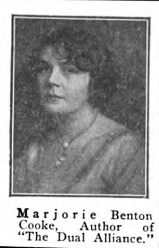
Meet Francesca Parkhurst, called Bambi, a young woman whose sharp tongue and sharper mind make her father’s Boston drawing room feel like a boxing ring. When she meets Jarvis Jocelyn, a struggling playwright with more passion than prospects, Bambi recognizes something the world refuses to see: genius buried under poverty and unconventional manners. What begins as a father-daughter debate about success and suitable suitors becomes a fiercely independent young woman’s choice to forge her own path, marrying Jarvis not for security but for belief in his art and his future. Set in the early twentieth century, this is a novel about the economics of love, the weight of social expectations, and one woman who refuses to be ornamental. Bambi is not your typical heroine of her era: she is witty, imperious, and deeply principled about art, ambition, and what it means to truly support another person. Her marriage to Jarvis is less a romance than an act of faith and rebellion, a declaration that she will not wait for life to happen to her. Over a century old, Bambi still resonates for anyone who has been told their choices are wrong, who has loved someone the world dismissed, or who has insisted on defining success on their own terms.
Editions
X-Ray
“...I'm just beginning to understand how kind you are.””
— Marjorie Benton Cooke
“Bambi was inspired, and said trembling, "There is Another who is over us all, over us and over Him.””
— Marjorie Benton Cooke
“The most dreadful part of all," the old stag answered, "is that the dogs believe what the hound just said. They believe it, they pass their lives in fear, they hate Him and themselves and yet they'd die for His sake.””
— Marjorie Benton Cooke
“They fluttered and rustled ceaselessly through the air from all the tree-tops and branches. A delicate silvery sound was falling constantly to earth. It was wonderful to awaken amidst it, wonderful to fall asleep to this mysterious and melancholy whispering.””
— Marjorie Benton Cooke
“What do you want? What do you know about it? What are you talking about? Everything belongs to Him, just as I do. But I, I love Him. I worship Him, I serve Him. Do you think you can oppose Him, poor creatures like you? He's all-powerful. He's above all of you. Everything we have comes from Him. Everything that lives or grows comes from Him.””
— Marjorie Benton Cooke
“The young doe, Marena, said, "In this very hour many of us are going to die. Perhaps I shall be one of them.””
— Marjorie Benton Cooke
“Marena looked at all of them out of her big, calm, shining eyes. "Love is no nonsense," she said. "It has to come.””
— Marjorie Benton Cooke
“Don't lose your head," screamed the pheasant. And at the same time his voice broke in a whistling gasp and, spreading his wings, he flew up with a loud whir. Bambi watched how he flew straight up, directly between the trees, beating his wings. The dark metallic blue and greenish-brown marking son his body gleamed like gold. His long tail feathers swept proudly behind him. A short crash like thunder sounded sharply. The pheasant suddenly crumpled up in mid-flight.””
— Marjorie Benton Cooke
“Now the fox sat upright. His lovely pointed snout sank down to his bloodied breast, his eyes rose up and stared at the dog right into his face . In a quite different voice, in control of himself, sad and bitter, he snarled, “Aren’t you ashamed of yourself ...? You traitor!” “No! No! No!” the dog yelled. The fox, however went on. “You turncoat ... you defector!” His lacerated body became stiff with hatred and contempt. “You’re just His henchman,” he hissed. “You miserable ... you seek us out where He couldn’t find us ... you persecute us in places that He can’t get to ... you turn us in ..., and all of us are your relatives ... you turn me in, and you and I are nearly brothers ... and you just stand there ...are you not ashamed of yourself?””
— Marjorie Benton Cooke
Link to this book
Add a free, dofollow link to Lex on your blog, forum, syllabus, or reading list.

<a href="https://lex-books.com/book/bambi-f657f2c4-834c-4f8f-815b-04b2f39e1a7b"><img src="https://lex-books.com/badges/read-on-lex.svg" alt="Read Bambi by Marjorie Benton Cooke free on Lex" width="160" height="40"></a>[](https://lex-books.com/book/bambi-f657f2c4-834c-4f8f-815b-04b2f39e1a7b)[url=https://lex-books.com/book/bambi-f657f2c4-834c-4f8f-815b-04b2f39e1a7b][img]https://lex-books.com/badges/read-on-lex.svg[/img][/url]Read Bambi by Marjorie Benton Cooke free on Lex: https://lex-books.com/book/bambi-f657f2c4-834c-4f8f-815b-04b2f39e1a7bCite this book
Reading this edition for a paper or guide? Copy a citation.
Cooke, Marjorie Benton. Bambi. Lex, lex-books.com/book/bambi-f657f2c4-834c-4f8f-815b-04b2f39e1a7b.Cooke, M. B. (1914). Bambi. Lex. https://lex-books.com/book/bambi-f657f2c4-834c-4f8f-815b-04b2f39e1a7bCooke, Marjorie Benton. Bambi. Lex. https://lex-books.com/book/bambi-f657f2c4-834c-4f8f-815b-04b2f39e1a7b.