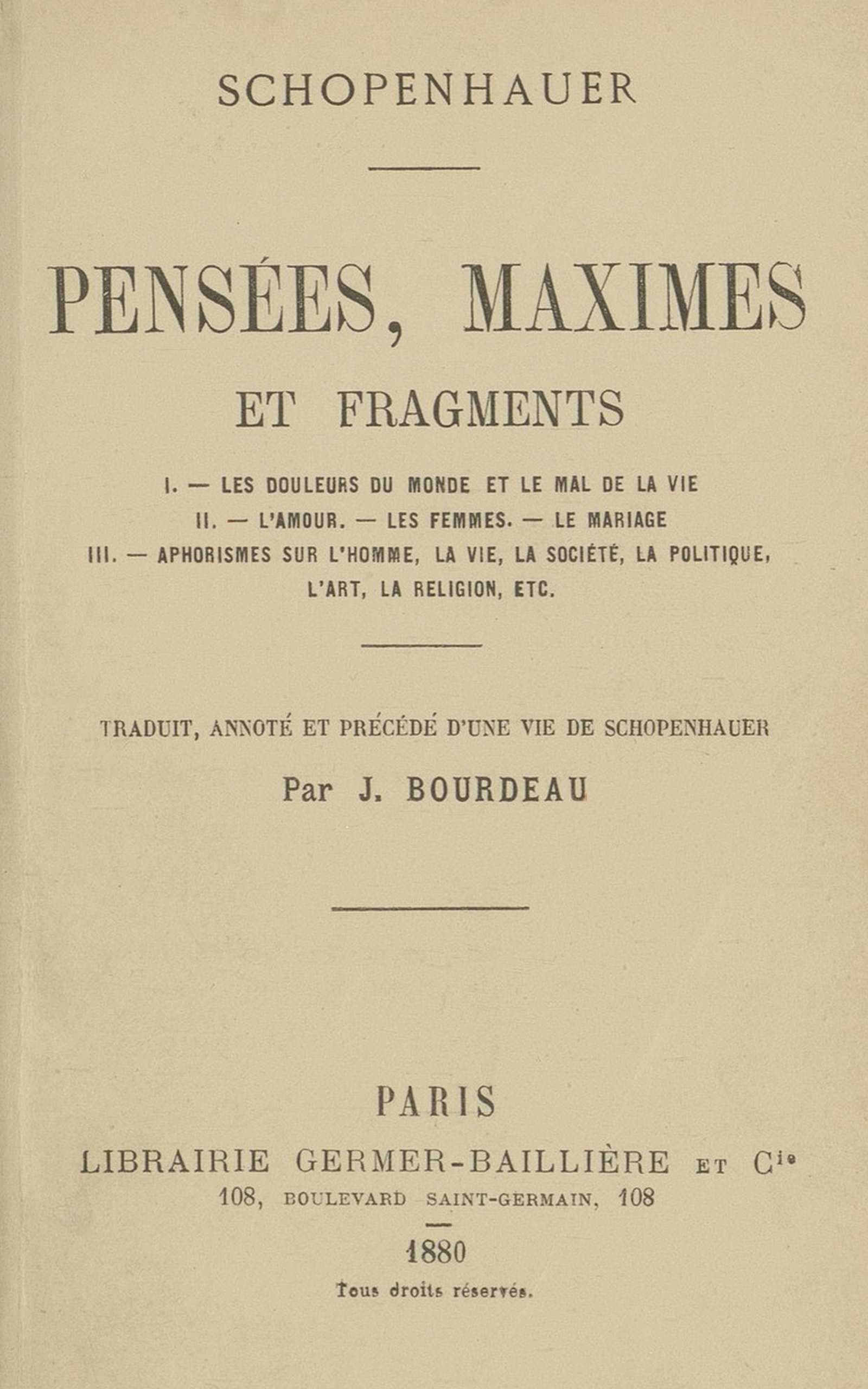
Aphorismes Sur La Sagesse Dans La Vie
1851
Aphorismes Sur La Sagesse Dans La Vie
1851
Translated by J. A. (Jean Alexandre) Cantacuzène
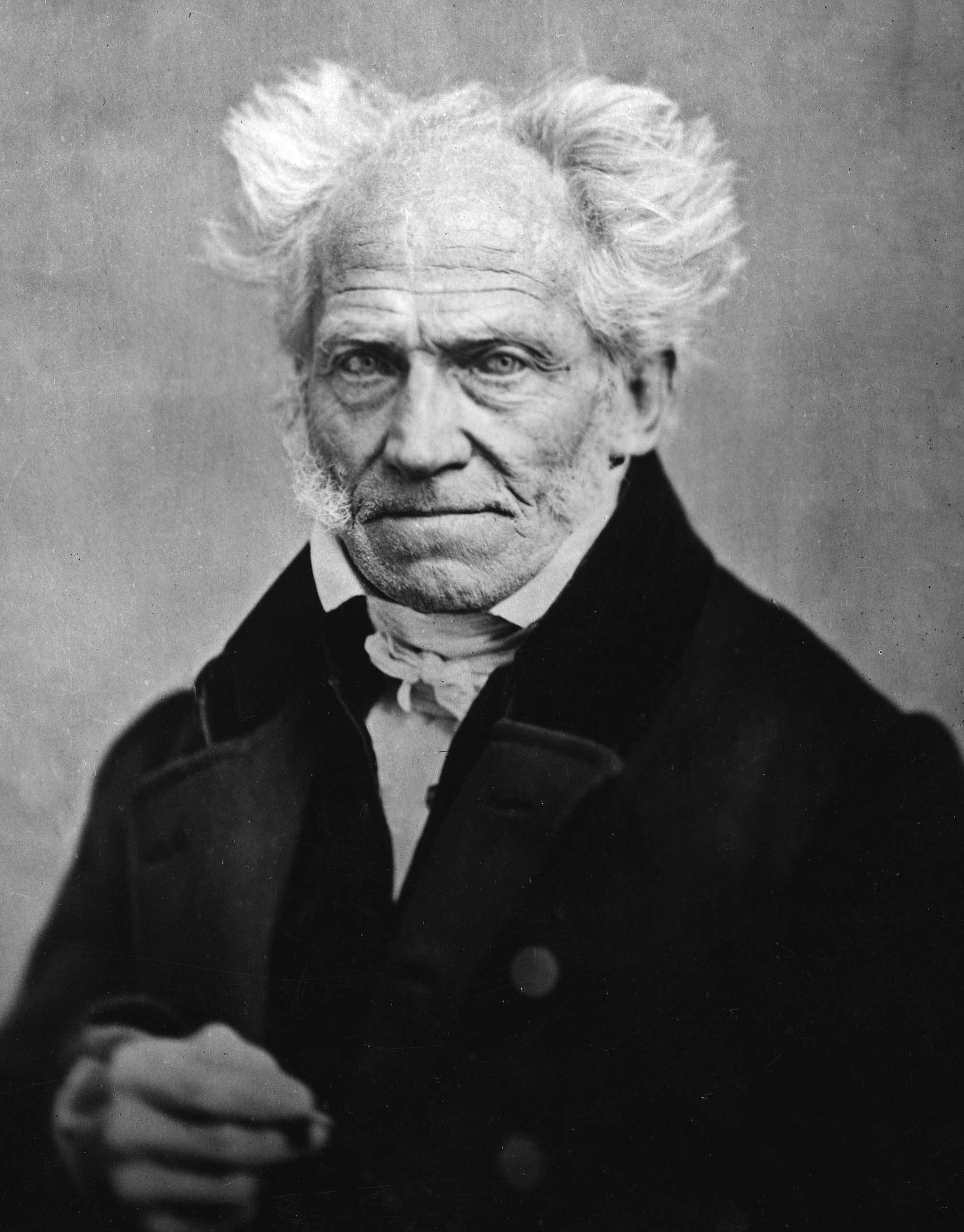
The real question is not whether life has meaning, but whether we know how to live it. Schopenhauer, the great pessimist, offers no comfort here, only clarity: happiness does not come from what we own or what others think of us, but from what we are. In these fragmented aphorisms, he divides human goods into three categories - our character and health, our possessions, and our reputation - then demonstrates with quiet ruthlessness why the first matters and the rest so rarely deliver. Central to his counsel is solitude. Not as misanthropy, but as necessity. The world, Schopenhauer argues, brings constraint, trouble, and danger; most people are morally suspect and intellectually limited. To be alone with oneself becomes both refuge and achievement. After health, he writes, tranquility of mind is the most essential element of our happiness - and this cannot exist without long moments of stripped-down solitude. The book is severe, unflinching, and oddly liberating. It tells you what you already suspect but don't want to hear: stop looking outward for what can only be found within.
Editions
X-Ray
“There is not much to be got anywhere in the world. It is filled with misery and pain; if a man escapes these, boredeom lies in wait for him at every corner. Nay more; it is evil which generally has the upper hand, and folly that makes the most noise. Fate is cruel and mankind pitiable.””
— Arthur Schopenhauer
“For the more a man has in himself, the less he will want from other people,”
— Arthur Schopenhauer
“When we see that almost everything men devote their lives to attain, sparing no effort and encountering a thousand toils and dangers in the process, has, in the end, no further object than to raise themselves in the estimation of others; when we see that not only offices, titles, decorations, but also wealth, nay, even knowledge[1] and art, are striven for only to obtain, as the ultimate goal of all effort, greater respect from one's fellowmen,”
— Arthur Schopenhauer
“Honor has not to be won; it must only not be lost.””
— Arthur Schopenhauer
“Die wohlfeilste Art des Stolzes hingegen ist der Nationalstolz. Denn er verrät in dem damit Behafteten den Mangel an individuellen Eigenschaften, auf die er stolz sein könnte, indem er sonst nicht zu dem greifen würde, was er mit so vielen Millionen teilt. Wer bedeutende persönliche Vorzüge besitzt, wird vielmehr die Fehler seiner eigenen Nation, da er sie beständig vor Augen hat, am deutlichsten erkennen. Aber jeder erbärmliche Tropf, der nichts in der Welt hat, darauf er stolz sein könnte, ergreift das letzte Mittel, auf die Nation, der er gerade angehört, stolz zu sein. Hieran erholt er sich und ist nun dankbarlich bereit, alle Fehler und Torheiten, die ihr eigen sind, mit Händen und Füßen zu verteidigen.””
— Arthur Schopenhauer
“The happiness we receive from ourselves is greater than that which we obtain from our surroundings[1]””
— Arthur Schopenhauer
“For what a man is in himself, what accompanies him when he is alone, what no one can give or take away, is obviously more essential to him than everything he has in the way of possessions, or even what he may be in the eyes of the world. An intellectual man in complete solitude has excellent entertainment in his own thoughts and fancies, while no amount of diversity or social pleasure, theatres, excursions and amusements, can ward off boredom from a dullard.””
— Arthur Schopenhauer
“Would a musician feel flattered by the loud applause of an audience if he knew that they were nearly all deaf, and that, to conceal their infirmity, they set to work to clap vigorously as soon as ever they saw one or two persons applauding?””
— Arthur Schopenhauer
“It is the possession of a great heart or a great head, and not the mere fame of it, which is worth having, and conducive to happiness. Not fame, but that which deserves to be famous, is what a man should hold in esteem.””
— Arthur Schopenhauer
Link to this book
Add a free, dofollow link to Lex on your blog, forum, syllabus, or reading list.

<a href="https://lex-books.com/book/aphorismes-sur-la-sagesse-dans-la-vie-3330ff4b-dfa3-4c2a-a048-3ae9d845455b"><img src="https://lex-books.com/badges/read-on-lex.svg" alt="Read Aphorismes Sur La Sagesse Dans La Vie by Arthur Schopenhauer free on Lex" width="160" height="40"></a>[](https://lex-books.com/book/aphorismes-sur-la-sagesse-dans-la-vie-3330ff4b-dfa3-4c2a-a048-3ae9d845455b)[url=https://lex-books.com/book/aphorismes-sur-la-sagesse-dans-la-vie-3330ff4b-dfa3-4c2a-a048-3ae9d845455b][img]https://lex-books.com/badges/read-on-lex.svg[/img][/url]Read Aphorismes Sur La Sagesse Dans La Vie by Arthur Schopenhauer free on Lex: https://lex-books.com/book/aphorismes-sur-la-sagesse-dans-la-vie-3330ff4b-dfa3-4c2a-a048-3ae9d845455bCite this book
Reading this edition for a paper or guide? Copy a citation.
Schopenhauer, Arthur. Aphorismes Sur La Sagesse Dans La Vie. Lex, lex-books.com/book/aphorismes-sur-la-sagesse-dans-la-vie-3330ff4b-dfa3-4c2a-a048-3ae9d845455b.Schopenhauer, A. (1851). Aphorismes Sur La Sagesse Dans La Vie. Lex. https://lex-books.com/book/aphorismes-sur-la-sagesse-dans-la-vie-3330ff4b-dfa3-4c2a-a048-3ae9d845455bSchopenhauer, Arthur. Aphorismes Sur La Sagesse Dans La Vie. Lex. https://lex-books.com/book/aphorismes-sur-la-sagesse-dans-la-vie-3330ff4b-dfa3-4c2a-a048-3ae9d845455b.