An Original Theory or New Hypothesis of the Universe Founded Upon the Laws of Nature, and Solving by Mathematical Principles the General Phænomena of the Visible Creation; And Particularly the Via Lactea ...
1750
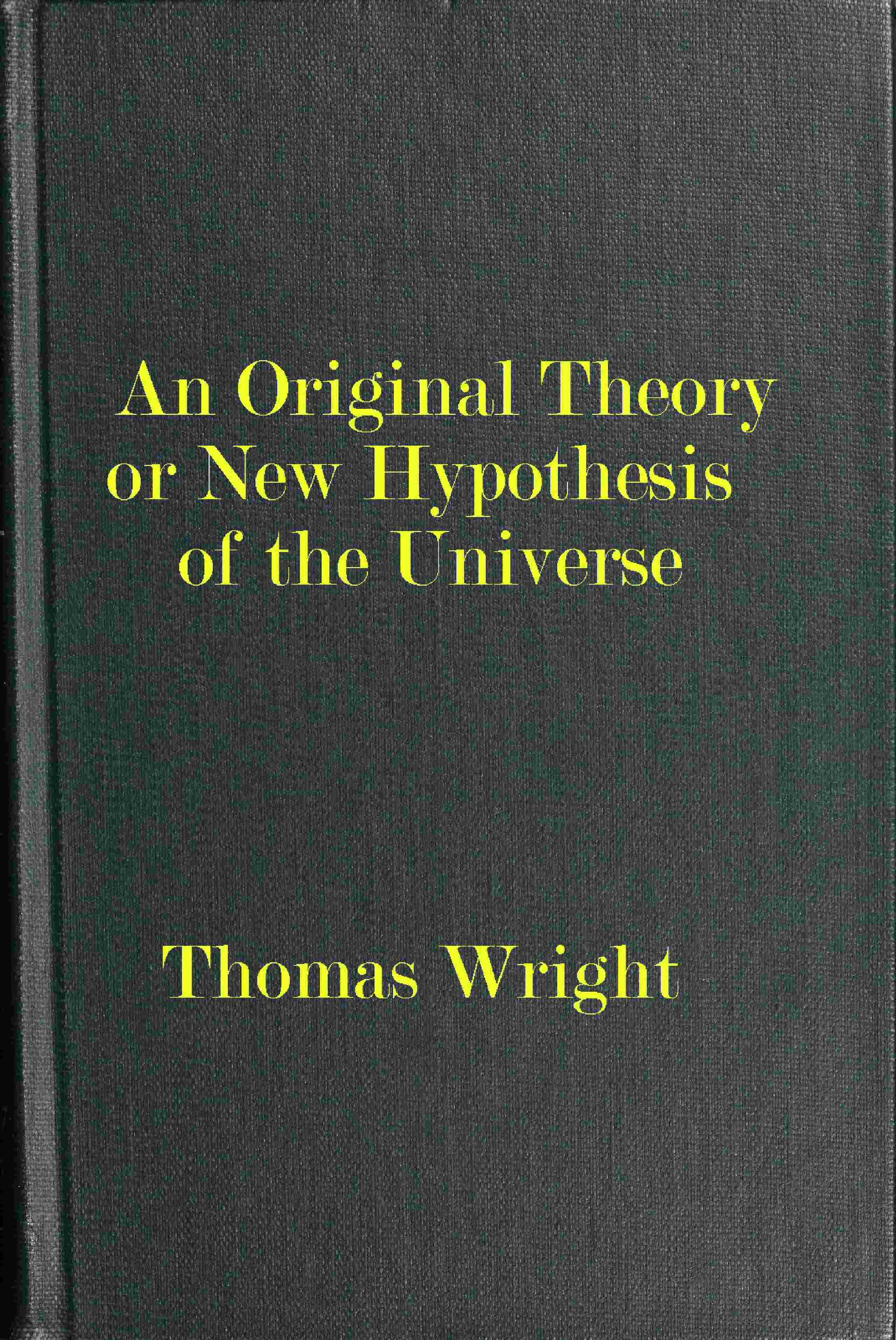
An Original Theory or New Hypothesis of the Universe Founded Upon the Laws of Nature, and Solving by Mathematical Principles the General Phænomena of the Visible Creation; And Particularly the Via Lactea ...
1750
In 1750, a self-taught English astronomer with no telescope and no university position changed how humanity sees its place in the cosmos. Thomas Wright simply looked at the Milky Way and asked: what if this smear of light is actually a vast ring of stars, with our own sun embedded somewhere within it? Through pure geometry and imagination, he mapped the structure of our galaxy a century before anyone could prove it. He also proposed that spiral nebulae might be distant "island universes," each containing millions of suns, radically expanding the known universe. Written as letters to a friend, this slim, eloquent work blends mathematical reasoning with philosophical wonder. It influenced Kant, inspired Herschel, and laid the groundwork for modern cosmology. Here, in one man's 18th-century mind, we see the first true glimpse of the galaxy we actually inhabit.
Editions
Link to this book
Add a free, dofollow link to Lex on your blog, forum, syllabus, or reading list.

<a href="https://lex-books.com/book/an-original-theory-or-new-hypothesis-of-the-universe-founded-upon-the-laws-of-na-6066459d-088d-44c6-95c6-4b9bf8d3eb3a"><img src="https://lex-books.com/badges/read-on-lex.svg" alt="Read An Original Theory or New Hypothesis of the Universe Founded Upon the Laws of Nature, and Solving by Mathematical Principles the General Phænomena of the Visible Creation; And Particularly the Via Lactea ... by Thomas Wright free on Lex" width="160" height="40"></a>[](https://lex-books.com/book/an-original-theory-or-new-hypothesis-of-the-universe-founded-upon-the-laws-of-na-6066459d-088d-44c6-95c6-4b9bf8d3eb3a)[url=https://lex-books.com/book/an-original-theory-or-new-hypothesis-of-the-universe-founded-upon-the-laws-of-na-6066459d-088d-44c6-95c6-4b9bf8d3eb3a][img]https://lex-books.com/badges/read-on-lex.svg[/img][/url]Read An Original Theory or New Hypothesis of the Universe Founded Upon the Laws of Nature, and Solving by Mathematical Principles the General Phænomena of the Visible Creation; And Particularly the Via Lactea ... by Thomas Wright free on Lex: https://lex-books.com/book/an-original-theory-or-new-hypothesis-of-the-universe-founded-upon-the-laws-of-na-6066459d-088d-44c6-95c6-4b9bf8d3eb3aCite this book
Reading this edition for a paper or guide? Copy a citation.
Wright, Thomas. An Original Theory or New Hypothesis of the Universe Founded Upon the Laws of Nature, and Solving by Mathematical Principles the General Phænomena of the Visible Creation; And Particularly the Via Lactea .... Lex, lex-books.com/book/an-original-theory-or-new-hypothesis-of-the-universe-founded-upon-the-laws-of-na-6066459d-088d-44c6-95c6-4b9bf8d3eb3a.Wright, T. (1750). An Original Theory or New Hypothesis of the Universe Founded Upon the Laws of Nature, and Solving by Mathematical Principles the General Phænomena of the Visible Creation; And Particularly the Via Lactea .... Lex. https://lex-books.com/book/an-original-theory-or-new-hypothesis-of-the-universe-founded-upon-the-laws-of-na-6066459d-088d-44c6-95c6-4b9bf8d3eb3aWright, Thomas. An Original Theory or New Hypothesis of the Universe Founded Upon the Laws of Nature, and Solving by Mathematical Principles the General Phænomena of the Visible Creation; And Particularly the Via Lactea .... Lex. https://lex-books.com/book/an-original-theory-or-new-hypothesis-of-the-universe-founded-upon-the-laws-of-na-6066459d-088d-44c6-95c6-4b9bf8d3eb3a.