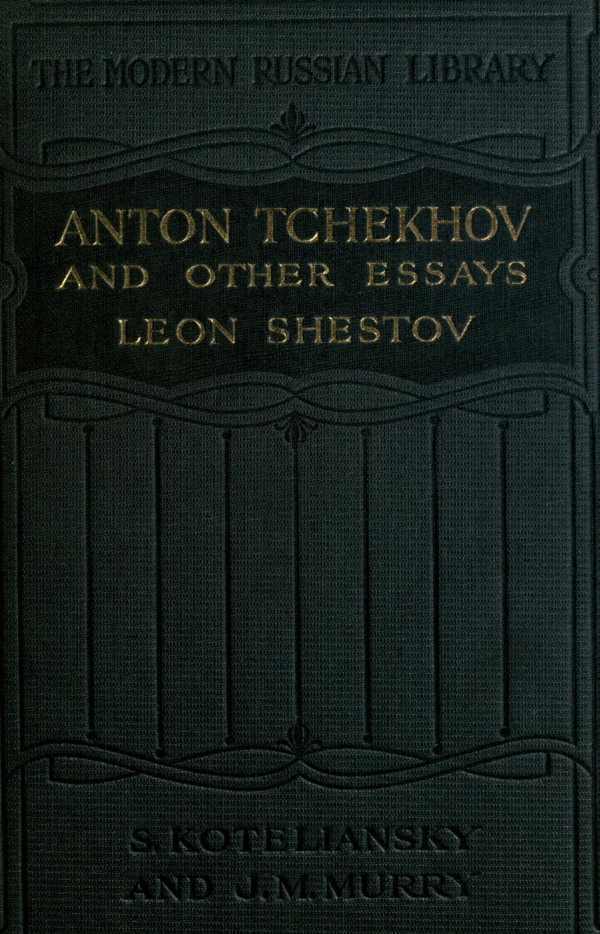
All Things Are Possible
1920
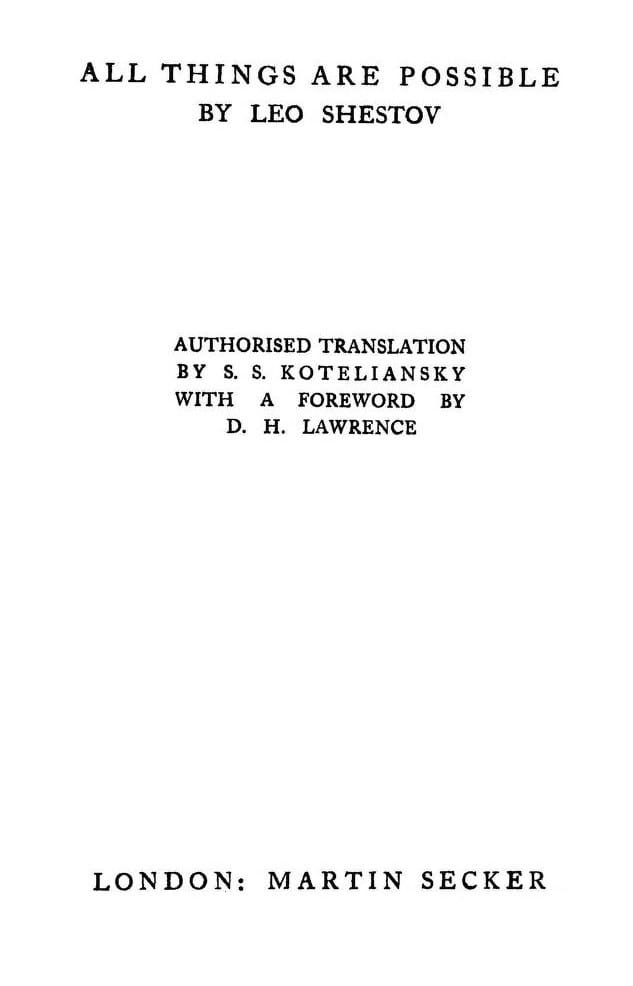
All Things Are Possible
1920
Translated by S. S. (Samuel Solomonovitch) Koteliansky
All Things Are Possible, published in 1920 by Lev Shestov, is a philosophical exploration of existence and the limitations of human understanding. Shestov critiques European rationalism and its influence on Russian thought, advocating for a more subjective approach to life. Through dense prose and vivid metaphors, he examines the chaotic nature of existence, emphasizing the importance of individual freedom and the necessity of embracing uncertainty over conforming to societal norms. This work is notable for its deep philosophical insights and its challenge to established truths.
Editions
X-Ray
“The business of philosophy is to teach man to live in uncertainty... not to reassure him, but to upset him.””
— Lev Shestov
“Moral people are the most revengeful of mankind, they employ their morality as the best and most subtle weapon of vengeance. They are not satisfied with simply despising and condemning their neighbour themselves, they want the condemnation to be universal and supreme: that is, that all men should rise as one against the condemned, and that even the offender's own conscience shall be against him. Then only are they fully satisfied and reassured. Nothing on earth but morality could lead to such wonderful results.””
— Lev Shestov
“After a tragedy, a farce. Philosophy enters into her power, and the earth returns under one's feet.””
— Lev Shestov
“Once an idea is there, the gates must be opened to it.””
— Lev Shestov
“If he tells the truth, it is because the most reeking lie no longer intoxicates him, even though he swallow it not in the modest doses that idealism offers, but in immoderate quantities, thousand-gallon-barrel gulps. He would taste the bitterness, but it would not make his head turn, as it does Schiller's, or Dostoevsky's, or even Socrates’, whose head, as we know, could stand any quantity of wine, but went spinning with the most commonplace lie.””
— Lev Shestov
“And many a time, towards the end of life, does the genius repent of his choice. "It would be better not to startle the world, but to live at one with it," says Ibsen in his last drama. Genius is a wretched, blind maniac, whose eccentricities are condoned because of what is got from him.””
— Lev Shestov
“Whilst stay-at-home persons are searching for truth, the apple will stay on the tree.””
— Lev Shestov
“So long as the child was fed on its mother's milk, everything seemed to it smooth and easy. But when it had to give up milk and take to vodka, - and this is the inevitable law of human development - the childish suckling dreams receded into the realm of the irretrievable past.””
— Lev Shestov
“When man finds in himself a certain defect, of which he can by no means rid himself, there remains but to accept the so-called failing as a natural quality. The more grave and important the defect, the more urgent is the need to ennoble it.””
— Lev Shestov
Link to this book
Add a free, dofollow link to Lex on your blog, forum, syllabus, or reading list.

<a href="https://lex-books.com/book/all-things-are-possible-ffb0b80f-6673-436a-bab5-c2d2441e5bf8"><img src="https://lex-books.com/badges/read-on-lex.svg" alt="Read All Things Are Possible by Lev Shestov free on Lex" width="160" height="40"></a>[](https://lex-books.com/book/all-things-are-possible-ffb0b80f-6673-436a-bab5-c2d2441e5bf8)[url=https://lex-books.com/book/all-things-are-possible-ffb0b80f-6673-436a-bab5-c2d2441e5bf8][img]https://lex-books.com/badges/read-on-lex.svg[/img][/url]Read All Things Are Possible by Lev Shestov free on Lex: https://lex-books.com/book/all-things-are-possible-ffb0b80f-6673-436a-bab5-c2d2441e5bf8Cite this book
Reading this edition for a paper or guide? Copy a citation.
Shestov, Lev. All Things Are Possible. Lex, lex-books.com/book/all-things-are-possible-ffb0b80f-6673-436a-bab5-c2d2441e5bf8.Shestov, L. (1920). All Things Are Possible. Lex. https://lex-books.com/book/all-things-are-possible-ffb0b80f-6673-436a-bab5-c2d2441e5bf8Shestov, Lev. All Things Are Possible. Lex. https://lex-books.com/book/all-things-are-possible-ffb0b80f-6673-436a-bab5-c2d2441e5bf8.