A Pickle for the Knowing Ones
1802
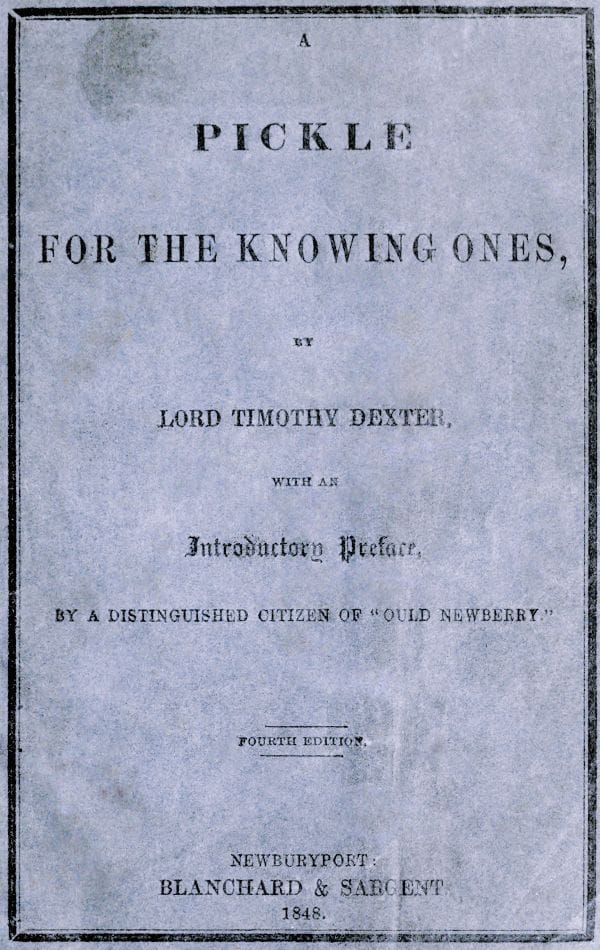
A Pickle for the Knowing Ones
1802
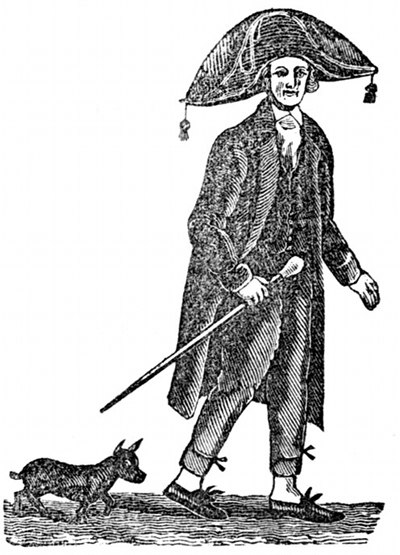
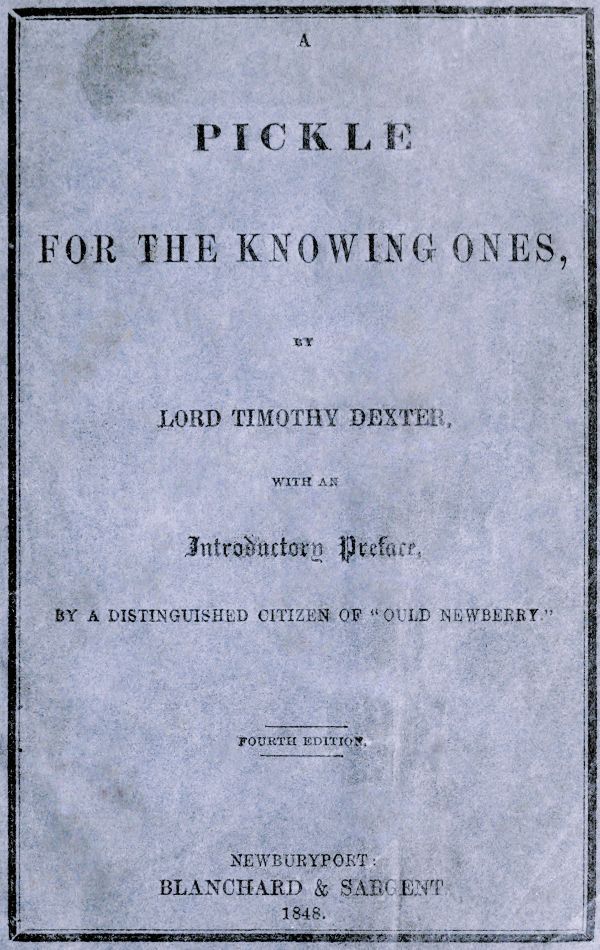
In 1802, a wealthy Massachusetts merchant named Timothy Dexter did something no author had done before: he published an autobiography with absolutely no punctuation. Not a single period, comma, or question mark. The result is a wild, phonetic tumble of words that reads like someone shouting their life story directly onto the page. Dexter was a self-made millionaire whose business acumen seemed laughable until it wasn't (he once sent coal to Newcastle, England, right before a miners' strike and made a fortune). He called himself Lord Dexter and insisted he should be emperor of the United States. His book complains about politicians, derides the clergy, and occasionally praises his own glory. When readers predictably griped about the lack of punctuation, Dexter's solution was pure defiance: the second edition included eleven lines of punctuation marks with the instruction that readers could "peper and solt it as they plese." Two centuries later, the book remains a fascinating artifact of American eccentricity, a self-taught man's chaotic masterpiece, and proof that sometimes the strangest books become the most unforgettable.
Editions
X-Ray
“Let this goue as you find it my way speling houe is the strangest man””
— Timothy Dexter
Link to this book
Add a free, dofollow link to Lex on your blog, forum, syllabus, or reading list.

<a href="https://lex-books.com/book/a-pickle-for-the-knowing-ones-72ffc8da-051e-46e3-98eb-ead3dced81d4"><img src="https://lex-books.com/badges/read-on-lex.svg" alt="Read A Pickle for the Knowing Ones by Timothy Dexter free on Lex" width="160" height="40"></a>[](https://lex-books.com/book/a-pickle-for-the-knowing-ones-72ffc8da-051e-46e3-98eb-ead3dced81d4)[url=https://lex-books.com/book/a-pickle-for-the-knowing-ones-72ffc8da-051e-46e3-98eb-ead3dced81d4][img]https://lex-books.com/badges/read-on-lex.svg[/img][/url]Read A Pickle for the Knowing Ones by Timothy Dexter free on Lex: https://lex-books.com/book/a-pickle-for-the-knowing-ones-72ffc8da-051e-46e3-98eb-ead3dced81d4Cite this book
Reading this edition for a paper or guide? Copy a citation.
Dexter, Timothy. A Pickle for the Knowing Ones. Lex, lex-books.com/book/a-pickle-for-the-knowing-ones-72ffc8da-051e-46e3-98eb-ead3dced81d4.Dexter, T. (1802). A Pickle for the Knowing Ones. Lex. https://lex-books.com/book/a-pickle-for-the-knowing-ones-72ffc8da-051e-46e3-98eb-ead3dced81d4Dexter, Timothy. A Pickle for the Knowing Ones. Lex. https://lex-books.com/book/a-pickle-for-the-knowing-ones-72ffc8da-051e-46e3-98eb-ead3dced81d4.