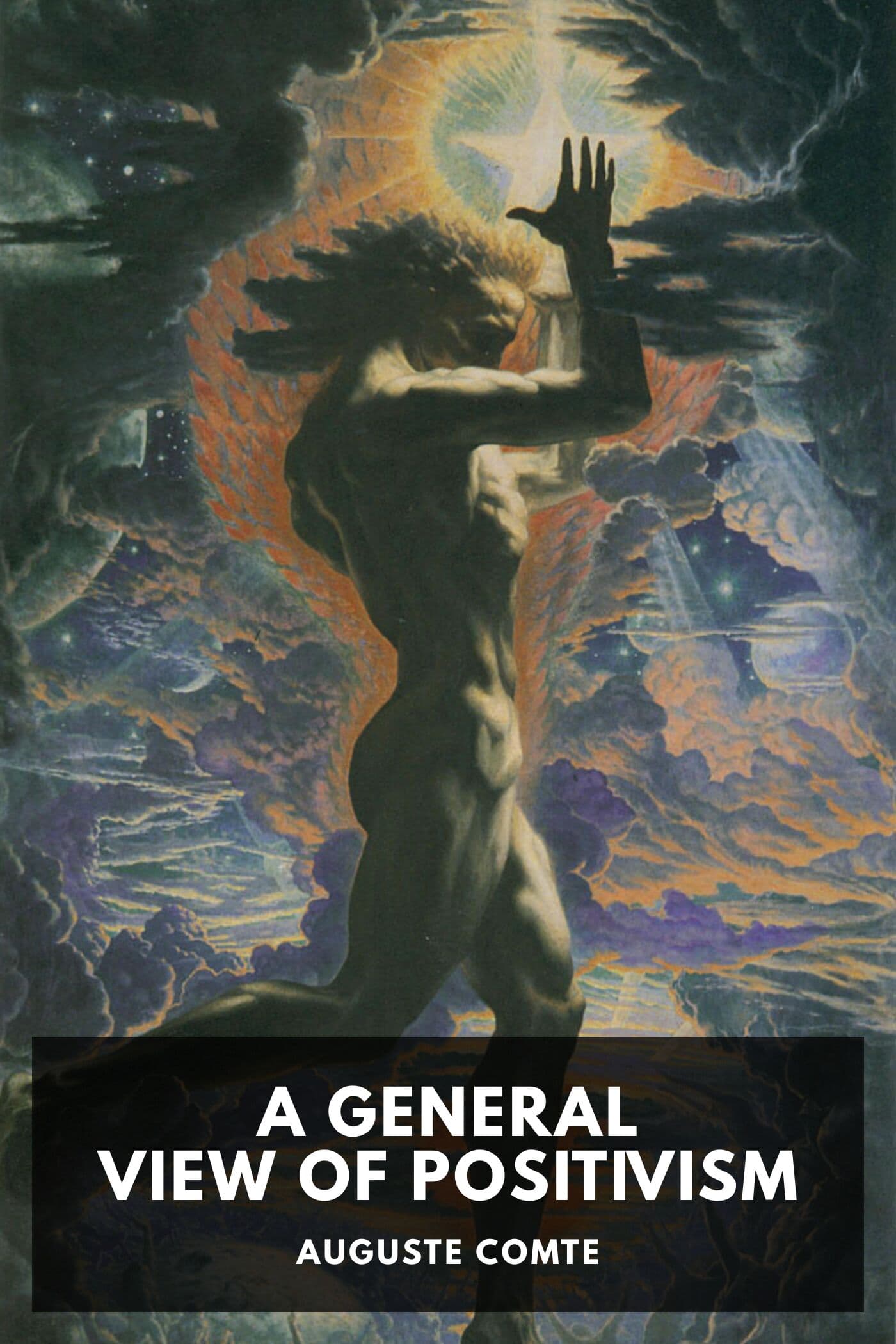
A General View of Positivismor, Summary Exposition of the System of Thought and Life
1848
A General View of Positivismor, Summary Exposition of the System of Thought and Life
1848
Translated by John Henry Bridges
Auguste Comte attempted something no philosopher had dared before: a complete reconstruction of human knowledge that would make theology obsolete and give science the moral authority religion once held. Written in 1848, this compact treatise distills the system that would make Comte the father of sociology and positivism, the radical claim that genuine knowledge means only what can be observed, tested, and expressed as law. He articulates his famous law of three stages (theological, metaphysical, positive), argues that the same methods that explain celestial mechanics must govern the study of human society, and proposes a new science of society that would operate with the certainty of physics. But Comte's ambition extends beyond methodology. He envisions a complete reorganization of human life around scientific reason, arguing that the integration of intellect, feeling, and action would regenerate humanity. This is the text where positivism ceases to be an epistemological puzzle and becomes a blueprint for civilization. For students of philosophy, the history of science, and anyone curious about the intellectual origins of our secular, data-obsessed age.
Editions
X-Ray
“. This is incontestable, in our present advanced stage; but, if we look back to the primitive stage of human knowledge, we shall see that it must have been otherwise then. If it is true that every theory must be based upon observed facts, it is equally true that facts cannot be observed without the guidance of some theory. Without such guidance, our facts would be desultory and fruitless; we could not retain them: for the most part we could not even perceive them.””
— Auguste Comte
“The human mind, by its nature, employs in its progress three methods of philosophizing, the character of which is essentially different, and even radically opposed: viz., the theological method, the metaphysical, and the positive. Hence arises three philosophies, or general systems of conceptions on the aggregate of phenomena, each of which excludes the others. The first is the necessary point of departure of the human understanding; and the third is its fixed and definitive state. The second is merely a state of transition.””
— Auguste Comte
Link to this book
Add a free, dofollow link to Lex on your blog, forum, syllabus, or reading list.

<a href="https://lex-books.com/book/a-general-view-of-positivismor-summary-exposition-of-the-system-of-thought-and-l-5cd00122-a316-4b16-93dd-f69158677a10"><img src="https://lex-books.com/badges/read-on-lex.svg" alt="Read A General View of Positivismor, Summary Exposition of the System of Thought and Life by Auguste Comte free on Lex" width="160" height="40"></a>[](https://lex-books.com/book/a-general-view-of-positivismor-summary-exposition-of-the-system-of-thought-and-l-5cd00122-a316-4b16-93dd-f69158677a10)[url=https://lex-books.com/book/a-general-view-of-positivismor-summary-exposition-of-the-system-of-thought-and-l-5cd00122-a316-4b16-93dd-f69158677a10][img]https://lex-books.com/badges/read-on-lex.svg[/img][/url]Read A General View of Positivismor, Summary Exposition of the System of Thought and Life by Auguste Comte free on Lex: https://lex-books.com/book/a-general-view-of-positivismor-summary-exposition-of-the-system-of-thought-and-l-5cd00122-a316-4b16-93dd-f69158677a10Cite this book
Reading this edition for a paper or guide? Copy a citation.
Comte, Auguste. A General View of Positivismor, Summary Exposition of the System of Thought and Life. Lex, lex-books.com/book/a-general-view-of-positivismor-summary-exposition-of-the-system-of-thought-and-l-5cd00122-a316-4b16-93dd-f69158677a10.Comte, A. (1848). A General View of Positivismor, Summary Exposition of the System of Thought and Life. Lex. https://lex-books.com/book/a-general-view-of-positivismor-summary-exposition-of-the-system-of-thought-and-l-5cd00122-a316-4b16-93dd-f69158677a10Comte, Auguste. A General View of Positivismor, Summary Exposition of the System of Thought and Life. Lex. https://lex-books.com/book/a-general-view-of-positivismor-summary-exposition-of-the-system-of-thought-and-l-5cd00122-a316-4b16-93dd-f69158677a10.