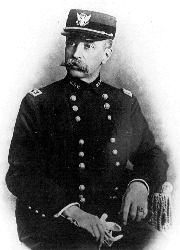
William Ludlow
William Ludlow was a prominent officer in the United States Army, recognized for his significant contributions during pivotal conflicts such as the Civil War, the Plains Indian Wars, and the Spanish–American War. A graduate of the United States Military Academy at West Point, he served with distinction in the Corps of Engineers, where his expertise in military engineering was instrumental in various campaigns. Ludlow's military career was marked not only by his leadership in battle but also by his commitment to scientific inquiry, particularly during his role in a groundbreaking expedition to Yellowstone National Park. This expedition was crucial in documenting the region's natural wonders and contributed to the establishment of national parks in the United States. Ludlow's legacy extends beyond his military achievements; he played a vital role in the evolution of military engineering and the promotion of environmental conservation. His work in Yellowstone helped to raise awareness of the need to protect America's natural landscapes, influencing future conservation efforts. As a figure who bridged the worlds of military service and scientific exploration, Ludlow's contributions have had a lasting impact on both the military and environmental fields, marking him as a notable figure in American history.
Books from the author

Link to this page
Add a free, dofollow link to Lex on your blog, forum, syllabus, or reading list.

<a href="https://lex-books.com/author/william-ludlow"><img src="https://lex-books.com/badges/read-on-lex.svg" alt="William Ludlow on Lex" width="160" height="40"></a>[](https://lex-books.com/author/william-ludlow)[url=https://lex-books.com/author/william-ludlow][img]https://lex-books.com/badges/read-on-lex.svg[/img][/url]William Ludlow on Lex: https://lex-books.com/author/william-ludlow