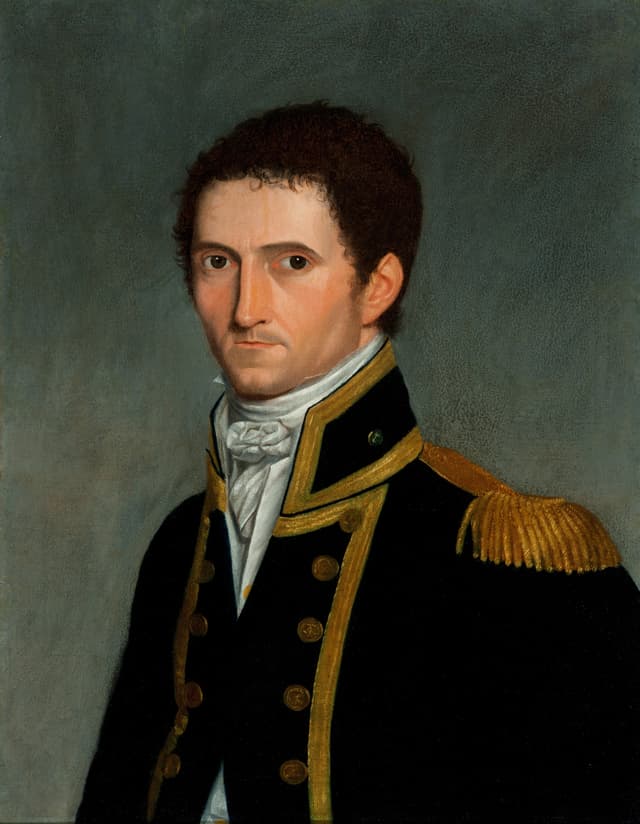
Matthew Flinders
Captain Matthew Flinders was a pioneering Royal Navy officer, navigator, and cartographer, renowned for his significant contributions to the exploration of Australia. He is best remembered for leading the first inshore circumnavigation of mainland Australia, a feat that not only mapped the coastline but also solidified his role in the early understanding of the continent. Flinders was the first to propose the name 'Australia' for the entire landmass, a term he found more pleasing than the previously used 'Terra Australis.' His expeditions, particularly those with George Bass, were instrumental in confirming that Van Diemen's Land (now Tasmania) was an island, further enhancing the geographical knowledge of the region during the late 18th and early 19th centuries. Flinders' career was marked by both triumph and adversity. After returning from his landmark voyages, he was unexpectedly detained by the French at the Isle de France, where he spent over six years in captivity. During this time, he meticulously documented his findings and articulated his rationale for the name Australia, which would later gain acceptance. Although he returned to Britain in 1810, he did not live to witness the publication of his acclaimed work, 'A Voyage to Terra Australis,' which showcased his extensive research and maps. Flinders' legacy is not only defined by his navigational achievements but also by his enduring influence on Australian identity and geography, with his remains recently identified and reinterred in his birthplace, symbolizing a posthumous recognition of his contributions to the nation he helped define.
Famous Quotes
View all 2 quotes“Political cynicism, disengagement, democratic decadence — call it what you will — is too often an excuse for physical and intellectual laziness.”
“Is it possible that we ‘hate’ politics because we have forgotten its specifi c and limited nature, its overwhelming value, and also its innate fragility? Could it be that our expectations are so high that politics appears almost destined to disappoint? Democratic politics cannot make ‘every sad heart glad’, as Crick argued, nor did it ever promise to do so. But not always getting what you want, an awareness that public governance is often slow and bureaucratic, a frustration that some decisions are hard to understand or have to be made in secret, disbelief and anger at the selfinterested behaviour of a small number of politicians, and an acceptance that some people will always take out more from the system than they put in—these are the prices you pay for living in a democracy.”
Books from the author





Link to this page
Add a free, dofollow link to Lex on your blog, forum, syllabus, or reading list.

<a href="https://lex-books.com/author/matthew-flinders"><img src="https://lex-books.com/badges/read-on-lex.svg" alt="Matthew Flinders on Lex" width="160" height="40"></a>[](https://lex-books.com/author/matthew-flinders)[url=https://lex-books.com/author/matthew-flinders][img]https://lex-books.com/badges/read-on-lex.svg[/img][/url]Matthew Flinders on Lex: https://lex-books.com/author/matthew-flinders