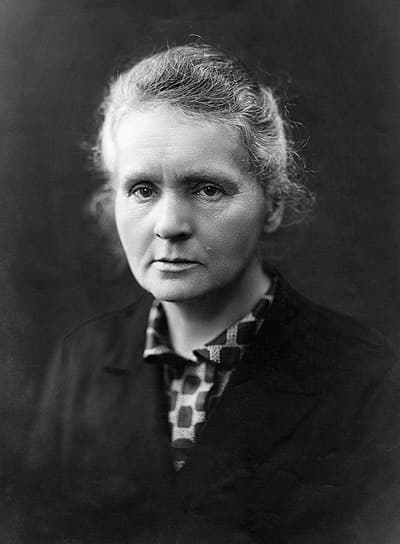
Marie Curie
Marie Curie was a groundbreaking physicist and chemist, renowned for her pioneering research on radioactivity. Born in Warsaw, Poland, she defied societal norms by pursuing her education at the clandestine Flying University before moving to Paris in 1891 to further her studies. There, she earned her degrees and conducted significant scientific work, eventually marrying fellow physicist Pierre Curie in 1895. Together, they were awarded the 1903 Nobel Prize in Physics alongside Henri Becquerel for their contributions to the understanding of radioactivity, a term that Curie herself coined. This achievement made her the first woman to receive a Nobel Prize and the first person to win Nobel Prizes in two distinct scientific fields. After the tragic death of Pierre in 1906, Curie continued her groundbreaking work, becoming the first female professor at the University of Paris. In 1911, she was awarded the Nobel Prize in Chemistry for her discovery of the elements polonium and radium, showcasing her innovative techniques for isolating radioactive isotopes. Curie's legacy is monumental, not only for her scientific achievements but also for her role in paving the way for women in science. Her work laid the foundation for advancements in medical treatment and nuclear physics, and her family continued her legacy with multiple Nobel Prizes, solidifying the Curie name in the annals of scientific history.
Famous Quotes
View all 17 quotes“Nothing in life is to be feared, it is only to be understood. Now is the time to understand more, so that we may fear less.””
“Be less curious about people and more curious about ideas.””
“Nothing in life is to be feared. It is only to be understood.””
Books from the author
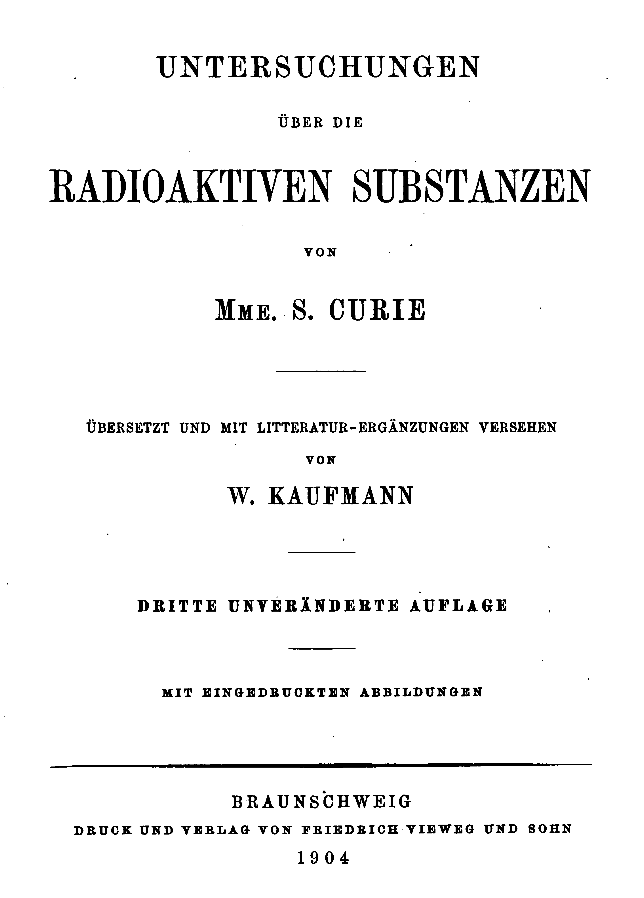

Link to this page
Add a free, dofollow link to Lex on your blog, forum, syllabus, or reading list.

<a href="https://lex-books.com/author/marie-curie"><img src="https://lex-books.com/badges/read-on-lex.svg" alt="Marie Curie on Lex" width="160" height="40"></a>[](https://lex-books.com/author/marie-curie)[url=https://lex-books.com/author/marie-curie][img]https://lex-books.com/badges/read-on-lex.svg[/img][/url]Marie Curie on Lex: https://lex-books.com/author/marie-curie