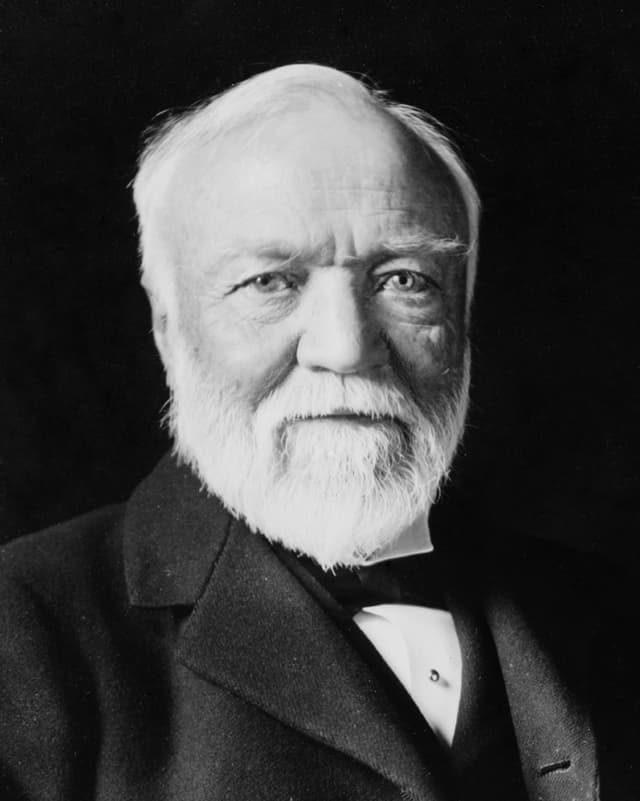
Andrew Carnegie
Andrew Carnegie was a Scottish-American industrialist and philanthropist who played a pivotal role in the expansion of the American steel industry during the late 19th century. Born in Dunfermline, Scotland, he immigrated to the United States with his family at the age of twelve, settling in Pittsburgh, Pennsylvania. Starting his career in a cotton mill, Carnegie quickly transitioned to telegraphy and then to investments in railroads and other ventures. By the 1860s, he had established himself as a significant figure in American industry, ultimately founding Carnegie Steel Company, which he sold to J.P. Morgan in 1901 for a staggering $303 million, making him the richest American of his time. Carnegie's legacy extends far beyond his business success; he became a leading philanthropist, donating approximately $350 million—nearly 90 percent of his fortune—to various charitable causes, including libraries, educational institutions, and cultural organizations. His influential 1889 essay, "The Gospel of Wealth," advocated for the wealthy to use their fortunes for the greater good, promoting ideas of progressive taxation and social responsibility. This work not only shaped the philanthropic landscape of his era but also inspired future generations of philanthropists, solidifying Carnegie's place as a key figure in both American industry and social reform.
Famous Quotes
View all 3 quotes“A library outranks any other one thing a community can do to benefit its people. It is a never failing spring in the desert.”
“As I grow older, I pay less attention to what men say. I just watch what they do.”
“People who are unable to motivate themselves must be content with mediocrity, no matter how impressive their other talents.”
Books from the author






Link to this page
Add a free, dofollow link to Lex on your blog, forum, syllabus, or reading list.

<a href="https://lex-books.com/author/andrew-carnegie"><img src="https://lex-books.com/badges/read-on-lex.svg" alt="Andrew Carnegie on Lex" width="160" height="40"></a>[](https://lex-books.com/author/andrew-carnegie)[url=https://lex-books.com/author/andrew-carnegie][img]https://lex-books.com/badges/read-on-lex.svg[/img][/url]Andrew Carnegie on Lex: https://lex-books.com/author/andrew-carnegie