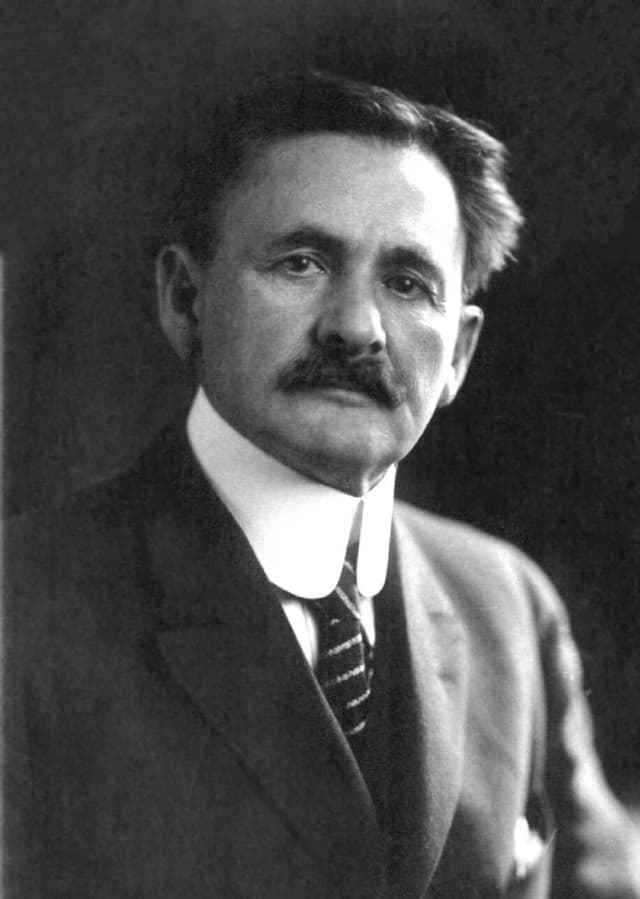
Albert A. Michelson
Albert A. Michelson was a pioneering American physicist best known for his groundbreaking work in the field of optics and for being the first American to receive the Nobel Prize in Physics. Born in Strelno, Prussia, he emigrated to the United States with his family as a child. Michelson's most notable contributions to science include his precise measurements of the speed of light and his experiments to determine the relative motion of the Earth through the luminiferous ether, a concept that was later discarded with the advent of Einstein's theory of relativity. His work, particularly detailed in 'Experimental Determination of the Velocity of Light' and 'On the Relative Motion of the Earth and the Luminiferous Æther', laid the groundwork for modern physics and significantly influenced the scientific community's understanding of light and motion. Michelson's meticulous experimental techniques and innovative approaches earned him a prominent place in the annals of science. His experiments not only provided critical data that challenged existing theories but also demonstrated the importance of precision in scientific measurement. The Michelson-Morley experiment, conducted in 1887, is particularly famous for its role in disproving the existence of the ether and for paving the way for Einstein's theory of relativity. Michelson's legacy endures through his contributions to physics, and he remains a key figure in the transition from classical to modern physics, illustrating the profound impact of experimental science on our understanding of the universe.
Famous Quotes
View all 1 quotes“The generalized theory of relativity has furnished still more remarkable results. This considers not only uniform but also accelerated motion. In particular, it is based on the impossibility of distinguishing an acceleration from the gravitation or other force which produces it. Three consequences of the theory may be mentioned of which two have been confirmed while the third is still on trial: (1) It gives a correct explanation of the residual motion of forty-three seconds of arc per century of the perihelion of Mercury. (2) It predicts the deviation which a ray of light from a star should experience on passing near a large gravitating body, the sun, namely, 1".7. On Newton's corpuscular theory this should be only half as great. As a result of the measurements of the photographs of the eclipse of 1921 the number found was much nearer to the prediction of Einstein, and was inversely proportional to the distance from the center of the sun, in further confirmation of the theory. (3) The theory predicts a displacement of the solar spectral lines, and it seems that this prediction is also verified.””
Books from the author







Link to this page
Add a free, dofollow link to Lex on your blog, forum, syllabus, or reading list.

<a href="https://lex-books.com/author/albert-a-michelson"><img src="https://lex-books.com/badges/read-on-lex.svg" alt="Albert A. Michelson on Lex" width="160" height="40"></a>[](https://lex-books.com/author/albert-a-michelson)[url=https://lex-books.com/author/albert-a-michelson][img]https://lex-books.com/badges/read-on-lex.svg[/img][/url]Albert A. Michelson on Lex: https://lex-books.com/author/albert-a-michelson