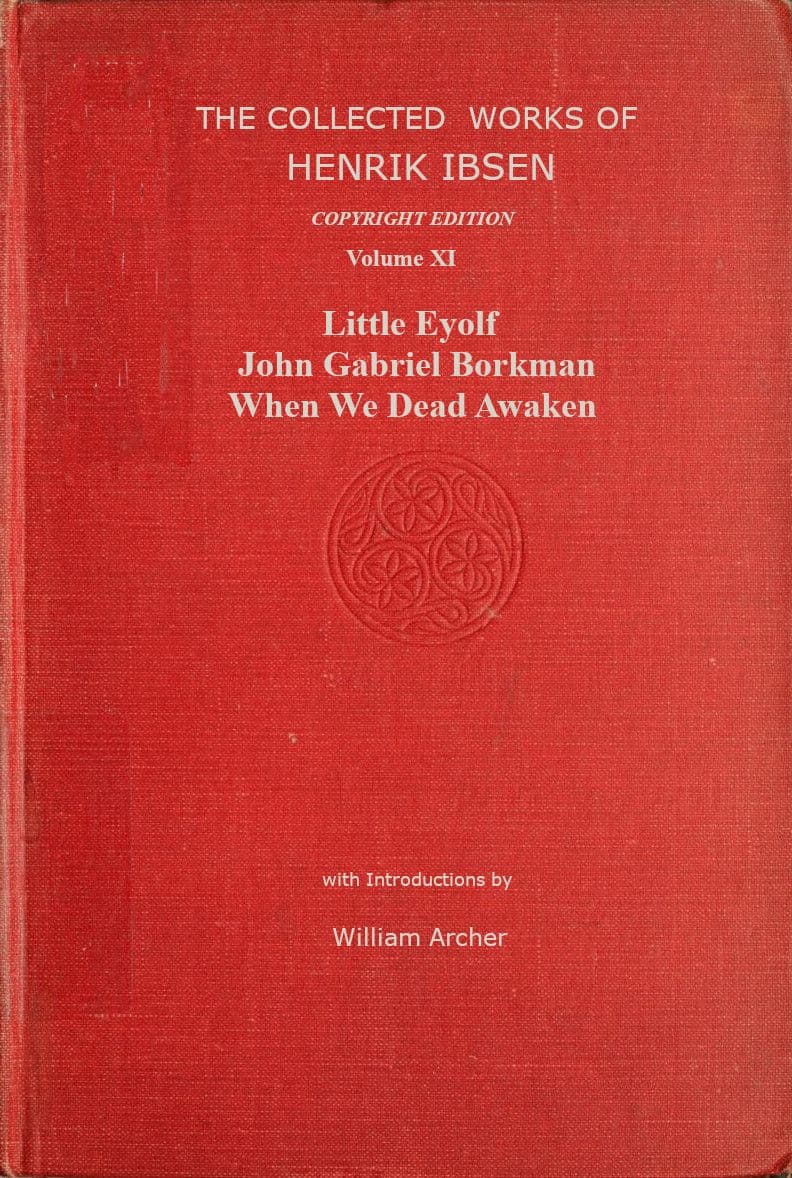
When We Dead Awaken
1899
Ibsen's final play pulses with the raw, existential energy of a man confronting what his life has cost him. Professor Arnold Rubek, a celebrated sculptor, returns to the mountains with his young wife Maia, haunted by the masterpiece that made him famous: a statue carved from the body and soul of Irene, the lover he used and abandoned. As the past resurfaces, Ibsen strips away the comfortable lies we tell ourselves about ambition, success, and what it means to have truly lived. The title reverberates with terrible irony: these are not the dead resurrected, but the living who awaken to find their humanity has been traded for achievement. This is Ibsen at his most naked and unforgiving, asking whether any art justifies a life unlived.
Editions
X-Ray
“Først når vi døde våkner, ser vi det uopprettelige, nemlig at vi aldri har levet.””
— Henrik Ibsen
“Not in that sense. What I need is the companionship of another person who can, as it were, complete me”
— Henrik Ibsen
“PROFESSOR RUBEK. Well, they are trifles, perhaps; but at any rate the time passes for us in that way as well as another, Maia.””
— Henrik Ibsen
“[Touching his own breast.] In here, you see”
— Henrik Ibsen
“[Suddenly letting slip the train of thought.] Do you know, the people down at the hotel think she's mad. PROFESSOR RUBEK. Indeed? And pray what do the people down at the hotel think of you and the bear-killer?””
— Henrik Ibsen
“I have come to realise that I am not at all adapted for seeking happiness in indolent enjoyment.””
— Henrik Ibsen
“Yes, is not life in sunshine and in beauty a hundred times better worth while than to hang about to the end of your days in a raw, damp hole, and wear yourself out in a perpetual struggle with lumps of clay and blocks of stone?””
— Henrik Ibsen
“Jeg merket det ble så lydløst ved alle de små stasjonene. Jeg hørte lydløsheten og forstod at nå var vi kommet over grensen. Nå var vi riktig hjemme.””
— Henrik Ibsen
Link to this book
Add a free, dofollow link to Lex on your blog, forum, syllabus, or reading list.

<a href="https://lex-books.com/book/when-we-dead-awaken-1df00095-45f9-40fb-86b6-f8755253c292"><img src="https://lex-books.com/badges/read-on-lex.svg" alt="Read When We Dead Awaken by Henrik Ibsen free on Lex" width="160" height="40"></a>[](https://lex-books.com/book/when-we-dead-awaken-1df00095-45f9-40fb-86b6-f8755253c292)[url=https://lex-books.com/book/when-we-dead-awaken-1df00095-45f9-40fb-86b6-f8755253c292][img]https://lex-books.com/badges/read-on-lex.svg[/img][/url]Read When We Dead Awaken by Henrik Ibsen free on Lex: https://lex-books.com/book/when-we-dead-awaken-1df00095-45f9-40fb-86b6-f8755253c292Cite this book
Reading this edition for a paper or guide? Copy a citation.
Ibsen, Henrik. When We Dead Awaken. Lex, lex-books.com/book/when-we-dead-awaken-1df00095-45f9-40fb-86b6-f8755253c292.Ibsen, H. (1899). When We Dead Awaken. Lex. https://lex-books.com/book/when-we-dead-awaken-1df00095-45f9-40fb-86b6-f8755253c292Ibsen, Henrik. When We Dead Awaken. Lex. https://lex-books.com/book/when-we-dead-awaken-1df00095-45f9-40fb-86b6-f8755253c292.