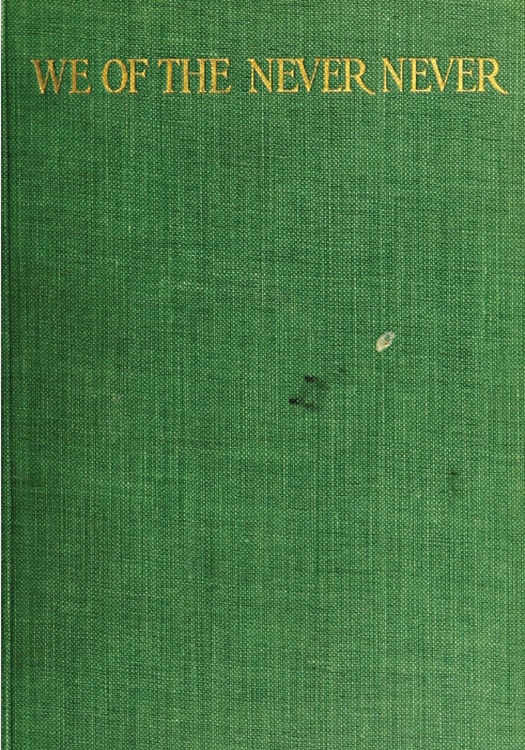
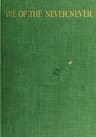
We of the Never-Never
1907

In 1902, a young woman arrives at Elsey Station, a remote outpost in Australia's Northern Territory, where the heat is merciless and the nearest neighbor is a day's ride away. She comes as "the Missus" to a husband she barely knows, met by a community of rough-hewn stockmen who openly doubt she can survive six months in the Never-Never. What unfolds is neither the adventure yarn the bushmen expect nor the romance of pioneer mythology, but something quieter and more radical: a portrait of a woman finding her place among people who speak plainly, love deeply, and endure endlessly. Jeannie Gunn writes with wit and hard-won tenderness about the Indigenous stockmen, raucous boundary riders, and the vast indifferent landscape that becomes home. The book captures a world where survival depends on accepting help from those society deems inferior, and where a woman's worth is measured not in drawing rooms but in grit. Over a century later, We of the Never-Never endures because it refuses sentimentality while remaining deeply humane.
Editions
X-Ray
“When the heart is happy it forgets to grow old.””
— Jeannie Gunn
“Heard of a chap once who reckoned it was good enough for a bath, but by the time he’d got himself nicely soaped the shower was travelling on ten miles a minute, and there wasn’t another drop of rain for a fortnight, which wasn’t too pleasant for the prickly heat.” The homestead rubbed its back in sympathy against the nearest upright, and Dan added that “of course the soap kept the mosquitoes dodged a bit,” which was something to be thankful for. “There generally is something to be thankful for, if you only reckon it out,” he assured all. But the traveller, reduced to a sweltering prickliness by his exertions, wasn’t “noticing much at present,” as he rubbed his back in his misery against the saddle of the horse he was unpacking. Then his horse, shifting its position, trod on his foot; and as he hopped round, nursing his stinging toes, Dan found an illustration for his argument. “Some chaps,” he said, “ ’ud be thankful to have toes to be trod on”; and ducking to avoid a coming missile, he added cheerfully, “But there’s even an advantage about having wooden legs at times. Heard once of a chap that reckoned ’em just the thing. Trod on a death-adder unexpected-like in his camp, and when the death-adder whizzed round to strike it, just struck wood, and the chap enjoyed his supper as usual that night. That chap had a wooden leg,” he added, unnecessarily explicit; and then his argument being nicely rounded off, he lent a hand with the pack-bags.””
— Jeannie Gunn
“Around one central fire sat the lubras, with an outer circle of smaller fires behind them: one central fire and one fire behind each lubra, for such is the wisdom of the black folk; they warm themselves both back and front. Within another circle of fires chirruped and gossiped the “boys,” while around an immense glowing heap of logs sat the white folk”
— Jeannie Gunn
“Hoe your own row the best you can. Lend others a hand with theirs. Let God see to the rest.””
— Jeannie Gunn
“...for although necessity may be the mother of invention, she more often brings thankful hearts into this world.””
— Jeannie Gunn
“...but forgetting that life is life wherever it may be lived.””
— Jeannie Gunn
“It is men like the Fizzer who, “keeping the roads open”, lay the foundation-stones of great cities; and yet when cities creep into the Never-Never along the Fizzer’s mail route, in all probability they will be called after Members of Parliament and the Prime Ministers of that day, grandsons, perhaps, of the men who forgot to keep the old well in repair, while our Fizzer and the mail-man who perished will be forgotten; for townsfolk are apt to forget the beginnings of things.””
— Jeannie Gunn
“There is no isolation so weird in its feeling of cut-offness as that of a night camp in the heart of the bush.””
— Jeannie Gunn
“In life we generally find in our fellow-men just what we seek; and the Maluka, seeking only the good, found only the good, and drew much of it into his own sympathetic, sunny nature. He demanded the best and was given the best, and while with him, men found they were better men than at other times.””
— Jeannie Gunn
Link to this book
Add a free, dofollow link to Lex on your blog, forum, syllabus, or reading list.

<a href="https://lex-books.com/book/we-of-the-never-never-545a5d1e-174a-4311-b261-e1fa189c413d"><img src="https://lex-books.com/badges/read-on-lex.svg" alt="Read We of the Never-Never by Jeannie Gunn free on Lex" width="160" height="40"></a>[](https://lex-books.com/book/we-of-the-never-never-545a5d1e-174a-4311-b261-e1fa189c413d)[url=https://lex-books.com/book/we-of-the-never-never-545a5d1e-174a-4311-b261-e1fa189c413d][img]https://lex-books.com/badges/read-on-lex.svg[/img][/url]Read We of the Never-Never by Jeannie Gunn free on Lex: https://lex-books.com/book/we-of-the-never-never-545a5d1e-174a-4311-b261-e1fa189c413dCite this book
Reading this edition for a paper or guide? Copy a citation.
Gunn, Jeannie. We of the Never-Never. Lex, lex-books.com/book/we-of-the-never-never-545a5d1e-174a-4311-b261-e1fa189c413d.Gunn, J. (1907). We of the Never-Never. Lex. https://lex-books.com/book/we-of-the-never-never-545a5d1e-174a-4311-b261-e1fa189c413dGunn, Jeannie. We of the Never-Never. Lex. https://lex-books.com/book/we-of-the-never-never-545a5d1e-174a-4311-b261-e1fa189c413d.