Vitruvii De Architectura Libri Decem
1486
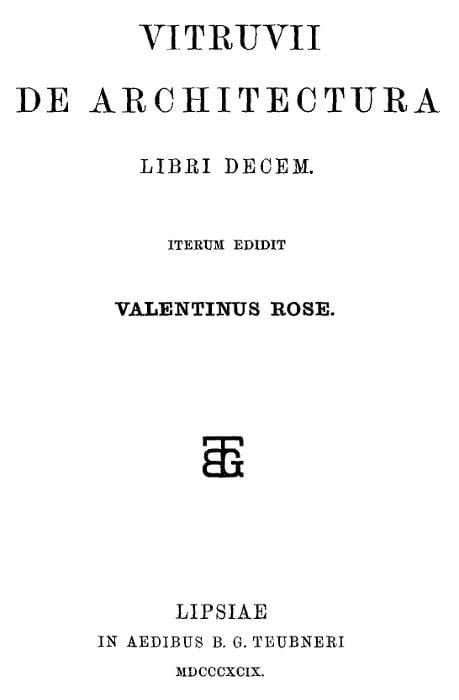
The oldest book on architecture in existence, written by a Roman engineer in the first century BC and first printed in 1486, De Architectura established the principles that would shape Western buildings for the next two millennia. Vitruvius wrote for Emperor Augustus, offering a sweeping vision of how great cities function: the geometry of temples, the acoustics of theaters, the proper proportions of the Doric, Ionic, and Corinthian orders, and the science behind materials like brick, marble, and concrete. His text was the secret weapon of Renaissance masters. Michelangelo studied it. Palladio built from it. Bramante used it to reimagine St. Peter's. Yet this is no dry technical manual. Vitruvius digresses with pleasure, explaining how Archimedes discovered displacement in his bath, why writers deserve honors as much as athletes, and the nature of wind itself. Here is the mind of antiquity, preserved in amber, speaking directly across twenty centuries about how humans build to endure, to inspire, and to order their world.
Editions
X-Ray
“I think that men have no right to profess themselves architects hastily, without having climbed from boyhood the steps of these studies and thus, nursed by the knowledge of many arts and sciences, having reached the heights of the holy ground of architecture.””
— Vitruvius Pollio
“Our ancestors established the intelligent and useful practice of transmitting their thoughts to future generations in the form of bodies of notes so they would not be lost but, growing generation by generation once they had been published as books, they would gradually arrive at the highest level of scientific development in the course of time. So for this we owe them no half-hearted thanks but infinite gratitude, because they did not jealousy pass over these matters in silence but took great care to hand on to posterity their insights of all kinds in written form.””
— Vitruvius Pollio
“Socrates […] is recorded as having said, sagely and with the greatest acuteness, that men’s breasts should have windows in them and be open so that their thoughts would not remain concealed but open for inspection.””
— Vitruvius Pollio
“The architect should be equipped with knowledge of many branches of study and varied kinds of learning, for it is by his judgement that all work be done by the other arts is put to test.””
— Vitruvius Pollio
“Writing on architecture is not like history or poetry.””
— Vitruvius Pollio
“architects who have aimed at acquiring manual skill without scholarship have never been able to reach a position of authority to correspond to their pains, while those who relied only upon theories and scholarship were obviously hunting the shadow, not the substance.””
— Vitruvius Pollio
“…perhaps laymen will find it unbelievable that a man’s intellect enables him to understand and retain such a large number of disciplines. But when they realize that all disciplines are connected with, and feed into, each other, they will readily believe that this can happen. For a general education is like a single body composed of these different limbs. That is why those who are instructed in various subjects from a tender age recognise the ground common to all areas of study and the complimentary relationships between all the disciplines, and for that reason can readily understand all of them.””
— Vitruvius Pollio
“For all fields, and especially architecture, comprise two aspects: that which is signified and that which signifies it. [... ] Therefore it is evident that a man who wants to proclaim himself an architect must be proficient with regards to both aspects.””
— Vitruvius Pollio
“This was how Dinocrates, recommended only by his good looks and dignified carriage, came to be so famous. But as for me, Emperor, nature has not given me stature, age has marred my face, and my strength is impaired by ill health.””
— Vitruvius Pollio
Link to this book
Add a free, dofollow link to Lex on your blog, forum, syllabus, or reading list.

<a href="https://lex-books.com/book/vitruvii-de-architectura-libri-decem-cab59d7f-5085-4c50-8d52-a96e4430807e"><img src="https://lex-books.com/badges/read-on-lex.svg" alt="Read Vitruvii De Architectura Libri Decem by Vitruvius Pollio free on Lex" width="160" height="40"></a>[](https://lex-books.com/book/vitruvii-de-architectura-libri-decem-cab59d7f-5085-4c50-8d52-a96e4430807e)[url=https://lex-books.com/book/vitruvii-de-architectura-libri-decem-cab59d7f-5085-4c50-8d52-a96e4430807e][img]https://lex-books.com/badges/read-on-lex.svg[/img][/url]Read Vitruvii De Architectura Libri Decem by Vitruvius Pollio free on Lex: https://lex-books.com/book/vitruvii-de-architectura-libri-decem-cab59d7f-5085-4c50-8d52-a96e4430807eCite this book
Reading this edition for a paper or guide? Copy a citation.
Pollio, Vitruvius. Vitruvii De Architectura Libri Decem. Lex, lex-books.com/book/vitruvii-de-architectura-libri-decem-cab59d7f-5085-4c50-8d52-a96e4430807e.Pollio, V. (1486). Vitruvii De Architectura Libri Decem. Lex. https://lex-books.com/book/vitruvii-de-architectura-libri-decem-cab59d7f-5085-4c50-8d52-a96e4430807ePollio, Vitruvius. Vitruvii De Architectura Libri Decem. Lex. https://lex-books.com/book/vitruvii-de-architectura-libri-decem-cab59d7f-5085-4c50-8d52-a96e4430807e.