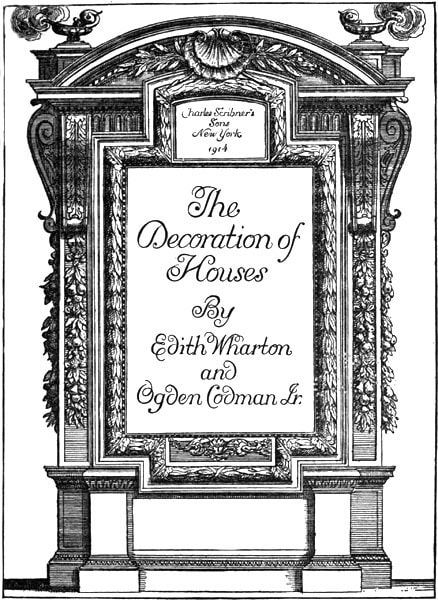
The Decoration of Houses
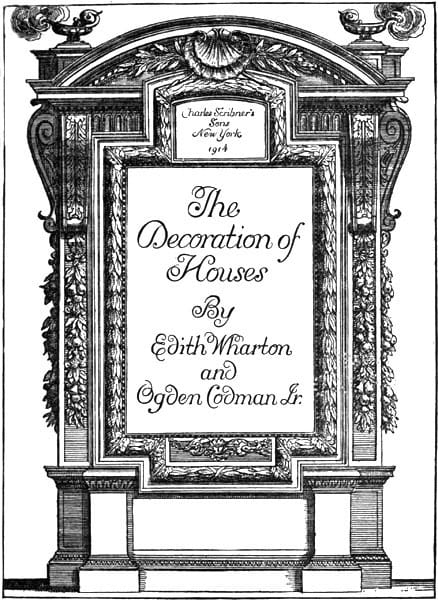
Before Edith Wharton became the celebrated novelist of The House of Mirth and The Age of Innocence, she wrote a book that would revolutionize how Americans thought about their homes. The Decoration of Houses (1897), co-authored with architect Ogden Codman, is both a radical polemic and a practical manifesto. Wharton despised the Victorian era's signature interior style: heavy window curtains swallowing windows, tabletops buried under ornamental objects, furniture so overstuffed it was barely sitable. She saw these spaces as fundamentally dishonest, decoration that disguised rather than celebrated a room's architecture. Her solution was uncompromising: restore rooms to their essential proportions, let walls and ceilings speak, choose furniture for its line and craftsmanship rather than its upholstery. The book argues that well-designed rooms should be comfortable through simplicity, not despite it. Its influence was immediate and profound - Elsie de Wolfe read it, left acting, and became America's first professional interior decorator. More than a period piece, this is Wharton applying her renowned precision and moral clarity to the spaces people actually inhabit. For readers of her novels, it is a revelation; for anyone interested in design, it is essential.
Editions
X-Ray
“What is originality in art? Perhaps it is easier to define what it is not and this may be done by saying that it is never a willful rejection of what has been accepted as the necessary laws of various forms of art. Thus in reasoning originality relies not in discarding the necessary laws of thought, but in using them to express new intellectual conceptions. In poetry originality consists not in discarding the necessary laws of rhythm but in finding new rhythms within the limits of those laws.””
— Edith Wharton
“L'Architecture Françoise. 1727. Briseux, Charles Étienne. L'Art de Bâtir les Maisons de Campagne. Paris, 1743.””
— Edith Wharton
Link to this book
Add a free, dofollow link to Lex on your blog, forum, syllabus, or reading list.

<a href="https://lex-books.com/book/the-decoration-of-houses-486ba5e7-58a6-4c73-8430-eac5f3b71437"><img src="https://lex-books.com/badges/read-on-lex.svg" alt="Read The Decoration of Houses by Edith Wharton free on Lex" width="160" height="40"></a>[](https://lex-books.com/book/the-decoration-of-houses-486ba5e7-58a6-4c73-8430-eac5f3b71437)[url=https://lex-books.com/book/the-decoration-of-houses-486ba5e7-58a6-4c73-8430-eac5f3b71437][img]https://lex-books.com/badges/read-on-lex.svg[/img][/url]Read The Decoration of Houses by Edith Wharton free on Lex: https://lex-books.com/book/the-decoration-of-houses-486ba5e7-58a6-4c73-8430-eac5f3b71437Cite this book
Reading this edition for a paper or guide? Copy a citation.
Wharton, Edith. The Decoration of Houses. Lex, lex-books.com/book/the-decoration-of-houses-486ba5e7-58a6-4c73-8430-eac5f3b71437.Wharton, E. (n.d.). The Decoration of Houses. Lex. https://lex-books.com/book/the-decoration-of-houses-486ba5e7-58a6-4c73-8430-eac5f3b71437Wharton, Edith. The Decoration of Houses. Lex. https://lex-books.com/book/the-decoration-of-houses-486ba5e7-58a6-4c73-8430-eac5f3b71437.