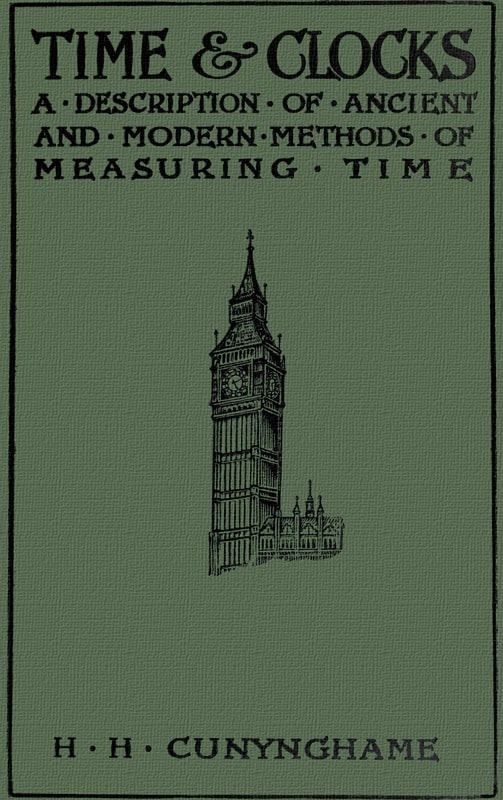
Time and Clocks: A Description of Ancient and Modern Methods of Measuring Time
1906
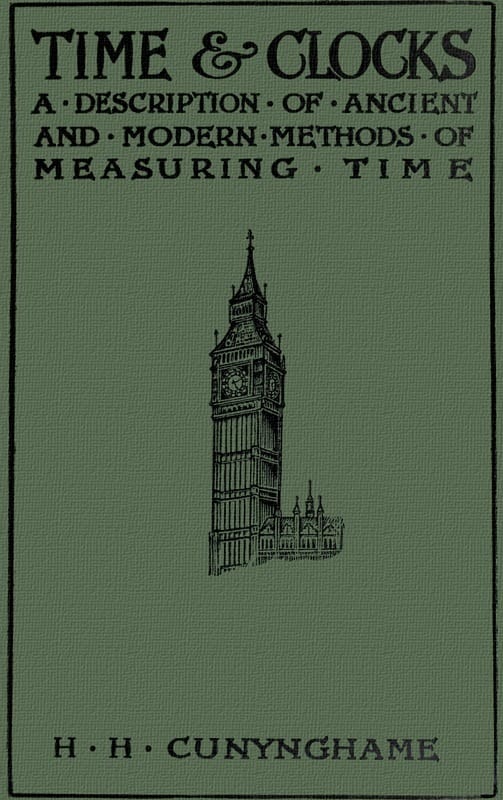
Time and Clocks: A Description of Ancient and Modern Methods of Measuring Time
1906
A scientific publication written in the early 20th century. This detailed work explores various methods for measuring time, tracing their development from ancient to modern techniques, while discussing the underlying principles of timekeeping. The primary focus is on the evolution of clocks and the philosophical implications of understanding time as a concept. The beginning of the book provides an introduction to the significance of time in understanding both the natural world and human history. It presents an argument about the superiority of modern scientific advancements over past artistic and philosophical achievements, emphasizing the relevant progress in time measurement and physical sciences from ancient cultures to contemporary society. Cunynghame's exposition is layered with philosophical reflections on concepts related to time and how they have shaped human thought, preparing readers for a more in-depth examination of the technical aspects and historical developments in clock-making and time measurement methods.
Editions
X-Ray
The author and narrator of this technical work on timekeeping. A learned Victorian gentleman with expertise in engineering and science who guides readers through the history and mechanics of time measurement.
Italian scientist and key figure in the development of pendulum clocks. Discovered the isochronous nature of pendulums while observing cathedral lamps and revolutionized the understanding of motion and force.
Ancient Greek philosopher whose erroneous scientific ideas dominated medieval thought. His theories about falling bodies and celestial motion were later disproven by Galileo.
Ancient astronomer who created the comprehensive 'Great Collection' on astronomy. His geocentric system dominated European astronomy until the Renaissance.
About Time and Clocks: A Description of Ancient and Modern Methods of Measuring Time
Chapter Summaries
- Introduction
- Cunynghame argues that while past ages excelled in literature and art, the modern era's glory lies in scientific discovery. He criticizes the educational emphasis on classical languages over practical science and warns against confusing words with understanding.
- I
- Explores the basic ideas of space, time, and mass as fundamental to physics. Discusses ancient observations of celestial motions that led to calendars and the development of sundials and water clocks.
- II
- Contrasts ancient deductive reasoning with modern experimental methods. Examines the work of Aristotle and Ptolemy, then describes Galileo's revolutionary experiments that overturned ancient theories about motion and gravity.
Key Themes
- Scientific Method vs. Authority
- Cunynghame contrasts medieval reliance on ancient authorities like Aristotle with modern experimental approaches pioneered by Galileo. He emphasizes that true understanding comes from observation and testing rather than accepting traditional teachings.
- The Nature of Time and Measurement
- The work explores time as both a philosophical concept and practical necessity. From ancient sundials to precision chronometers, the book shows how humanity's understanding and measurement of time has evolved.
- Mechanical Precision and Craftsmanship
- The detailed descriptions of clockwork mechanisms celebrate both traditional craftsmanship and modern manufacturing precision. Cunynghame shows how mechanical ingenuity solves practical problems.
Characters
- Sir Henry H. Cunynghame(protagonist)
- The author and narrator of this technical work on timekeeping. A learned Victorian gentleman with expertise in engineering and science who guides readers through the history and mechanics of time measurement.
- Galileo Galilei(major)
- Italian scientist and key figure in the development of pendulum clocks. Discovered the isochronous nature of pendulums while observing cathedral lamps and revolutionized the understanding of motion and force.
- Aristotle(major)
- Ancient Greek philosopher whose erroneous scientific ideas dominated medieval thought. His theories about falling bodies and celestial motion were later disproven by Galileo.
- Ptolemy of Alexandria(major)
- Ancient astronomer who created the comprehensive 'Great Collection' on astronomy. His geocentric system dominated European astronomy until the Renaissance.
- Copernicus(major)
- 16th-century ecclesiastic who revived the heliocentric theory, proposing that Earth moves around the sun rather than vice versa.
- Newton(major)
- Great physicist whose genius built upon Galileo's work to explain the motion of celestial bodies through his theory of mechanics and universal gravitation.
Link to this book
Add a free, dofollow link to Lex on your blog, forum, syllabus, or reading list.

<a href="https://lex-books.com/book/time-and-clocks-a-description-of-ancient-and-modern-methods-of-measuring-time-a81a9e8d-3828-4f15-9483-3c8f43cd0ca0"><img src="https://lex-books.com/badges/read-on-lex.svg" alt="Read Time and Clocks: A Description of Ancient and Modern Methods of Measuring Time by Henry H. , Sir Cunynghame free on Lex" width="160" height="40"></a>[](https://lex-books.com/book/time-and-clocks-a-description-of-ancient-and-modern-methods-of-measuring-time-a81a9e8d-3828-4f15-9483-3c8f43cd0ca0)[url=https://lex-books.com/book/time-and-clocks-a-description-of-ancient-and-modern-methods-of-measuring-time-a81a9e8d-3828-4f15-9483-3c8f43cd0ca0][img]https://lex-books.com/badges/read-on-lex.svg[/img][/url]Read Time and Clocks: A Description of Ancient and Modern Methods of Measuring Time by Henry H. , Sir Cunynghame free on Lex: https://lex-books.com/book/time-and-clocks-a-description-of-ancient-and-modern-methods-of-measuring-time-a81a9e8d-3828-4f15-9483-3c8f43cd0ca0Cite this book
Reading this edition for a paper or guide? Copy a citation.
Henry H. , Sir Cunynghame. Time and Clocks: A Description of Ancient and Modern Methods of Measuring Time. Lex, lex-books.com/book/time-and-clocks-a-description-of-ancient-and-modern-methods-of-measuring-time-a81a9e8d-3828-4f15-9483-3c8f43cd0ca0.Henry H., S. C. (1906). Time and Clocks: A Description of Ancient and Modern Methods of Measuring Time. Lex. https://lex-books.com/book/time-and-clocks-a-description-of-ancient-and-modern-methods-of-measuring-time-a81a9e8d-3828-4f15-9483-3c8f43cd0ca0Henry H. , Sir Cunynghame. Time and Clocks: A Description of Ancient and Modern Methods of Measuring Time. Lex. https://lex-books.com/book/time-and-clocks-a-description-of-ancient-and-modern-methods-of-measuring-time-a81a9e8d-3828-4f15-9483-3c8f43cd0ca0.