The Unseen Universe: Or, Physical Speculations on a Future State
1875
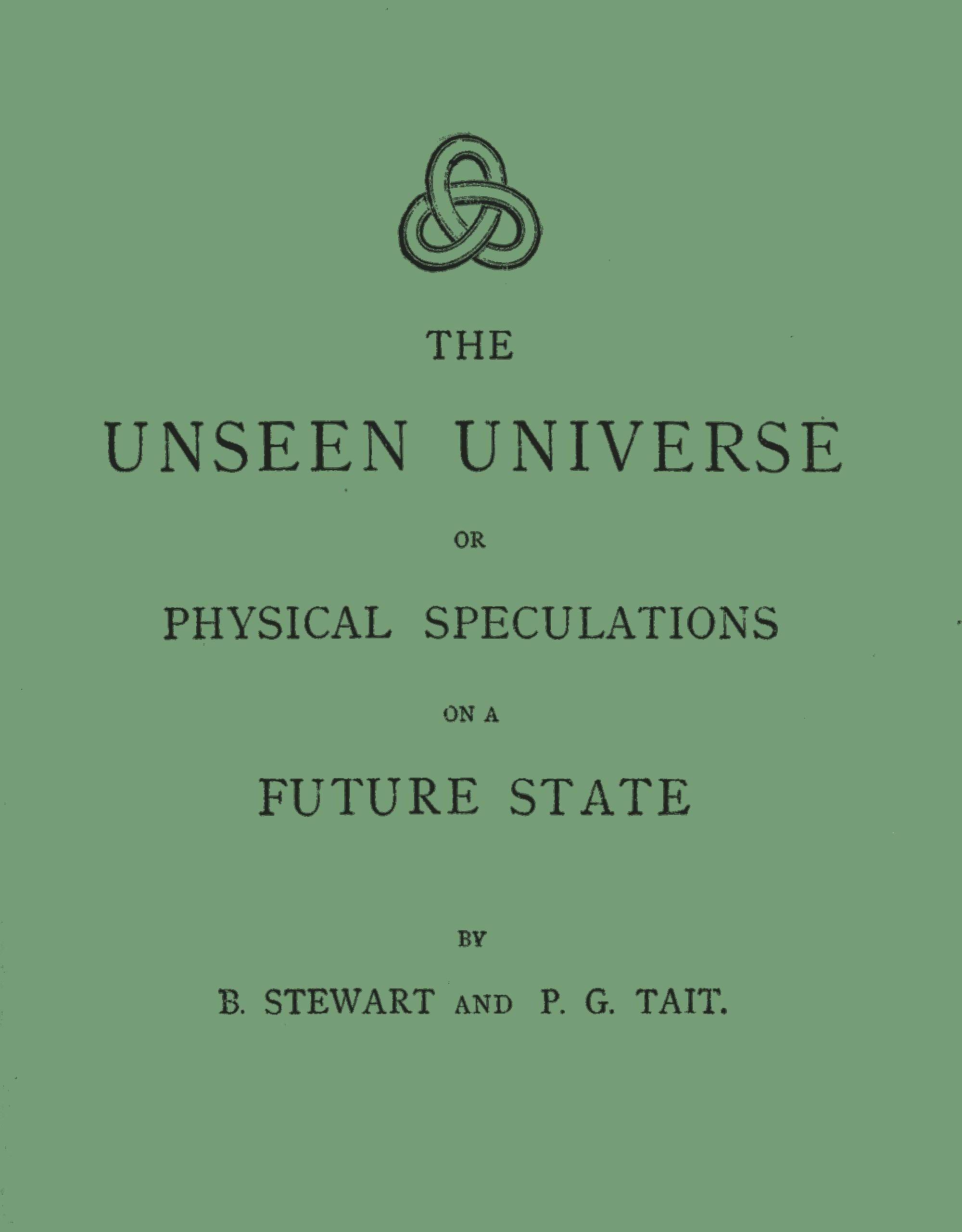
The Unseen Universe: Or, Physical Speculations on a Future State
1875
In 1875, two eminent Victorian scientists attempted something audacious: to prove the existence of heaven through physics. Balfour Stewart and P. G. Tait, a geophysicist and a mathematician, set out to demolish materialism not with theology but with thermodynamics, ether theory, and electromagnetic principles. They propose a Ptolemaic cosmos of concentric invisible universes surrounding our own, arguing that the soul survives death by transferring molecularly from the visible to the unseen realm through electromagnetic processes. The book traces afterlife beliefs across ancient Egypt, Greece, Buddhism, and Christianity before building its speculative case that science can justify immortality. What emerges is a peculiar time capsule of scientific ambition meeting existential dread, a Victorian attempt to garrison the boundaries of the afterlife with Newton's laws. The arguments are, of course, dated. The yearning is timeless.
Editions
Link to this book
Add a free, dofollow link to Lex on your blog, forum, syllabus, or reading list.

<a href="https://lex-books.com/book/the-unseen-universe-or-physical-speculations-on-a-future-state-3e72aa19-8a65-4c06-9c86-95e500cbf572"><img src="https://lex-books.com/badges/read-on-lex.svg" alt="Read The Unseen Universe: Or, Physical Speculations on a Future State by Balfour Stewart free on Lex" width="160" height="40"></a>[](https://lex-books.com/book/the-unseen-universe-or-physical-speculations-on-a-future-state-3e72aa19-8a65-4c06-9c86-95e500cbf572)[url=https://lex-books.com/book/the-unseen-universe-or-physical-speculations-on-a-future-state-3e72aa19-8a65-4c06-9c86-95e500cbf572][img]https://lex-books.com/badges/read-on-lex.svg[/img][/url]Read The Unseen Universe: Or, Physical Speculations on a Future State by Balfour Stewart free on Lex: https://lex-books.com/book/the-unseen-universe-or-physical-speculations-on-a-future-state-3e72aa19-8a65-4c06-9c86-95e500cbf572Cite this book
Reading this edition for a paper or guide? Copy a citation.
Stewart, Balfour. The Unseen Universe: Or, Physical Speculations on a Future State. Lex, lex-books.com/book/the-unseen-universe-or-physical-speculations-on-a-future-state-3e72aa19-8a65-4c06-9c86-95e500cbf572.Stewart, B. (1875). The Unseen Universe: Or, Physical Speculations on a Future State. Lex. https://lex-books.com/book/the-unseen-universe-or-physical-speculations-on-a-future-state-3e72aa19-8a65-4c06-9c86-95e500cbf572Stewart, Balfour. The Unseen Universe: Or, Physical Speculations on a Future State. Lex. https://lex-books.com/book/the-unseen-universe-or-physical-speculations-on-a-future-state-3e72aa19-8a65-4c06-9c86-95e500cbf572.