What would you like to read?Search books, authors, genres, shelves, users...
Search books, authors, genres, shelves, users...Search books, authors, genres, shelves, users...

What would you like to read?Search books, authors, genres, shelves, users...
Search books, authors, genres, shelves, users...Search books, authors, genres, shelves, users...
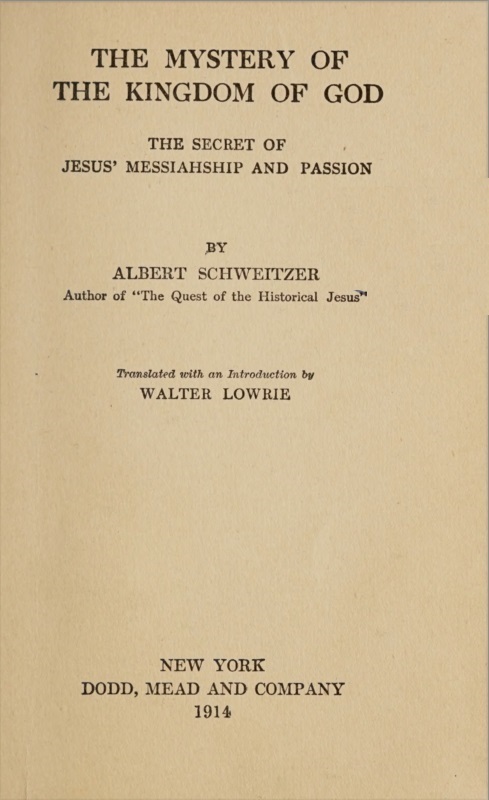
1914
Translated by Walter Lowrie
A scholarly theological treatise written in the early 20th century. The book likely explores new perspectives on the nature of Jesus’ messiahship, his passion (suffering and death), and the overarching idea of the Kingdom of God. Schweitzer questions and critiques the prevailing ''liberal'' and ''modern-historical'' interpretations of Jesus’ life, aiming instead to present an eschatological understanding rooted in both early Christian faith and the Synoptic Gospels. The beginning of this work sets out Schweitzer’s main argument: that traditional accounts of Jesus’ life become unclear when trying to explain why Jesus believed his own death was necessary and how he conceived of it as a redemptive act. He challenges the assumptions underlying the modern-historical approach, particularly the ideas that Jesus’ career had two distinct periods—success followed by failure—and that his understanding of the Passion was mainly shaped by early church doctrine (especially Pauline atonement concepts). Schweitzer contends instead that the secretive nature of Jesus’ messiahship, and the connection between his suffering and the coming of the Kingdom of God, require a fundamentally eschatological interpretation. The book’s opening critiques the inadequacies of contemporary scholarship and outlines the need for a new, more historically grounded approach that recognizes both the ethical teachings and the apocalyptic expectations at the heart of Jesus’ message.