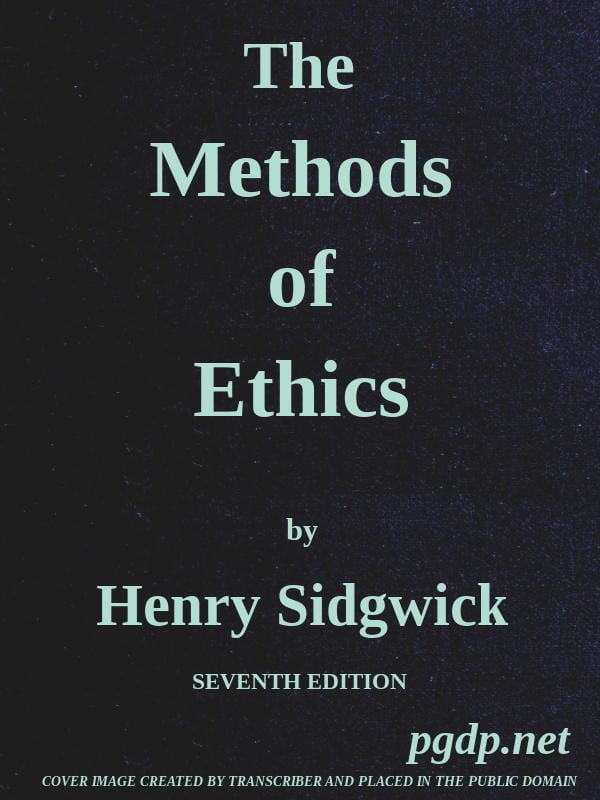
The Methods of Ethics
1874
The most rigorous defense of utilitarianism ever written, and still the benchmark against which all moral philosophy is measured. Sidgwick doesn't argue for a conclusion, he interrogates the very methods we use to reason about right and wrong. What emerges is a devastating clarity: three competing ethical frameworks (intuitionism, egoism, utilitarianism) examined with surgical precision, each held to the light of rational scrutiny. His landmark conclusion, that intuitionism and utilitarianism can coexist but egoism cannot be reconciled with the greater good, remains one of the most profound tensions in ethical thought. This is philosophy that refuses easy answers, demanding instead that readers confront the uncomfortable dualism at the heart of practical reasoning. For anyone who has ever wondered how they ought to live, Sidgwick offers not comfort, but clarity.
Editions
X-Ray
“The good of any one individual is of no more importance, from the point of view (if I may so say) of the Universe, than the good of any other; unless, that is, there are special grounds for believing that more good is likely to be realized in the one case than in the other.””
— Henry Sidgwick
“whereas the philosopher seeks unity of principle, and consistency of method at the risk of paradox, the unphilosophic man is apt to hold different principles at once, and to apply different methods in more or less confused combination.””
— Henry Sidgwick
“For we conceive it as the aim of a philosopher, as such, to do somewhat more than define and formulate the common normal opinions of mankind. His function is to tell men what they ought to think, rather than what they do think: he is expected to transcend Common Sense in his premises, and is allowed a certain divergence from Common Sense in his conclusions. It is true that the limits of this deviation are firmly, though indefinitely, fixed: the truth of a philosopher's premises will always be tested by the acceptability of his conclusions: if in any important point he be found in flagrant conflict with common opinion, his method is likely to be declared invalid. Still, though he is expected to establish and concatenate at least the main part of the commonly accepted moral rules, he is not necessarily bound to take them as the basis on which his own system is constructed. Rather, we should expect that the history of Moral Philosophy--so far at least as those whom we may call orthodox thinkers are concerned--would be a history of attempts to enunciate, in full breadth and clearness, those primary intuitions of Reason, by the scientific application of which the common moral thought of mankind may be at once systematized and corrected.””
— Henry Sidgwick
“Truthspeaking is only valuable as a means to the preservation of society: only if it be admitted that it is valuable on this ground I should say that it is implied that the preservation of society---or some further end to which this preservation, again, is a means---must be valuable per se, and therefore something at which a rational being, as such, ought to aim. If it be granted that we need not look beyond the preservation of society, the primary ‘dictate of reason' in this case would be ‘that society ought to be preserved': but reason would also dictate that truth ought to be spoken, so far as truthspeaking is recognised as the indispensable or fittest means to this end: and the notion “ought'' as used in either dictate is that which I have been trying to make clear.””
— Henry Sidgwick
Link to this book
Add a free, dofollow link to Lex on your blog, forum, syllabus, or reading list.

<a href="https://lex-books.com/book/the-methods-of-ethics-a9d67a52-5b56-4415-ac5d-71d5c6092ca5"><img src="https://lex-books.com/badges/read-on-lex.svg" alt="Read The Methods of Ethics by Henry Sidgwick free on Lex" width="160" height="40"></a>[](https://lex-books.com/book/the-methods-of-ethics-a9d67a52-5b56-4415-ac5d-71d5c6092ca5)[url=https://lex-books.com/book/the-methods-of-ethics-a9d67a52-5b56-4415-ac5d-71d5c6092ca5][img]https://lex-books.com/badges/read-on-lex.svg[/img][/url]Read The Methods of Ethics by Henry Sidgwick free on Lex: https://lex-books.com/book/the-methods-of-ethics-a9d67a52-5b56-4415-ac5d-71d5c6092ca5Cite this book
Reading this edition for a paper or guide? Copy a citation.
Sidgwick, Henry. The Methods of Ethics. Lex, lex-books.com/book/the-methods-of-ethics-a9d67a52-5b56-4415-ac5d-71d5c6092ca5.Sidgwick, H. (1874). The Methods of Ethics. Lex. https://lex-books.com/book/the-methods-of-ethics-a9d67a52-5b56-4415-ac5d-71d5c6092ca5Sidgwick, Henry. The Methods of Ethics. Lex. https://lex-books.com/book/the-methods-of-ethics-a9d67a52-5b56-4415-ac5d-71d5c6092ca5.