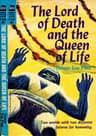
The Lord of Death and the Queen of Life
1965

What if humanity's origins lie not in a garden, but among the stars? This wild, visionary adventure from 1919 asks that question and then refuses to answer it neatly. Four scientists, traveling via reverse-magnetism (a concept so strange it might just work), embark on parallel journeys to two dead worlds. On Mercury, they discover a city of impossible machines and one survivor frozen in suspended animation: a man whose lust for power annihilated an entire civilization. On a glass-encased world threatened by the sun's radiation, they find an overpopulated society tearing itself apart, ruled by a queen who may be humanity's last hope. The narrative pulses with early 20th-century anxieties about evolution, empire, and civilizational collapse. Part two, 'The Queen of Life,' reads as surprisingly feminist for its era, offering a female leader as counterpoint to the male lord of death. This is speculative fiction at its most rollicking, premise-first form. Older than most science fiction readers' grandparents, yet asking questions about humanity's cosmic origins that still keep us up at night.
Editions
Link to this book
Add a free, dofollow link to Lex on your blog, forum, syllabus, or reading list.

<a href="https://lex-books.com/book/the-lord-of-death-and-the-queen-of-life-1e6828ef-e62c-4169-9e6f-9b87fb1d9415"><img src="https://lex-books.com/badges/read-on-lex.svg" alt="Read The Lord of Death and the Queen of Life by Homer Eon Flint free on Lex" width="160" height="40"></a>[](https://lex-books.com/book/the-lord-of-death-and-the-queen-of-life-1e6828ef-e62c-4169-9e6f-9b87fb1d9415)[url=https://lex-books.com/book/the-lord-of-death-and-the-queen-of-life-1e6828ef-e62c-4169-9e6f-9b87fb1d9415][img]https://lex-books.com/badges/read-on-lex.svg[/img][/url]Read The Lord of Death and the Queen of Life by Homer Eon Flint free on Lex: https://lex-books.com/book/the-lord-of-death-and-the-queen-of-life-1e6828ef-e62c-4169-9e6f-9b87fb1d9415Cite this book
Reading this edition for a paper or guide? Copy a citation.
Flint, Homer Eon. The Lord of Death and the Queen of Life. Lex, lex-books.com/book/the-lord-of-death-and-the-queen-of-life-1e6828ef-e62c-4169-9e6f-9b87fb1d9415.Flint, H. E. (1965). The Lord of Death and the Queen of Life. Lex. https://lex-books.com/book/the-lord-of-death-and-the-queen-of-life-1e6828ef-e62c-4169-9e6f-9b87fb1d9415Flint, Homer Eon. The Lord of Death and the Queen of Life. Lex. https://lex-books.com/book/the-lord-of-death-and-the-queen-of-life-1e6828ef-e62c-4169-9e6f-9b87fb1d9415.