The Guide for the Perplexed
1190
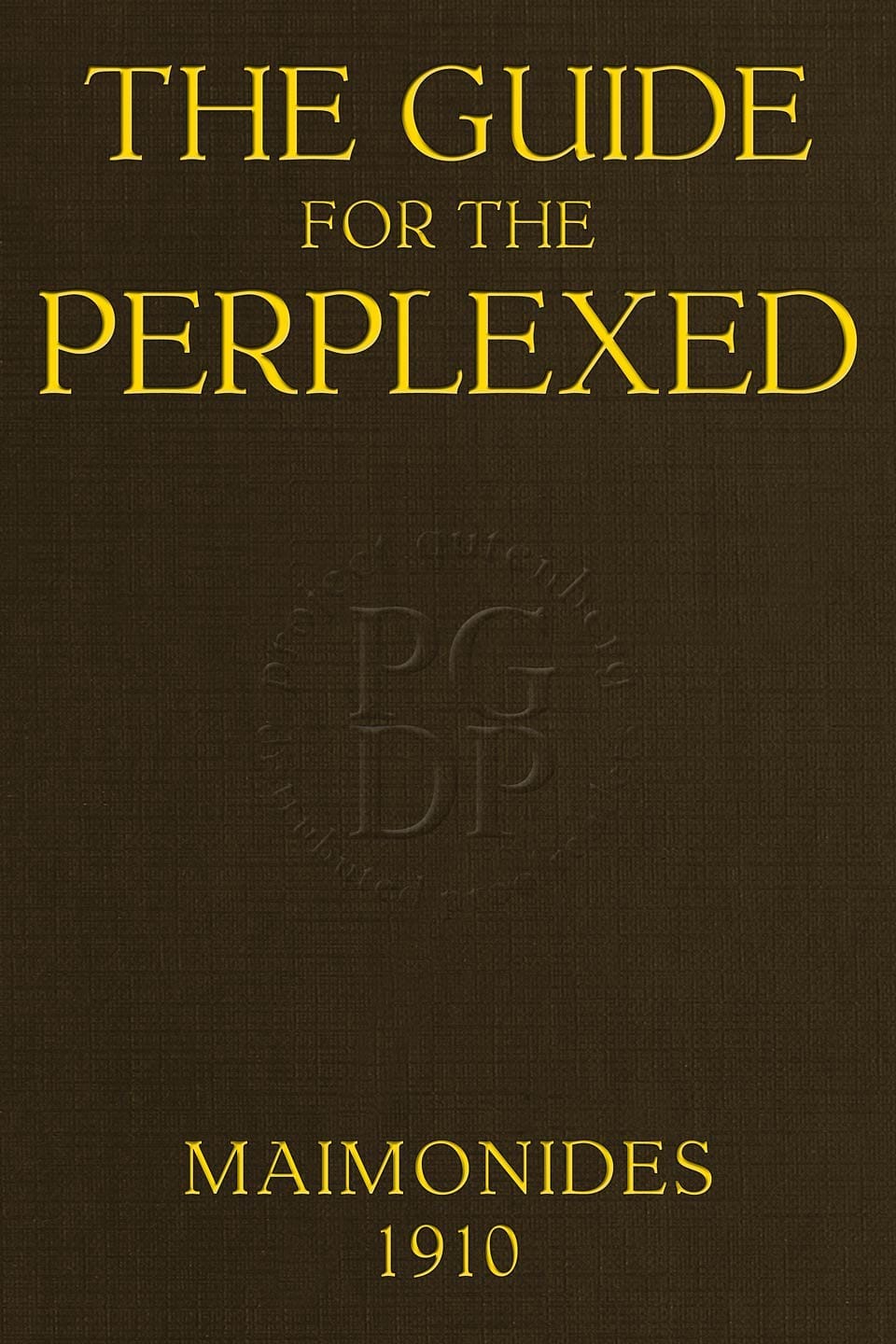
The Guide for the Perplexed
1190
Translated by M. (Michael) Friedländer
Moses Maimonides attempted something that still feels radical eight centuries later: he asked whether sacred text could survive rational inquiry, and answered yes. Written in Judeo-Arabic for a single perplexed student, the Guide for the Perplexed became the most influential work of medieval Jewish philosophy. Maimonides reads the Hebrew Bible through Aristotle's lens, arguing that scripture uses metaphor, that God's true nature exceeds human language, and that many Biblical narratives are not meant literally. He tackles prophecy, the problem of evil, and the limits of knowledge with relentless logic. The work caused immediate uproar. Some Jewish communities banned it; others secretly copied and circulated it. It shaped Christian Scholasticism, influenced Aquinas, and altered Islamic philosophical thought. Its central question never stopped being urgent: how does a person of faith live alongside reason?
Editions
X-Ray
“Truth does not become more true by virtue of the fact that the entire world agrees with it, nor less so even if the whole world disagrees with it.””
— Moses Maimonides
“We naturally like what we have been accustomed to, and are attracted towards it. [...] The same is the case with those opinions of man to which he has been accustomed from his youth; he likes them, defends them, and shuns the opposite views.””
— Moses Maimonides
“Your purpose...should always be to know...the whole that was intended to be known.””
— Moses Maimonides
“The risk of a wrong decision is preferable to the terror of indecision.””
— Moses Maimonides
“The person who wishes to attain human perfection should study logic first, next mathematics, then physics, and, lastly, metaphysics.””
— Moses Maimonides
“If God were corporeal, He would consist of atoms, and would not be one; or He would be comparable to other beings: but a comparison implies the existence of similar and of dissimilar elements, and God would thus not be one. A corporeal God would be finite, and an external power would be required to define those limits.””
— Moses Maimonides
“WHEN reading my present treatise, bear in mind that by "faith" we do not understand merely that which is uttered with the lips, but also that which is apprehended by the soul, the conviction that the object [of belief] is exactly as it is apprehended. If, as regards real or supposed truths, you content yourself with giving utterance to them in words, without apprehending them or believing in them, especially if you do not seek real truth, you have a very easy task as, in fact, you will find many ignorant people professing articles of faith without connecting any idea with them.””
— Moses Maimonides
“The passage, “And He rested on the seventh day” (Exod. xx. 11) is interpreted as follows: On the seventh Day the forces and laws were complete, which during the previous six days were in the state of being established for the preservation of the Universe. They were not to be increased or modified.””
— Moses Maimonides
“The definition of a thing includes its efficient cause; and since God is the Primal Cause, He cannot be defined, or described by a partial definition. A quality, whether psychical, physical, emotional, or quantitative, is always regarded as something distinct from its substratum;””
— Moses Maimonides
Link to this book
Add a free, dofollow link to Lex on your blog, forum, syllabus, or reading list.

<a href="https://lex-books.com/book/the-guide-for-the-perplexed-5c99fafb-26c8-4378-bfed-6897a052f492"><img src="https://lex-books.com/badges/read-on-lex.svg" alt="Read The Guide for the Perplexed by Moses Maimonides free on Lex" width="160" height="40"></a>[](https://lex-books.com/book/the-guide-for-the-perplexed-5c99fafb-26c8-4378-bfed-6897a052f492)[url=https://lex-books.com/book/the-guide-for-the-perplexed-5c99fafb-26c8-4378-bfed-6897a052f492][img]https://lex-books.com/badges/read-on-lex.svg[/img][/url]Read The Guide for the Perplexed by Moses Maimonides free on Lex: https://lex-books.com/book/the-guide-for-the-perplexed-5c99fafb-26c8-4378-bfed-6897a052f492Cite this book
Reading this edition for a paper or guide? Copy a citation.
Maimonides, Moses. The Guide for the Perplexed. Lex, lex-books.com/book/the-guide-for-the-perplexed-5c99fafb-26c8-4378-bfed-6897a052f492.Maimonides, M. (1190). The Guide for the Perplexed. Lex. https://lex-books.com/book/the-guide-for-the-perplexed-5c99fafb-26c8-4378-bfed-6897a052f492Maimonides, Moses. The Guide for the Perplexed. Lex. https://lex-books.com/book/the-guide-for-the-perplexed-5c99fafb-26c8-4378-bfed-6897a052f492.