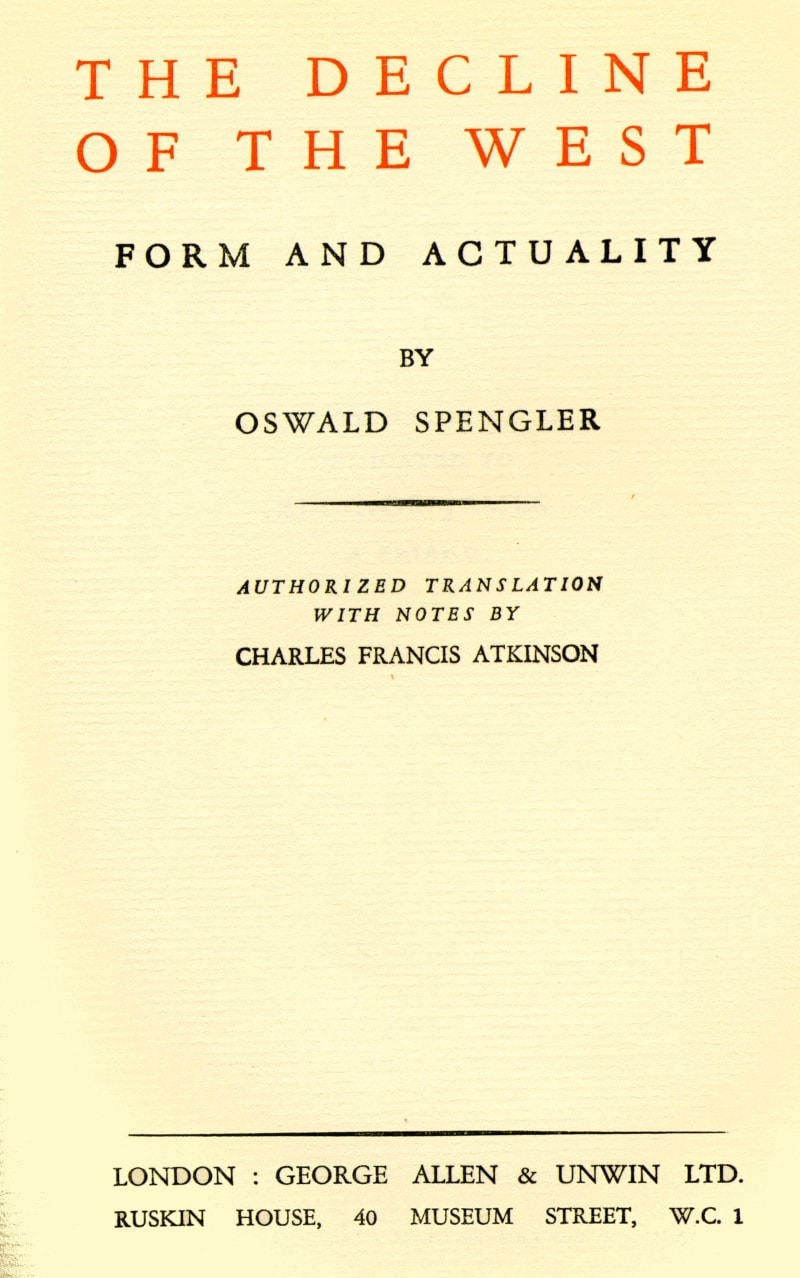
The Decline of the West: Volume 1, Form and Actuality
1918
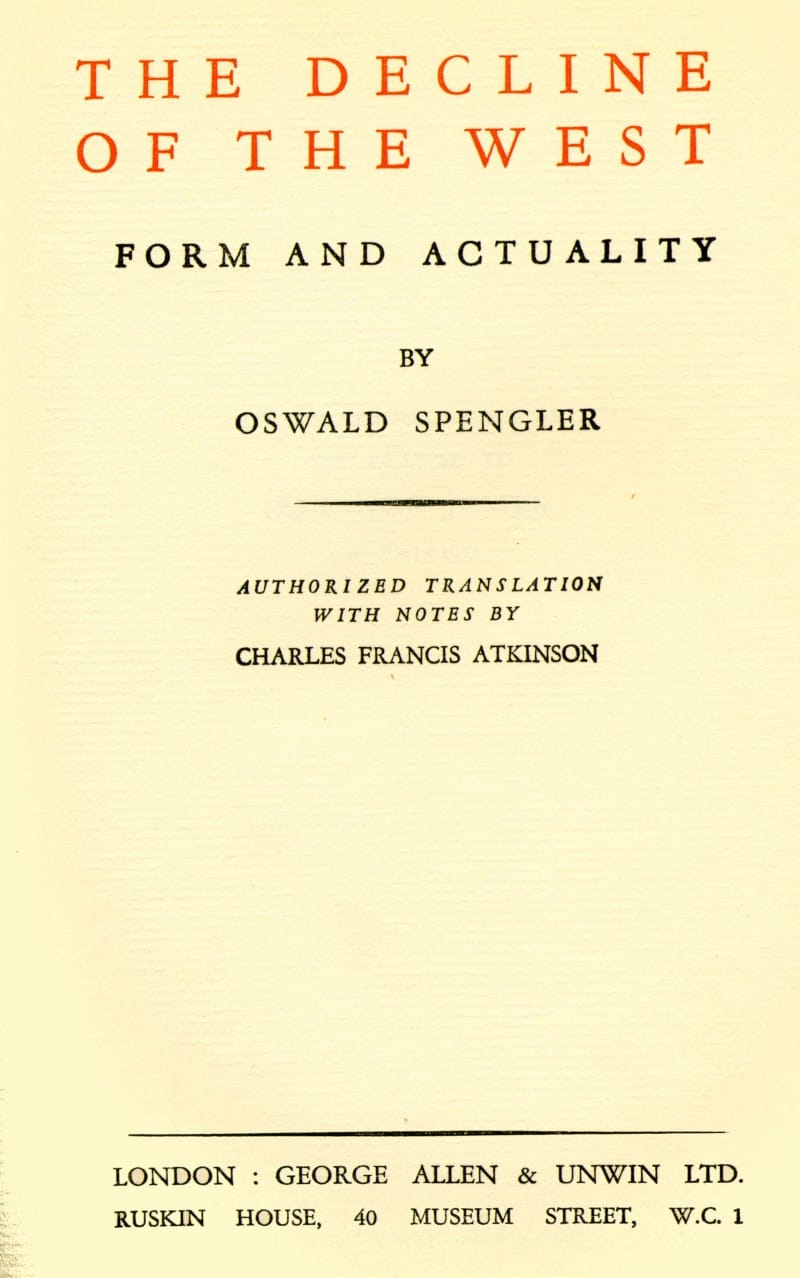
The Decline of the West: Volume 1, Form and Actuality
1918
Translated by Charles Francis Atkinson
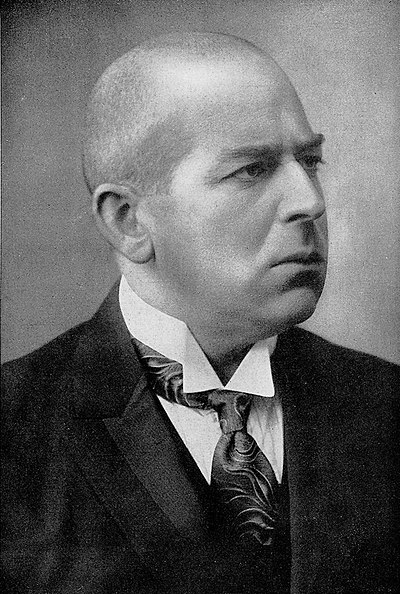
Oswald Spengler wrote this book in the shadow of World War I, and it reads like an autopsy performed while the patient still breathes. He argues that civilizations are not stories of linear progress but living organisms: they spring from specific landscapes, bloom into greatness, then wither as their creative energies exhaust themselves. Western culture, Spengler contends, has already entered its late phase, what he calls "winter," the age of "world-historical" exhaustion comparable to late antiquity. This is not melancholy prophecy but clinical diagnosis, drawn from exhaustive comparison with Egypt, Babylon, Rome, Greece, and other civilizations that rose before us. Rejecting the comfortable notion that history moves upward toward progress, Spengler offers a cyclical morphology: each culture passes through spring, summer, autumn, and winter. The book remains controversial, prophetic to some, dangerously seductive to others. What cannot be denied is its staggering ambition, a complete theory of how civilizations are born, flourish, and die, written by a man who watched his own world tear itself apart.
Editions
X-Ray
“The press today is an army with carefully organized weapons, the journalists its officers, the readers its soldiers. The reader neither knows nor is supposed to know the purposes for which he is used and the role he is to play.””
— Oswald Spengler
“Through money, democracy becomes its own destroyer, after money has destroyed intellect.””
— Oswald Spengler
“There is no proletarian, not even a Communist movement, that has not operated in the interests of money, and for the time being permitted by money - and that without the idealists among its leaders having the slightest suspicion of the fact.””
— Oswald Spengler
“Long ago the country bore the country-town and nourished it with her best blood. Now the giant city sucks the country dry, insatiably and incessantly demanding and devouring fresh streams of men, till it wearies and dies in the midst of an almost uninhabited waste of country.””
— Oswald Spengler
“Every Socialist outbreak only blazes new paths for Capitalism.””
— Oswald Spengler
“You are dying. I see in you all the characteristic stigma of decay. I can prove to you that your great wealth and your great poverty, your capitalism and your socialism, your wars and your revolutions, your atheism and your pessimism and your cynicism, your immorality, your broken-down marriages, your birth-control, that is bleeding you from the bottom and killing you off at the top in your brains”
— Oswald Spengler
“At the beginning a man was wealthy because he was powerful”
— Oswald Spengler
“World-history is the history of the great Cultures, and peoples are but the symbolic forms and vessels in which the men of these Cultures fulfil their Destinies.””
— Oswald Spengler
“In place of a true-type people, born of and grown on the soil, there is a new sort of nomad, cohering unstably in fluid masses, the parasitical city dweller, traditionless, utterly matter-of-fact, religionless, clever, unfruitful, deeply contemptuous of the countryman and especially that highest form of countryman, the country gentleman...””
— Oswald Spengler
Link to this book
Add a free, dofollow link to Lex on your blog, forum, syllabus, or reading list.

<a href="https://lex-books.com/book/the-decline-of-the-west-volume-1-form-and-actuality-f5abf000-fc60-4d38-8aa1-76f41e4915e6"><img src="https://lex-books.com/badges/read-on-lex.svg" alt="Read The Decline of the West: Volume 1, Form and Actuality by Oswald Spengler free on Lex" width="160" height="40"></a>[](https://lex-books.com/book/the-decline-of-the-west-volume-1-form-and-actuality-f5abf000-fc60-4d38-8aa1-76f41e4915e6)[url=https://lex-books.com/book/the-decline-of-the-west-volume-1-form-and-actuality-f5abf000-fc60-4d38-8aa1-76f41e4915e6][img]https://lex-books.com/badges/read-on-lex.svg[/img][/url]Read The Decline of the West: Volume 1, Form and Actuality by Oswald Spengler free on Lex: https://lex-books.com/book/the-decline-of-the-west-volume-1-form-and-actuality-f5abf000-fc60-4d38-8aa1-76f41e4915e6Cite this book
Reading this edition for a paper or guide? Copy a citation.
Spengler, Oswald. The Decline of the West: Volume 1, Form and Actuality. Lex, lex-books.com/book/the-decline-of-the-west-volume-1-form-and-actuality-f5abf000-fc60-4d38-8aa1-76f41e4915e6.Spengler, O. (1918). The Decline of the West: Volume 1, Form and Actuality. Lex. https://lex-books.com/book/the-decline-of-the-west-volume-1-form-and-actuality-f5abf000-fc60-4d38-8aa1-76f41e4915e6Spengler, Oswald. The Decline of the West: Volume 1, Form and Actuality. Lex. https://lex-books.com/book/the-decline-of-the-west-volume-1-form-and-actuality-f5abf000-fc60-4d38-8aa1-76f41e4915e6.