The Colour Out of Space
1927
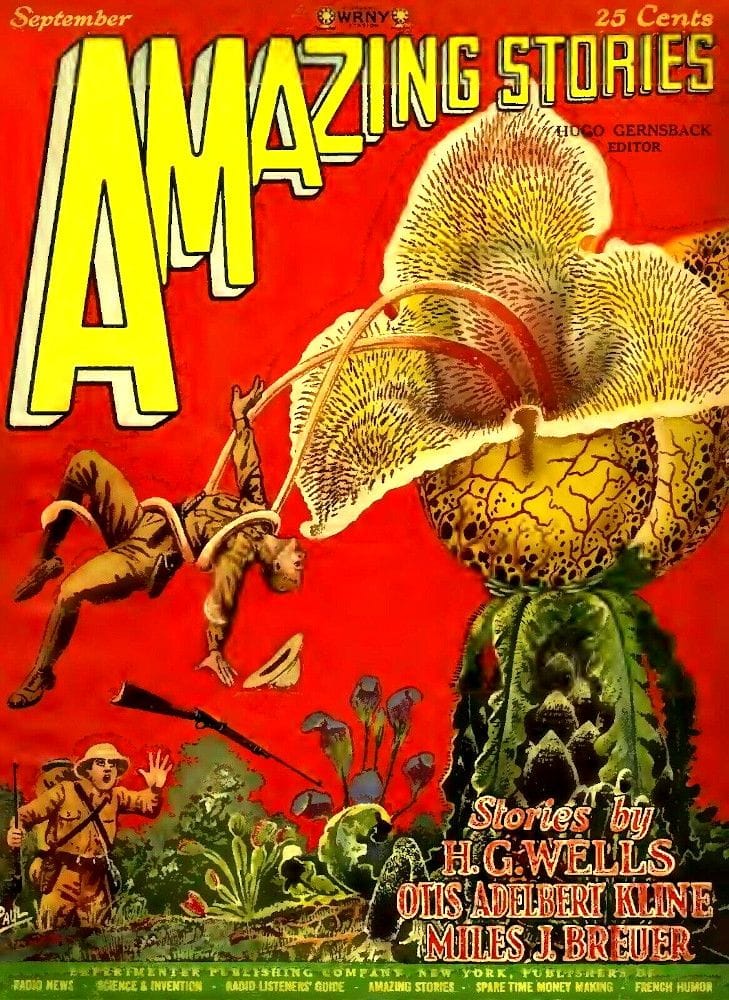
The last thing Nahum Gardner sees before his mind shatters is a colour that should not exist. In the rolling hills west of Arkham, a meteorite crashes onto his farm, and with it comes something that defies every law of nature and human comprehension. The stone is not a stone. The colour is not a colour. It is a presence, an intelligence, a hunger that seeps into the soil and corrupts everything it touches: crops swell into grotesque, poisonous masses, livestock birthing horrors, and the Gardner family slowly descending into madness, one by one. An unnamed narrator years later pieces together what happened from frightened locals and a dying surveyor, drawn to the blasted heath to witness its alien, unforgettable stench and the sky's wrongness above it. Lovecraft's personal favorite among his stories represents his purest attempt at the truly alien: not a monster, not a ghost, not a demon in familiar guise, but something whose nature human language cannot capture. The colour itself cannot be seen by human eyes as colour, cannot be named, cannot be understood. It simply is, and it consumes. What remains is a New England farm turned wasteland, a family erased, and an implication that the universe contains forces indifferent to human existence, not malicious but utterly incomprehensible. This is cosmic horror at its most elegant and most terrifying.
Editions
X-Ray
“It was a scene from a vision of Fuseli, and over all the rest reigned that riot of luminous amorphousness, that alien and undimensioned rainbow of cryptic poison from the well”
— H. P. Lovecraft
“It was nothing of this earth, but a piece of the great outside; and as such dowered with outside properties and obedient to outside laws.””
— H. P. Lovecraft
“West of Arkham the hills rise wildand there are valleys with deep woods that no ax has ever cut.There are dark, narrow glens where the trees slope fantastically,where thin brooklets trickle without ever having caught the glimpse of sunlight.””
— H. P. Lovecraft
“The trees budded prematurely around Nahum’s, and at night they swayed ominously in the wind. Nahum’s second son Thaddeus, a lad of fifteen, swore that they swayed also when there was no wind; but even the gossips would not credit this.””
— H. P. Lovecraft
Link to this book
Add a free, dofollow link to Lex on your blog, forum, syllabus, or reading list.

<a href="https://lex-books.com/book/the-colour-out-of-space-70eba3af-b1c3-4451-8c2d-88d6da8d2b42"><img src="https://lex-books.com/badges/read-on-lex.svg" alt="Read The Colour Out of Space by H. P. Lovecraft free on Lex" width="160" height="40"></a>[](https://lex-books.com/book/the-colour-out-of-space-70eba3af-b1c3-4451-8c2d-88d6da8d2b42)[url=https://lex-books.com/book/the-colour-out-of-space-70eba3af-b1c3-4451-8c2d-88d6da8d2b42][img]https://lex-books.com/badges/read-on-lex.svg[/img][/url]Read The Colour Out of Space by H. P. Lovecraft free on Lex: https://lex-books.com/book/the-colour-out-of-space-70eba3af-b1c3-4451-8c2d-88d6da8d2b42Cite this book
Reading this edition for a paper or guide? Copy a citation.
Lovecraft, H. P.. The Colour Out of Space. Lex, lex-books.com/book/the-colour-out-of-space-70eba3af-b1c3-4451-8c2d-88d6da8d2b42.Lovecraft, H. P. (1927). The Colour Out of Space. Lex. https://lex-books.com/book/the-colour-out-of-space-70eba3af-b1c3-4451-8c2d-88d6da8d2b42Lovecraft, H. P.. The Colour Out of Space. Lex. https://lex-books.com/book/the-colour-out-of-space-70eba3af-b1c3-4451-8c2d-88d6da8d2b42.




![Night Watches [complete]](/_next/image?url=https%3A%2F%2Fd3b2n8gj62qnwr.cloudfront.net%2FCOVERS%2Fgutenberg_covers75k%2Febook-12161.png&w=3840&q=75)