The Christ: A Critical Review and Analysis of the Evidences of His Existence
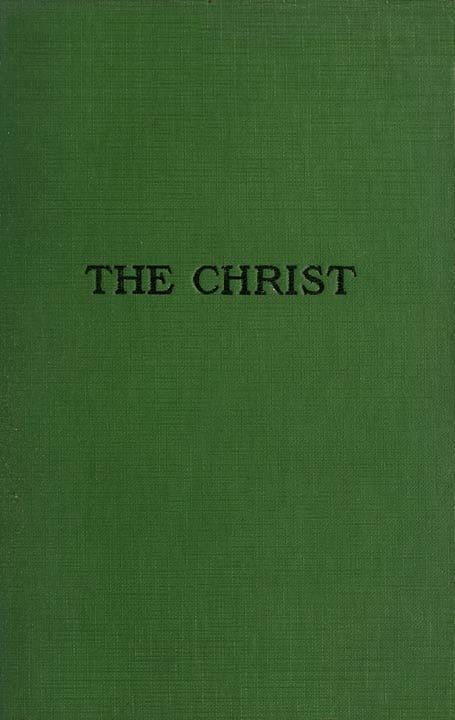
The Christ: A Critical Review and Analysis of the Evidences of His Existence
This is one of the foundational texts of freethought and biblical criticism, written when a writer could lose his reputation, his community, even his livelihood for asking these questions. Remsburg brings the tools of 19th-century historical scholarship to the most consequential claim in Western civilization: that a man named Jesus was also the divine Christ, born of a virgin, worker of miracles, resurrected and ascended to heaven. With meticulous attention to the New Testament texts, the sparse contemporary pagan sources, and the writings of early Christian apologists, Remsburg finds something startling: the absence of robust historical documentation, glaring discrepancies between the gospel accounts, and a Christ figure that bears the unmistakable imprint of Greek, Roman, and Eastern mythological traditions. His conclusion is careful and devastating: a historical Jesus may have existed, but the supernatural Christ of Christian doctrine is a construction, built over centuries by believers drawing on ancient myths. This book remains essential reading for anyone curious about the intellectual foundations of Christianity and the audacious act of subjecting faith to reason.
Editions
X-Ray
“To Judaism Christians ascribe the glory of having been the first religion to teach a pure monotheism. But monotheism existed long before the Jews attained to it. Zoroaster and his earliest followers were monotheists, dualism being a later development of the Persian theology. The adoption of monotheism by the Jews, which occurred only at a very late period in their history, was not, however, the result of a divine revelation, or even of an intellectual superiority, for the Jews were immeasurably inferior intellectually to the Greeks and Romans, to the Hindus and Egyptians, and to the Assyrians and Babylonians, who are supposed to have retained a belief in polytheism. This monotheism of the Jews has chiefly the result of a religious intolerance never before equaled and never since surpassed, except in the history of Christianity and Mohammedanism, the daughters of Judaism. Jehovistic priests and kings tolerated no rivals of their god and made death the penalty for disloyalty to him. The Jewish nation became monotheistic for the same reason that Spain, in the clutches of the Inquisition, became entirely Christian.””
— John E. Remsburg
“That the writers of the Bible recognized a plurality of gods -- were polytheists -- is proved by the following 'And the Lord God said, Behold, the man is become as one of us' (Gen. iii, 22). 'Who is like unto thee, O Lord, among the gods?' (Ex. xv, 11.) 'Among the gods, there is none like unto thee, O Lord' (Ps. Ixxxvi, 8). 'The Lord is a great God, and a great king above all gods' (Ps. xcv, 3). 'Thou shalt not revile the gods' (Ex. xxii, 28).Monotheism, the doctrine of one god, is not merely the worship of one god, but the belief in the existence of one god only. Many were monotheistic in worship -- worshiped one god, their national deity -- while at the same time they were polytheistic in belief -- believed in the existence of many gods. The Jews who worshiped Jehovah have been called monotheists. And yet, for a thousand years, they believed in the existence of Kemosh, Baal, Moloch, Tammuz, and other deities. They believed that Jehovah was their national god and that they owed allegiance to him; just as the subjects of an earthly king profess their loyalty to him without denying the existence of other kings.””
— John E. Remsburg
“There is one element in Christianity which was not borrowed from Paganism -- religious intolerance. Referring to Buddhism, Confucianism, and Taoism, a writer on China says: 'Between the followers of the three national religions there is not only a total absence of persecution and bitter feeling, but a very great indifference as to which of them a man may belong.... Among the politer classes, when strangers meet, the question is asked: 'To what sublime religion do you belong,' and each one pronounces a eulogium, not on his own religion, but on that professed by the others, and concludes with the oft-repeated formula 'Religions are many; reason is one; we are all brothers.””
— John E. Remsburg
“The supernatural Christ of the New Testament, the god of orthodox Christianity, is dead. But priestcraft lives and conjures up the ghost of this dead god to frighten and enslave the masses of mankind. The name of Christ has caused more persecutions, wars, and miseries than any other name has caused. The darkest wrongs are still inspired by it. The wails of anguish that went up from Kishinev, Odessa, and Bialystok still vibrate in our ears.””
— John E. Remsburg
“This doctrine of forgiveness of sin is a premium on crime. 'Forgive us our sins' means "Let us continue in our iniquity." It is one of the most pernicious of doctrines, and one of the most fruitful sources of immorality. It has been the chief cause of making Christian nations the most immoral of nations. In teaching this doctrine Christ committed a sin for which his death did not atone, and which can never be forgiven. There is no forgiveness of sin. Every cause has its effect; every sinner must suffer the consequences of his sins.””
— John E. Remsburg
Link to this book
Add a free, dofollow link to Lex on your blog, forum, syllabus, or reading list.

<a href="https://lex-books.com/book/the-christ-a-critical-review-and-analysis-of-the-evidences-of-his-existence-da9d9ad7-9395-4857-9c4e-bce59cc4b61b"><img src="https://lex-books.com/badges/read-on-lex.svg" alt="Read The Christ: A Critical Review and Analysis of the Evidences of His Existence by John E. Remsburg free on Lex" width="160" height="40"></a>[](https://lex-books.com/book/the-christ-a-critical-review-and-analysis-of-the-evidences-of-his-existence-da9d9ad7-9395-4857-9c4e-bce59cc4b61b)[url=https://lex-books.com/book/the-christ-a-critical-review-and-analysis-of-the-evidences-of-his-existence-da9d9ad7-9395-4857-9c4e-bce59cc4b61b][img]https://lex-books.com/badges/read-on-lex.svg[/img][/url]Read The Christ: A Critical Review and Analysis of the Evidences of His Existence by John E. Remsburg free on Lex: https://lex-books.com/book/the-christ-a-critical-review-and-analysis-of-the-evidences-of-his-existence-da9d9ad7-9395-4857-9c4e-bce59cc4b61bCite this book
Reading this edition for a paper or guide? Copy a citation.
Remsburg, John E.. The Christ: A Critical Review and Analysis of the Evidences of His Existence. Lex, lex-books.com/book/the-christ-a-critical-review-and-analysis-of-the-evidences-of-his-existence-da9d9ad7-9395-4857-9c4e-bce59cc4b61b.Remsburg, J. E. (n.d.). The Christ: A Critical Review and Analysis of the Evidences of His Existence. Lex. https://lex-books.com/book/the-christ-a-critical-review-and-analysis-of-the-evidences-of-his-existence-da9d9ad7-9395-4857-9c4e-bce59cc4b61bRemsburg, John E.. The Christ: A Critical Review and Analysis of the Evidences of His Existence. Lex. https://lex-books.com/book/the-christ-a-critical-review-and-analysis-of-the-evidences-of-his-existence-da9d9ad7-9395-4857-9c4e-bce59cc4b61b.