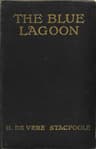
The Blue Lagoon: A Romance
1908

A ship burns at sea. Two children are set adrift in a small boat. This is how Emmeline and Dick Lestrange arrive at Palm Tree Island, a paradise so lush and isolated it feels like the garden before the fall. For five years, they live alone with only the jungle, the lagoon, and Paddy Button, a weathered sailor who raises them and then drinks himself to death. The children's world is one of perfect innocence: they know nothing of sex, death, or the civilization waiting beyond the horizon. When they discover each other as teenagers, it's not with knowledge but with instinct. A child is born. Then, just as suddenly as they arrived, they're found and dragged back to a world they no longer recognize. The Blue Lagoon has the strange power of a fairy tale that refuses to stay gentle. Stacpoole writes about innocence with an urgency that feels almost pagan, asking what we truly are before society teaches us otherwise. It endures because it captures the impossible: that moment before everything changes, and how we can never return.
Editions

X-Ray
“A great sea fog is not homogenous--its density varies: it is honeycombed with streets, it has its caves of clear air, its cliffs of solid vapour, all shifting and changing place with the subtlety of legerdemain.””
— H. De Vere Stacpoole
“The moon rose up that evening and shot her silver arrows at the house under the artu tree. The house was empty. Then the moon came across the sea and across the reef. She lit the lagoon to it's dark, dim heart. She lit the coral brains and sand spaces, and the fish casting their shadows on the sand and the coral. The keeper of the lagoon rose to greet her, and the fin of him broke her reflection on the mirror-like surface into a thousand glittering ripples. She saw the white staring ribs of the form on the reef. Then, peeping over the trees, she looked down into the valley, where the great stone idol had kept it's solitary vigil for five thousand years, perhaps, and more.At this base, in his shadow, looking as if under his protection, lay two human beings, naked, clasped in each other's arms and fast asleep. One could scarcely pity his vigil, had it been marked sometimes through the years by such an incident as this. The thing had been conducted just as the birds conduct their love affairs. An affair absolutely natural, absolutely blameless and without sin. A marriage according to Nature, without feasts or guests, consummated with accidental cynicism under the shadow of a religion a thousand years dead.””
— H. De Vere Stacpoole
“...the thoughts we think inchildhood, Captain, are the fathers of the thoughts we think when weare grown up.””
— H. De Vere Stacpoole
“When we have learnt to call storms, storms, and death, death, and birth, birth, when we have mastered the sailor's horn-book and Mr Piddington's law of cyclones, Ellis's anatomy and Lewer's midwifery, we have already made ourself half blind. We have become hypnotized by words and names. We think in words and names, not in ideas; the commonplace has triumphed, the true intellect is half crushed.””
— H. De Vere Stacpoole
“Memory cannot produce a picture that Imagination has not retouched; and her pictures, even the ones least touched by Imagination, are no mere photographs, but the world of an artist.””
— H. De Vere Stacpoole
“It is a rare experience for a man to hold a tame and unstruggling and unfrightened bird in his hands; next to pressing a woman in his arms, it is the pleasantest tactile sensation he will ever experience, perhaps, in life. He will feel a desire to press it to his heart, if he has such a thing.””
— H. De Vere Stacpoole
“Nowhere in the world, perhaps, so well as here, could you appreciate Nature’s splendid indifference to the great affairs of Man.””
— H. De Vere Stacpoole
“When I was quite a child,” went on Lestrange, “a child no older than Dicky, my nurse used to terrify me with tales about dead people. I was told I’d go to hell when I died if I wasn’t a good child. I cannot tell you how much that has poisoned my life, for the thoughts we think in childhood, Captain, are the fathers of the thoughts we think when we are grown up. And can a diseased father”
— H. De Vere Stacpoole
“Le Farge came aft, on to the poop, and stood for a moment looking over the sea on the port side, where a bank of fog had suddenly appeared””
— H. De Vere Stacpoole
Link to this book
Add a free, dofollow link to Lex on your blog, forum, syllabus, or reading list.

<a href="https://lex-books.com/book/the-blue-lagoon-a-romance-f0a71512-f509-48e1-89dc-b611abd2e376"><img src="https://lex-books.com/badges/read-on-lex.svg" alt="Read The Blue Lagoon: A Romance by H. De Vere Stacpoole free on Lex" width="160" height="40"></a>[](https://lex-books.com/book/the-blue-lagoon-a-romance-f0a71512-f509-48e1-89dc-b611abd2e376)[url=https://lex-books.com/book/the-blue-lagoon-a-romance-f0a71512-f509-48e1-89dc-b611abd2e376][img]https://lex-books.com/badges/read-on-lex.svg[/img][/url]Read The Blue Lagoon: A Romance by H. De Vere Stacpoole free on Lex: https://lex-books.com/book/the-blue-lagoon-a-romance-f0a71512-f509-48e1-89dc-b611abd2e376Cite this book
Reading this edition for a paper or guide? Copy a citation.
Stacpoole, H. De Vere. The Blue Lagoon: A Romance. Lex, lex-books.com/book/the-blue-lagoon-a-romance-f0a71512-f509-48e1-89dc-b611abd2e376.Stacpoole, H. D. V. (1908). The Blue Lagoon: A Romance. Lex. https://lex-books.com/book/the-blue-lagoon-a-romance-f0a71512-f509-48e1-89dc-b611abd2e376Stacpoole, H. De Vere. The Blue Lagoon: A Romance. Lex. https://lex-books.com/book/the-blue-lagoon-a-romance-f0a71512-f509-48e1-89dc-b611abd2e376.