The Advancement of Learning
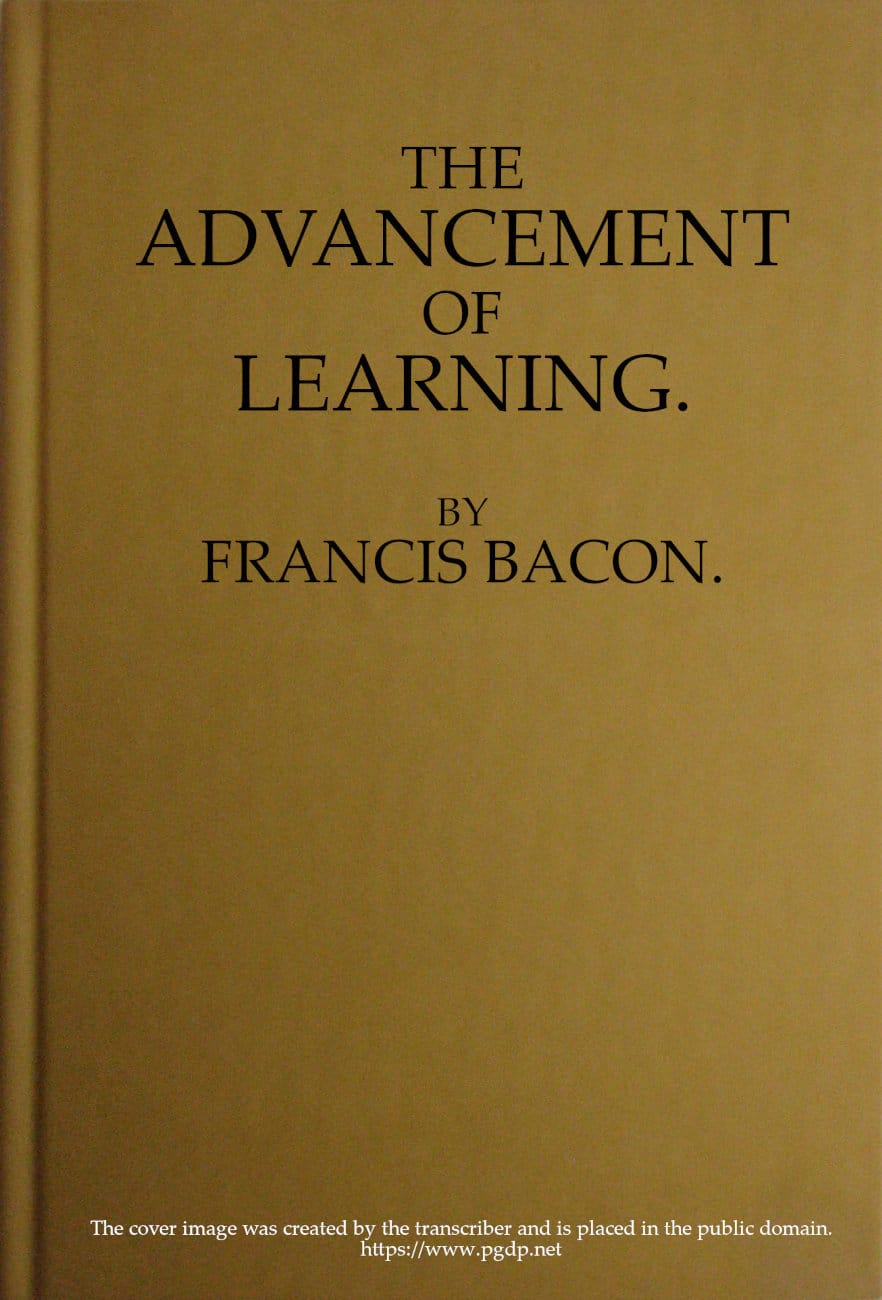
The Advancement of Learning
In 1605, a world still trapped in Aristotelian certainties received a dangerous proposition: that knowledge begins not with received wisdom, but with careful observation of the world itself. Francis Bacon's radical treatise argues that the learning of his time had become a sterile exercise in quote-mining ancient authorities, producing endless controversies that improved nothing. He calls for nothing less than the reformation of the human understanding. Bacon divides knowledge into history, poetry, and philosophy, then systematically dismantles the pretensions of each, arguing that true learning must be active, experimental, and aimed at the improvement of human life. The work that introduced and popularized the scientific method of observation, skepticism, and testability remains a foundational document in the emergence of modern thought. It is essential reading for anyone who wants to understand where our empirical tradition came from, and why the ancient habit of deferring to authorities still wars with the Baconian impulse to look and see for oneself.
Editions
X-Ray
“If a man will begin with certainties, he shall end in doubts; but if he will be content to begin with doubts, he shall end in certainties.””
— Francis Bacon
“To conclude, therefore, let no man upon a weak conceit of sobriety or an ill-applied moderation think or maintain that a man can search too far, or be too well studied in the book of God's word, or the book of God's works, divinity or philosophy; but rather let men endeavor an endless progress or proficience in both; only let men beware that they apply both to charity, and not to swelling; to use, and not to ostentation; and again, that they do not unwisely mingle or confound these learnings together.””
— Francis Bacon
“They are ill discoverers that think there is no land, when they can see nothing but sea.””
— Francis Bacon
“Nay, the same Solomon the king, although he excelled in the glory of treasure and magnificent buildings, of shipping and navigation, of service and attendance, of fame and renown, and the like, yet he maketh no claim to any of those glories, but only to the glory of inquisition of truth; for so he saith expressly, "The glory of God is to conceal a thing, but the glory of the king is to find it out;" as if, according to the innocent play of children, the Divine Majesty took delight to hide His works, to the end to have them found out; and as if kings could not obtain a greater honour than to be God's playfellows in that game””
— Francis Bacon
“The poets did well to conjoin music and medicine, in Apollo, because the office of medicine is but to tune the curious harp of man's body and reduce it to harmony.””
— Francis Bacon
“For the unlearned man knows not what it is to descend into himself, or to call himself to account, nor the pleasure of that suavissima vita, indies sentire se fieri meliorem. ””
— Francis Bacon
“So if any man think philosophy and universality to be idle studies, he doth not consider that all professions are from thence served and supplied. And this I take to be a great cause that hath hindered the progression of learning, because these fundamental knowledges have been studied but in passage. ””
— Francis Bacon
“And yet surely to alchemy this right is due, that it may be compared to the husbandman whereof makes the fable, that when he died he told his sons that he had left unto them gold buried under the ground in his vineyard: and they digged over the ground, gold they found none, but by reason of their stirring and digging the mould about the roots of their vines, they had a great vintage the year following: so assuredly the search and stir to make gold hath brought to light a great number of good and fruitful inventions and experiments, as well for the disclosing of nature as for the use of man's life.””
— Francis Bacon
“Tot astfel în ce privește mântuirea: alegerea și planul trimit la Tatăl, actul propriu-zis și săvârșirea sa [trimit] la Fiul, iar realizarea la Sfântul Duh; căci prin Sfântul Duh S-a întrupat Cristos și prin Sfântul Duh renasc spiritual aleșii.””
— Francis Bacon
Link to this book
Add a free, dofollow link to Lex on your blog, forum, syllabus, or reading list.

<a href="https://lex-books.com/book/the-advancement-of-learning-215258d1-13e1-4dca-bb71-82b47c12b39d"><img src="https://lex-books.com/badges/read-on-lex.svg" alt="Read The Advancement of Learning by Francis Bacon free on Lex" width="160" height="40"></a>[](https://lex-books.com/book/the-advancement-of-learning-215258d1-13e1-4dca-bb71-82b47c12b39d)[url=https://lex-books.com/book/the-advancement-of-learning-215258d1-13e1-4dca-bb71-82b47c12b39d][img]https://lex-books.com/badges/read-on-lex.svg[/img][/url]Read The Advancement of Learning by Francis Bacon free on Lex: https://lex-books.com/book/the-advancement-of-learning-215258d1-13e1-4dca-bb71-82b47c12b39dCite this book
Reading this edition for a paper or guide? Copy a citation.
Bacon, Francis. The Advancement of Learning. Lex, lex-books.com/book/the-advancement-of-learning-215258d1-13e1-4dca-bb71-82b47c12b39d.Bacon, F. (n.d.). The Advancement of Learning. Lex. https://lex-books.com/book/the-advancement-of-learning-215258d1-13e1-4dca-bb71-82b47c12b39dBacon, Francis. The Advancement of Learning. Lex. https://lex-books.com/book/the-advancement-of-learning-215258d1-13e1-4dca-bb71-82b47c12b39d.