Of Gardens: An Essay
1625
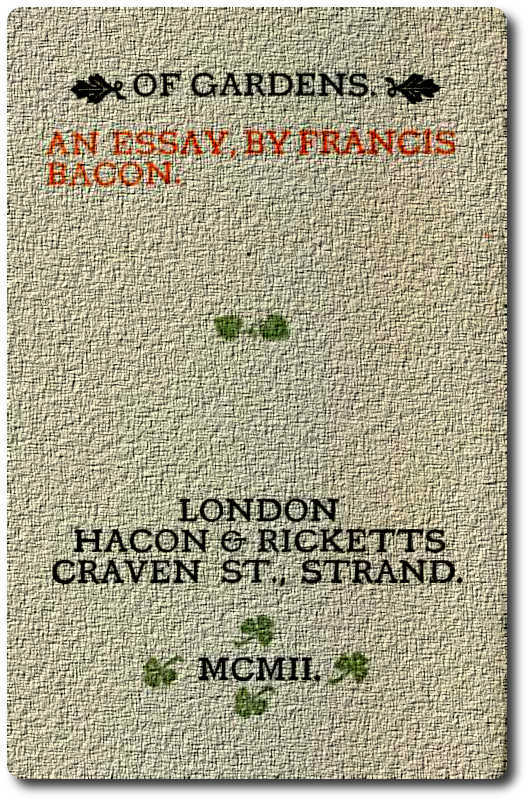
Francis Bacon, the father of empiricism and the man who declared knowledge to be power, turns his precise and restless mind to something unexpectedly tender: the art of gardens. Written in 1625, this elegant essay distills a lifetime of observation into a vision of the ideal garden as both designed space and spiritual refuge. Bacon presc ribes layouts with the rigor of a scientist arranging an experiment, yet his true subject transcends horticulture. He writes of gardens as earthly paradises, places where human intention meets wildness, where fountains cool the air and flowers bloom in careful succession through the seasons. The green entrance, the scented myrtle, the distant heath, the murmuring water: each element serves both eye and spirit. Bacon argues that of all human pleasures, the garden is the most wholesome and refreshing, a place where civilization's cares dissolve into the ordered beauty of growing things. Nearly four centuries later, the essay endures because the longing it describes has not faded. We still seek green sanctuaries. We still believe that the right arrangement of trees and flowers can restore what modern life erodes. For anyone who tends a plot of earth, dreams of one, or simply believes that cultivated beauty matters.
Editions
X-Ray
“For better it is to make a beginning of that which may lead to something, than to engage in a perpetual struggle and pursuit in courses which have no exit.””
— Francis Bacon
“Look when the world hath fewest barbarous peoples, but such as commonly will not marry or generate, except they know means to live (as it is almost everywhere at this day, except Tartary), there is no danger of inundations of people; but when there be great shoals of people, which go on to populate, without foreseeing means of life and sustentation, it is of necessity that once in an age or two, they discharge a portion of their people upon other nations; which the ancient northern people were wont to do by lot; casting lots what part should stay at home, and what should seek their fortunes. When a warlike state grows soft and effeminate, they may be sure of a war. For commonly such states are grown rich in the time of their degenerating; and so the prey inviteth, and their decay in valor, encourageth a war.””
— Francis Bacon
“The productions of the mind and hand seem very numerous in books and manufactures. But all this variety lies in an exquisite subtlety and derivations from a few things already known, not in the number of axioms. VIII””
— Francis Bacon
“Men fear death, as children fear to go in the dark; and as that natural fear in children, is increased with tales,””
— Francis Bacon
Link to this book
Add a free, dofollow link to Lex on your blog, forum, syllabus, or reading list.

<a href="https://lex-books.com/book/of-gardens-an-essay-1371e022-514a-4556-bd8e-48e9b3202eab"><img src="https://lex-books.com/badges/read-on-lex.svg" alt="Read Of Gardens: An Essay by Francis Bacon free on Lex" width="160" height="40"></a>[](https://lex-books.com/book/of-gardens-an-essay-1371e022-514a-4556-bd8e-48e9b3202eab)[url=https://lex-books.com/book/of-gardens-an-essay-1371e022-514a-4556-bd8e-48e9b3202eab][img]https://lex-books.com/badges/read-on-lex.svg[/img][/url]Read Of Gardens: An Essay by Francis Bacon free on Lex: https://lex-books.com/book/of-gardens-an-essay-1371e022-514a-4556-bd8e-48e9b3202eabCite this book
Reading this edition for a paper or guide? Copy a citation.
Bacon, Francis. Of Gardens: An Essay. Lex, lex-books.com/book/of-gardens-an-essay-1371e022-514a-4556-bd8e-48e9b3202eab.Bacon, F. (1625). Of Gardens: An Essay. Lex. https://lex-books.com/book/of-gardens-an-essay-1371e022-514a-4556-bd8e-48e9b3202eabBacon, Francis. Of Gardens: An Essay. Lex. https://lex-books.com/book/of-gardens-an-essay-1371e022-514a-4556-bd8e-48e9b3202eab.