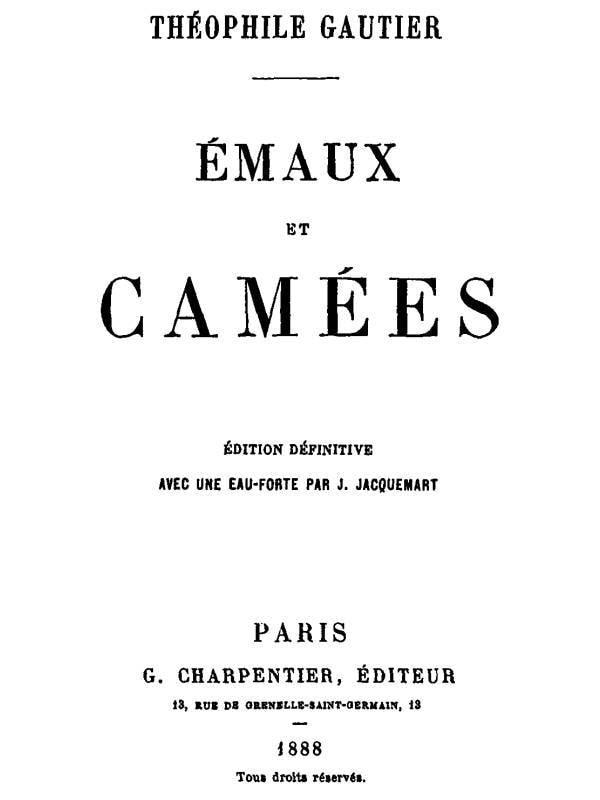
Émaux Et Camées
1852
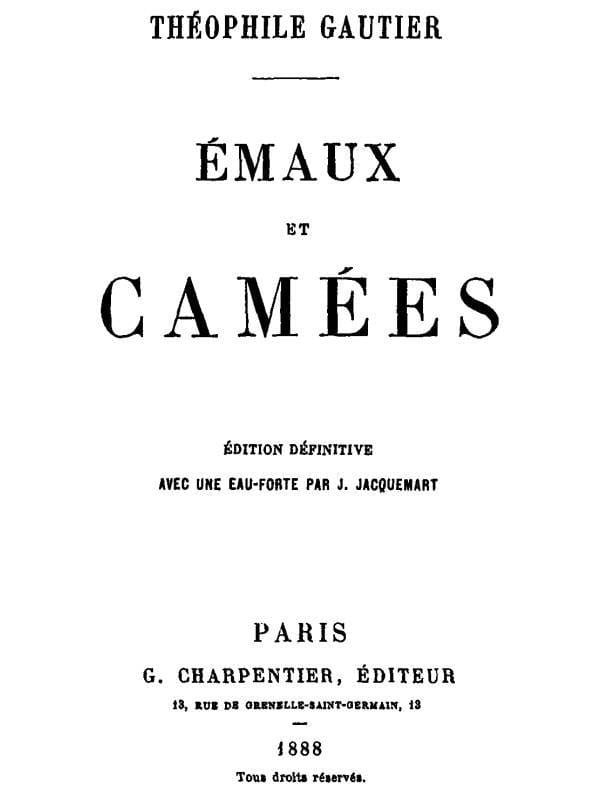
Émaux et Camées is a collection of small, perfect artifacts - sixty-four poems carved with the precision of a cameo cutter or an enamel artist. Gautier conceived these verses amid the chaos of 1848, finding in formal beauty a response to political disorder. The poems shimmer with classical allusion, sensuous descriptions of women and nature, and a deliberate restraint that would become the hallmark of the Parnassian movement Gautier inadvertently birthed. Each piece functions like a jewel box: miniature, self-contained, glittering with exacting rhyme and image. Yet beneath the surface polish runs an undercurrent of melancholy - these are celebrations of beauty acutely aware of its own transience. The collection moves from the sensual "Affinity" (a pantheistic madrigal pairing marble, pearls, roses, and doves) to contemplations of art as immortality. Gautier insisted poetry need not teach or reform; it need only be beautiful. These poems remain that argument in crystalline, unforgettable form. For readers who believe that perfection of form is itself a kind of meaning.
Editions
X-Ray
“And of a Sunday swarm the folkUnder the honeysuckle vine, Quaffing, the while they talk and smoke, The sun, the melody, the wine.””
— Théophile Gautier
“Things perish. Gods have passed.But song sublimely castShall citadels outlast.””
— Théophile Gautier
“For Art alone is great:The bust survives the state, The crown the potentate.””
— Théophile Gautier
Link to this book
Add a free, dofollow link to Lex on your blog, forum, syllabus, or reading list.

<a href="https://lex-books.com/book/maux-et-cam-es-3b68d395-ff7f-43fb-b58b-18b66e8856b6"><img src="https://lex-books.com/badges/read-on-lex.svg" alt="Read Émaux Et Camées by Théophile Gautier free on Lex" width="160" height="40"></a>[](https://lex-books.com/book/maux-et-cam-es-3b68d395-ff7f-43fb-b58b-18b66e8856b6)[url=https://lex-books.com/book/maux-et-cam-es-3b68d395-ff7f-43fb-b58b-18b66e8856b6][img]https://lex-books.com/badges/read-on-lex.svg[/img][/url]Read Émaux Et Camées by Théophile Gautier free on Lex: https://lex-books.com/book/maux-et-cam-es-3b68d395-ff7f-43fb-b58b-18b66e8856b6Cite this book
Reading this edition for a paper or guide? Copy a citation.
Gautier, Théophile. Émaux Et Camées. Lex, lex-books.com/book/maux-et-cam-es-3b68d395-ff7f-43fb-b58b-18b66e8856b6.Gautier, T. (1852). Émaux Et Camées. Lex. https://lex-books.com/book/maux-et-cam-es-3b68d395-ff7f-43fb-b58b-18b66e8856b6Gautier, Théophile. Émaux Et Camées. Lex. https://lex-books.com/book/maux-et-cam-es-3b68d395-ff7f-43fb-b58b-18b66e8856b6.