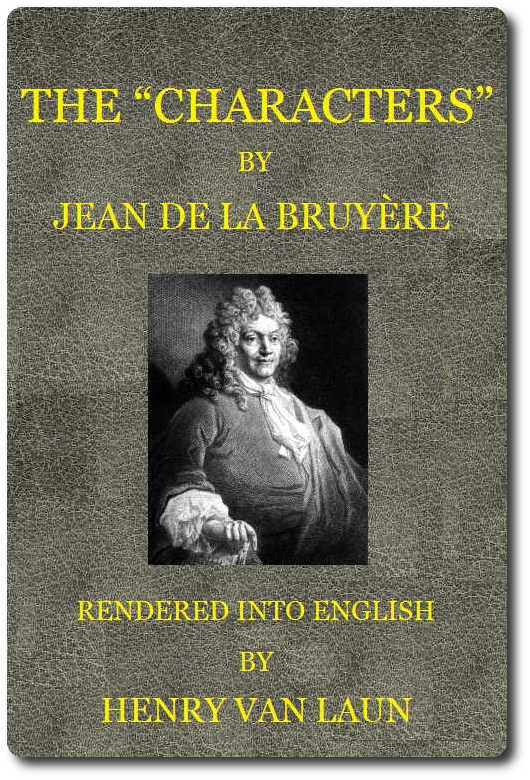
Les Caractères
1688
La Bruyère holds a mirror to the court of Louis XIV and finds human nature wanting. In a series of sharp, precise character sketches, he dissects the vanities, hypocrisies, and absurdities of his contemporaries with the cool detachment of an anatomist and the sting of a satirist. The pedant drowning in useless knowledge, the courtier scheming for favor, the provincial pretending to belong in Paris, the hypocrite who practices vice while professing virtue, all receive their devastating portrait. But this is more than social mockery. La Bruyère probes deeper, questioning how we judge others, how we deceive ourselves, and whether genuine virtue exists at all. Written with elegant precision and an irony that occasionally breaks through like sunlight through clouds, Les Caractères endures because human nature has not fundamentally changed. The court has moved to corporate boardrooms, the pedants now broadcast their certainties on social media, and the rituals of status continue unchanged. We still recognize ourselves in his unflattering portraits.
Editions
X-Ray
“Those who make the worst use of their time are the first to complain of its brevity.””
— Jean de La Bruyère
“Not to be able to bear with all bad-tempered people with whom the world is crowded, shows that a man has not a good temper himself.””
— Jean de La Bruyère
“The pleasure of criticism takes away from us the pleasure of being deeply moved by very fine things.””
— Jean de La Bruyère
“A man is rich whose income is larger than his expenses, and he is poor if his expenses are greater than his income.””
— Jean de La Bruyère
“No vice exists which does not pretend to be more or less like some virtue, and which docs not take advantage of this assumed resemblance.””
— Jean de La Bruyère
“[Il ne manque cependant à l'oisiveté du sage qu'un meilleur nom, et que méditer, parler, lire, et être tranquille s'appelât travailler.]There is, however, nothing wanting to the idleness of a philosopher but a better name, and that meditation, conversation, and reading should be called “work”.””
— Jean de La Bruyère
“Une froideur ou une incivilité qui vient de ceux qui sont au-dessus de nous nous les fait haïr, mais un salut ou un sourire nous les réconcilie.””
— Jean de La Bruyère
“The same common-sense which makes an author write good things, makes him dread they are not good enough to deserve reading.””
— Jean de La Bruyère
“Men are willing to be slaves in one place if they can only lord it in another.””
— Jean de La Bruyère
Link to this book
Add a free, dofollow link to Lex on your blog, forum, syllabus, or reading list.

<a href="https://lex-books.com/book/les-caract-res-6d42a392-ea4f-411f-b859-e2f9822ea6eb"><img src="https://lex-books.com/badges/read-on-lex.svg" alt="Read Les Caractères by Jean de La Bruyère free on Lex" width="160" height="40"></a>[](https://lex-books.com/book/les-caract-res-6d42a392-ea4f-411f-b859-e2f9822ea6eb)[url=https://lex-books.com/book/les-caract-res-6d42a392-ea4f-411f-b859-e2f9822ea6eb][img]https://lex-books.com/badges/read-on-lex.svg[/img][/url]Read Les Caractères by Jean de La Bruyère free on Lex: https://lex-books.com/book/les-caract-res-6d42a392-ea4f-411f-b859-e2f9822ea6ebCite this book
Reading this edition for a paper or guide? Copy a citation.
Bruyère, Jean de La. Les Caractères. Lex, lex-books.com/book/les-caract-res-6d42a392-ea4f-411f-b859-e2f9822ea6eb.Bruyère, J. D. L. (1688). Les Caractères. Lex. https://lex-books.com/book/les-caract-res-6d42a392-ea4f-411f-b859-e2f9822ea6ebBruyère, Jean de La. Les Caractères. Lex. https://lex-books.com/book/les-caract-res-6d42a392-ea4f-411f-b859-e2f9822ea6eb.