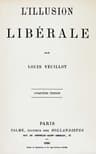
L'illusion Libérale
1866
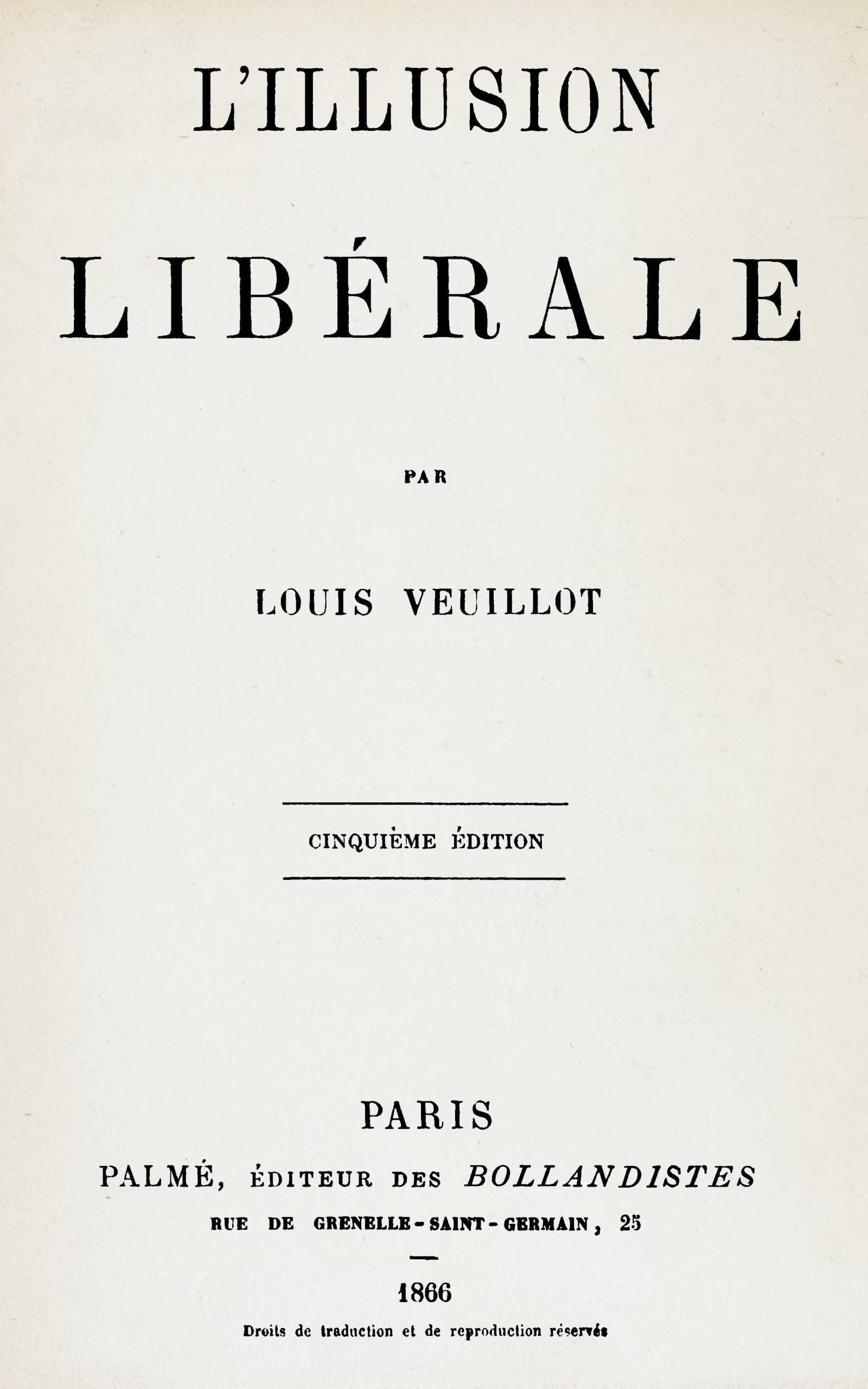
A philosophical treatise written in the late 19th century. The work critiques liberal interpretations of Catholic faith and examines the conflict between traditional Catholicism and modern liberalism. The author delves into the thoughts and arguments of a liberal Catholic, addressing the perceived dangers of separating the Church from its authoritative role in society. At the start of the text, the author recounts a dialogue with a self-proclaimed ''liberal Catholic,'' who argues for a more progressive understanding of faith and its relationship with modern society. This individual suggests that traditional Catholics lack enlightenment and advocates for a complete separation between Church and state. However, as the discussion unfolds, the author challenges these views, presenting compelling counterarguments about the necessity of authority within the Church and the dangers of embracing liberal ideology. The opening sets the stage for a deeper exploration of the tensions between faith, authority, and modernity.
Editions
X-Ray
“The non-Christian secular power, even if it have no religion at all, is an evil, it is of the devil, and it is the theocracy of evil. If we are forced to undergo this misfortune and shame, the misfortune and shame, the misfortune and shame will be greater still for the world than for ourselves. We can survive it by the grace of God, and we alone can help the world survive it. But to seek actively, or to establish with our own hands, a government that would be atheistic in principle - to consecrate a thing so vile and absurd - would be a betrayal of mankind. Mankind would make us render an account before God. It would accuse us of having extinguished the light and of having been the accomplishes of that darkness which is the shadow of death.””
— Louis Veuillot
“It is ignoble to suggest that we go with the flow; the suggestion is repulsive to human honor alone. It is a sign of our decadent times that anyone would dare make such a suggestion to Christians confirmed with holy chrism! Imagine a king disposed from his throne, the last, best hope of his conquered fatherland, who was suddenly to declare that he considered himself justly disposed and that he only aspired to enjoy his personal possessions, according to the laws governing all citizens, beneath the protection of the very men who are plundering his subjects; can you see the infinite disgrace of such a wretched king? But that would be nothing in comparison with what is proposed to us.””
— Louis Veuillot
“We turn toward the Man Crucified of Jerusalem, toward the Man Crucified of Rome, toward His truth abandoned and betrayed; we say to Him: "I believe You, I adore You, and I accept to be trampled underfoot as You were, and mocked as You were; I wish to die with You! . . . " When we say such a thing, the world is conquered.It will never be conquered any other way. In no other way will we ever wrest its weapons out of its hands, in order to transfigure and sanctify them by turning them over to the silencing of all blaspheming and the removing of every obstacle between the little ones of this world and eternal truth. For all men must know and pronounce these words, the "I believe" which alone can deliver the world; the "Thy kingdom come" which calls down eternal peace.””
— Louis Veuillot
“For indeed, the Church is divinely constituted and lives by her own right, not by privilege. Who ever would have granted her such a privilege had it not belonged to her by nature? The State? So civil society is then superior to religious society and can legitimately take back what it generously bestowed? History - along with Christian common sense - condemns the false conception behind such a way of talking. The Church was not created by the State; on the contrary, it was she who created the State and society; and neither the State nor society bestowed any privileges on the Church; they recognized her mode of existence as prior to their own, as endowed with rights in no way deriving from them and which they can only modify by some abuse of power, against which the public interest is bound to protest.””
— Louis Veuillot
Link to this book
Add a free, dofollow link to Lex on your blog, forum, syllabus, or reading list.

<a href="https://lex-books.com/book/l-illusion-lib-rale-23294d62-7b0b-4168-842d-85a593daa989"><img src="https://lex-books.com/badges/read-on-lex.svg" alt="Read L'illusion Libérale by Louis Veuillot free on Lex" width="160" height="40"></a>[](https://lex-books.com/book/l-illusion-lib-rale-23294d62-7b0b-4168-842d-85a593daa989)[url=https://lex-books.com/book/l-illusion-lib-rale-23294d62-7b0b-4168-842d-85a593daa989][img]https://lex-books.com/badges/read-on-lex.svg[/img][/url]Read L'illusion Libérale by Louis Veuillot free on Lex: https://lex-books.com/book/l-illusion-lib-rale-23294d62-7b0b-4168-842d-85a593daa989Cite this book
Reading this edition for a paper or guide? Copy a citation.
Veuillot, Louis. L'illusion Libérale. Lex, lex-books.com/book/l-illusion-lib-rale-23294d62-7b0b-4168-842d-85a593daa989.Veuillot, L. (1866). L'illusion Libérale. Lex. https://lex-books.com/book/l-illusion-lib-rale-23294d62-7b0b-4168-842d-85a593daa989Veuillot, Louis. L'illusion Libérale. Lex. https://lex-books.com/book/l-illusion-lib-rale-23294d62-7b0b-4168-842d-85a593daa989.