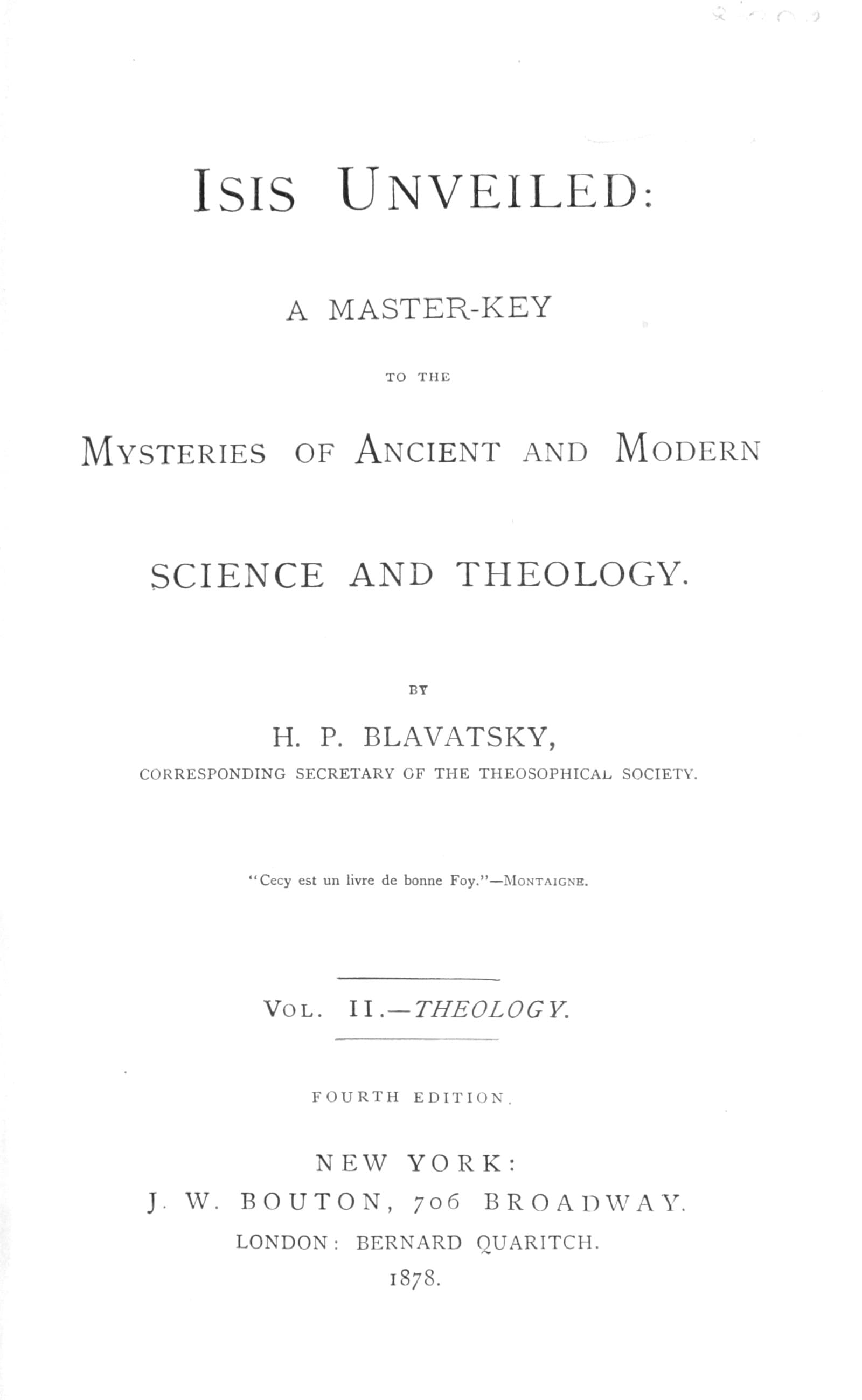
Isis Unveiled, Volume 1 (of 2), Science: A Master-Key to Mysteries of Ancient and Modern Science and Theology
1877
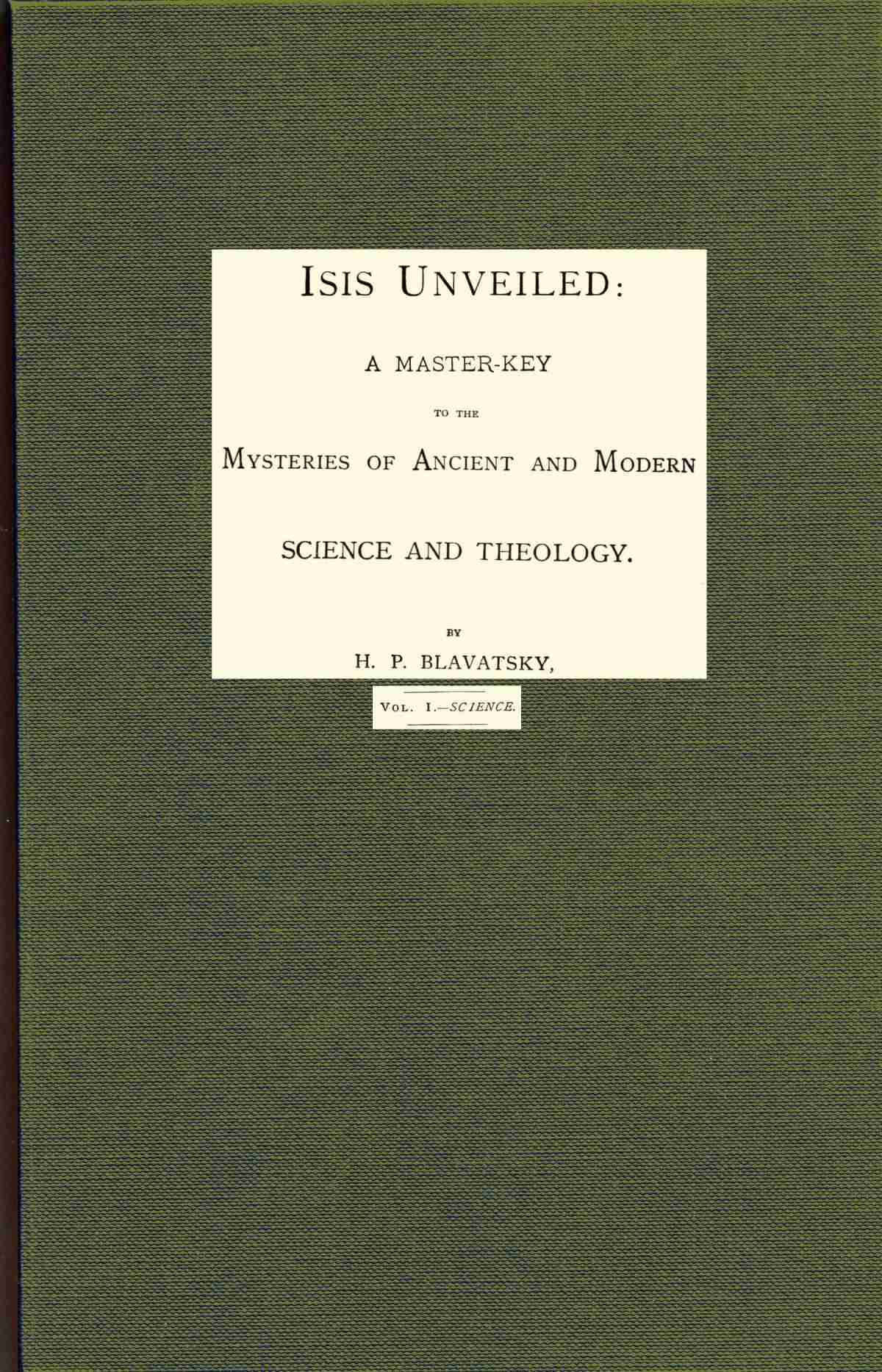
Isis Unveiled, Volume 1 (of 2), Science: A Master-Key to Mysteries of Ancient and Modern Science and Theology
1877
In 1877, a Russian aristocrat with mysterious teachers in Tibet published a book that would launch a worldwide spiritual movement and scandalize the Victorian establishment. H.P. Blavatsky's Isis Unveiled is a sprawling, audacious assault on the materialism she saw consuming both science and religion. She argues that Western civilization has forgotten what the ancients knew: that behind the visible world lies a hidden order, a 'Wisdom Religion' once universal, now preserved only in Eastern esoteric traditions. Volume I dissects the pretensions of contemporary science, exposing what Blavatsky considers its dogmatic blind spots, while weaving in Hermetic philosophy, Pythagorean mathematics, and testimony from her alleged masters. This is not a comfortable read. It is a polemic, a manifesto, and an encyclopedia of arcane knowledge all at once. It influenced Jung, stimulated the New Age movement, and remains essential reading for anyone curious about the hidden currents beneath modern thought.
Editions
X-Ray
“Man is a little world--a microcosm inside the great universe. Like a fetus, he is suspended, by all his three spirits, in the matrix of the macrocosmos; and while his terrestrial body is in constant sympathy with its parent earth, his astral soul lives in unison with the sidereal anima mundi. He is in it, as it is in him, for the world-pervading element fills all space, and is space itself, only shoreless and infinite. As to his third spirit, the divine, what is it but an infinitesimal ray, one of the countless radiations proceeding directly from the Highest Cause--the Spiritual Light of the World? This is the trinity of organic and inorganic nature--the spiritual and the physical, which are three in one, and of which Proclus says that 'The first monad is the Eternal God; the second, eternity; the third, the paradigm, or pattern of the universe;' the three constituting the Intelligible Triad.””
— H. P. Blavatsky
“REALITY in an illusionary universe of ever-passing forms.””
— H. P. Blavatsky
“The Kalmucks and some tribes of Siberia also describe in their legends earlier creations than our present race. These beings, they say, were possessed of almost boundless knowledge, and in their audacity even threatened rebellion against the Great Chief Spirit. To punish their presumption and humble them, he imprisoned them in bodies, and so shut in their senses. From these they can escape but through long repentance, self-purification, and development. Their Shamans, they think, occasionally enjoy the divine powers originally possessed by all human beings.””
— H. P. Blavatsky
“A flower blossoms; then withers and dies. It leaves a fragrance behind, which, long after its delicate petals are but a little dust, still lingers in the air. Our material sense may not be cognizant of it, but it nevertheless exists. Let a note be struck on an instrument, and the faintest sound produces an eternal echo. A disturbance is created on the invisible waves of the shoreless ocean of space, and the vibration is never wholly lost.””
— H. P. Blavatsky
“Apollonius and Iamblichus held that it was not "in the knowledge of things without, but in the perfection of the soul within, that lies the empire of man, aspiring to be more than men.””
— H. P. Blavatsky
“The will,” says Van Helmont, “is the first of all powers. For through the will of the Creator all things were made and put in motion.””
— H. P. Blavatsky
“Schopenhauer’s doctrine is that the universe is but the manifestation of the will.””
— H. P. Blavatsky
“What is this something which thinks and even speaks but yet is not human; that is impalpable and yet not a disembodied spirit; that simulates affection, passion, remorse, fear, joy, but yet feels neither? What is this canting creature which rejoices in cheating the truthful inquirer and mocking at sacred human feeling?””
— H. P. Blavatsky
“But why should the operations of nature be changed? There may be a deeper philosophy than we dream of”
— H. P. Blavatsky
Link to this book
Add a free, dofollow link to Lex on your blog, forum, syllabus, or reading list.

<a href="https://lex-books.com/book/isis-unveiled-volume-1-of-2-science-a-master-key-to-mysteries-of-ancient-and-mod-a4207fbe-ef9f-412a-9ed2-6ecd0884f11a"><img src="https://lex-books.com/badges/read-on-lex.svg" alt="Read Isis Unveiled, Volume 1 (of 2), Science: A Master-Key to Mysteries of Ancient and Modern Science and Theology by H. P. Blavatsky free on Lex" width="160" height="40"></a>[](https://lex-books.com/book/isis-unveiled-volume-1-of-2-science-a-master-key-to-mysteries-of-ancient-and-mod-a4207fbe-ef9f-412a-9ed2-6ecd0884f11a)[url=https://lex-books.com/book/isis-unveiled-volume-1-of-2-science-a-master-key-to-mysteries-of-ancient-and-mod-a4207fbe-ef9f-412a-9ed2-6ecd0884f11a][img]https://lex-books.com/badges/read-on-lex.svg[/img][/url]Read Isis Unveiled, Volume 1 (of 2), Science: A Master-Key to Mysteries of Ancient and Modern Science and Theology by H. P. Blavatsky free on Lex: https://lex-books.com/book/isis-unveiled-volume-1-of-2-science-a-master-key-to-mysteries-of-ancient-and-mod-a4207fbe-ef9f-412a-9ed2-6ecd0884f11aCite this book
Reading this edition for a paper or guide? Copy a citation.
Blavatsky, H. P.. Isis Unveiled, Volume 1 (of 2), Science: A Master-Key to Mysteries of Ancient and Modern Science and Theology. Lex, lex-books.com/book/isis-unveiled-volume-1-of-2-science-a-master-key-to-mysteries-of-ancient-and-mod-a4207fbe-ef9f-412a-9ed2-6ecd0884f11a.Blavatsky, H. P. (1877). Isis Unveiled, Volume 1 (of 2), Science: A Master-Key to Mysteries of Ancient and Modern Science and Theology. Lex. https://lex-books.com/book/isis-unveiled-volume-1-of-2-science-a-master-key-to-mysteries-of-ancient-and-mod-a4207fbe-ef9f-412a-9ed2-6ecd0884f11aBlavatsky, H. P.. Isis Unveiled, Volume 1 (of 2), Science: A Master-Key to Mysteries of Ancient and Modern Science and Theology. Lex. https://lex-books.com/book/isis-unveiled-volume-1-of-2-science-a-master-key-to-mysteries-of-ancient-and-mod-a4207fbe-ef9f-412a-9ed2-6ecd0884f11a.