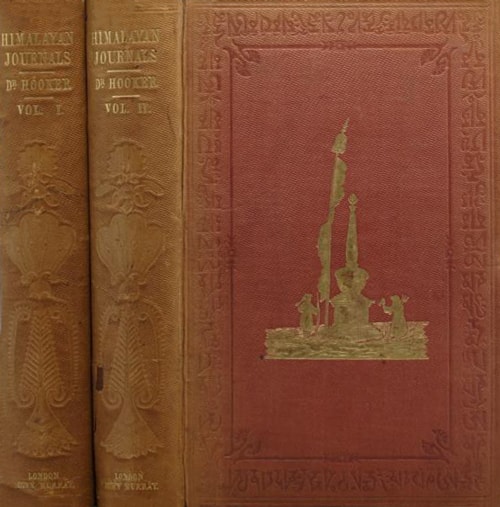
Himalayan Journals — Complete: Or, Notes of a Naturalist in Bengal, the Sikkim and Nepal Himalayas, the Khasia Mountains, Etc.
1854
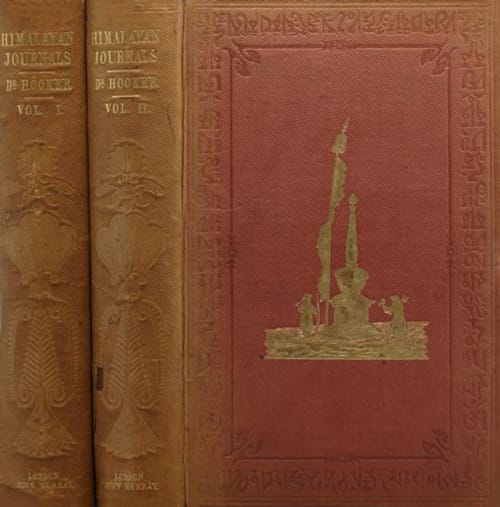
Himalayan Journals — Complete: Or, Notes of a Naturalist in Bengal, the Sikkim and Nepal Himalayas, the Khasia Mountains, Etc.
1854
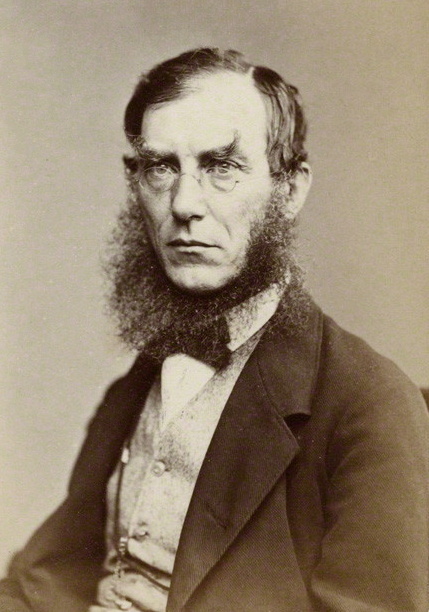
In 1847, a twenty-seven-year-old Joseph Dalton Hooker arrived in India with little more than a burning curiosity and an unbeatable scientific mind. Over the next years, he would become one of the first Western naturalists to systematically explore the Sikkim and Nepal Himalayas, braving political imprisonment, hostile terrain, and the constant threat of disease to document a natural world previously unknown to Western science. The result is this journals a work that reads part adventure narrative, part botanical encyclopedia, and part intimate travel memoir. Hooker descends into tropical valleys, scales impossible peaks, and catalogs thousands of plant species with a precision that still astounds. He offers vivid, often surprising observations of the peoples he encounters, the geological wonders he witnesses, and the extraordinary biodiversity that surrounds him. Written with the infectious wonder of a man seeing creation fresh, Himalayan Journals captures the golden age of exploration when the map still held secrets. It remains essential reading for anyone who wants to understand not just the history of botany, but how we learned to see the natural world.
Editions

X-Ray
“In the woods I heard and saw the wild peacock for the first time. Its voice is not to be distinguished from that of the tame bird in England, a curious instance of the perpetuation of character under widely different circumstances, for the crow of the wild jungle-fowl does not rival that of the farm-yard cock.””
— Joseph Dalton Hooker
“Our coolies with provisions not having come up, and it being two o'clock in the afternoon, I having had no breakfast, and being ignorant of the exclusively Jain population of the village, sent my servant to the bazaar, for some fowls and eggs; but he was mobbed for asking for these articles, and parched rice, beaten flat, with some coarse sugar, was all I could obtain; together with sweetmeats so odiously flavoured with various herbs, and sullied with such impurities, that we quickly made them over to the elephants.””
— Joseph Dalton Hooker
“The temples, though small, are well built, and carefully kept. No persuasion could induce the Brahmins to allow us to proceed beyond the vestibule without taking off our shoes, to which we were not inclined to consent.””
— Joseph Dalton Hooker
Link to this book
Add a free, dofollow link to Lex on your blog, forum, syllabus, or reading list.

<a href="https://lex-books.com/book/himalayan-journals-complete-or-notes-of-a-naturalist-in-bengal-the-sikkim-and-ne-c9edbbd6-a39d-4f7f-8ebe-91dcdf8148ff"><img src="https://lex-books.com/badges/read-on-lex.svg" alt="Read Himalayan Journals — Complete: Or, Notes of a Naturalist in Bengal, the Sikkim and Nepal Himalayas, the Khasia Mountains, Etc. by Joseph Dalton Hooker free on Lex" width="160" height="40"></a>[](https://lex-books.com/book/himalayan-journals-complete-or-notes-of-a-naturalist-in-bengal-the-sikkim-and-ne-c9edbbd6-a39d-4f7f-8ebe-91dcdf8148ff)[url=https://lex-books.com/book/himalayan-journals-complete-or-notes-of-a-naturalist-in-bengal-the-sikkim-and-ne-c9edbbd6-a39d-4f7f-8ebe-91dcdf8148ff][img]https://lex-books.com/badges/read-on-lex.svg[/img][/url]Read Himalayan Journals — Complete: Or, Notes of a Naturalist in Bengal, the Sikkim and Nepal Himalayas, the Khasia Mountains, Etc. by Joseph Dalton Hooker free on Lex: https://lex-books.com/book/himalayan-journals-complete-or-notes-of-a-naturalist-in-bengal-the-sikkim-and-ne-c9edbbd6-a39d-4f7f-8ebe-91dcdf8148ffCite this book
Reading this edition for a paper or guide? Copy a citation.
Hooker, Joseph Dalton. Himalayan Journals — Complete: Or, Notes of a Naturalist in Bengal, the Sikkim and Nepal Himalayas, the Khasia Mountains, Etc.. Lex, lex-books.com/book/himalayan-journals-complete-or-notes-of-a-naturalist-in-bengal-the-sikkim-and-ne-c9edbbd6-a39d-4f7f-8ebe-91dcdf8148ff.Hooker, J. D. (1854). Himalayan Journals — Complete: Or, Notes of a Naturalist in Bengal, the Sikkim and Nepal Himalayas, the Khasia Mountains, Etc.. Lex. https://lex-books.com/book/himalayan-journals-complete-or-notes-of-a-naturalist-in-bengal-the-sikkim-and-ne-c9edbbd6-a39d-4f7f-8ebe-91dcdf8148ffHooker, Joseph Dalton. Himalayan Journals — Complete: Or, Notes of a Naturalist in Bengal, the Sikkim and Nepal Himalayas, the Khasia Mountains, Etc.. Lex. https://lex-books.com/book/himalayan-journals-complete-or-notes-of-a-naturalist-in-bengal-the-sikkim-and-ne-c9edbbd6-a39d-4f7f-8ebe-91dcdf8148ff.