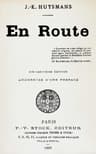
En Route
1895
A man who once investigated Satanism now finds himself kneeling in a Trappist monastery. Such is the improbable journey of Durtal, Joris-Karl Huysmans' thinly veiled alter ego, in this 1895 novel that scandalized the Catholic Church even as it chronicled one man's return to faith. En Route opens in the church of St. Sulpice, where Durtal seeks refuge from the spiritual void of modern Paris, drawn by the haunting beauty of plainchant and the mysterious weight of liturgy. What unfolds is neither straightforward conversion narrative nor simple redemption story, but something far more unsettling: a meditation on how aesthetic obsession might become, improbably, a path to God. Huysmans fills these pages with the sensory richness of Catholic ritual, the architecture of faith, the music that moves beyond words, all rendered with the same painstaking detail he once lavished on the occult. The Church condemned the book for obscenity, which tells you everything about how uncomfortable this portrait of a tortured, decadent soul finding grace truly was. For readers who crave literature that wrestles with the messiness of belief, that asks whether beauty can save us, this remains a strange and powerful artifact of fin-de-siècle spiritual anxiety.
Editions
X-Ray
“But that which remains for ever incomprehensible is the initial horror, the horror imposed on each of us, of having to live, and that is a mystery no philosophy can explain.””
— J.-K. Huysmans
“There are two ways of ridding ourselves of a thing which burdens us, casting it away or letting it fall. To cast away requires an effort of which we may not be capable, to let fall imposes no labour, is simpler, without peril, within reach of all. To cast away, again, implies a certain interest, a certain animation, even a certain fear; to let fall is absolute indifference, absolute contempt; believe me, use this method, and Satan will flee.””
— J.-K. Huysmans
“Go forth more boldly, look at things more widely, pray as best you can, and do not trouble yourself.””
— J.-K. Huysmans
“Every one has a sum of physical and moral suffering to pay, and whoever does not settle it here below, defrays it after death; happiness is only lent, and must be repaid; its very phantoms are like duties paid in advance on a future succession of sorrows.””
— J.-K. Huysmans
“All have suffered shipwreck. The Church, unbending in this matter, has remained upright and entire. She orders the body to be silent, and the soul to suffer, and contrary to all probability, humanity listens to her, and sweeps away like a dung-heap the seductive joys proposed to her.Again, the vitality of the Church is decision, which preserves her in spite of the unfathomable stupidity of her sons. She has resisted the disquieting folly of the clergy, and has not even been broken up by the awkwardness and lack of ability in her defenders, a very strong point.””
— J.-K. Huysmans
Link to this book
Add a free, dofollow link to Lex on your blog, forum, syllabus, or reading list.

<a href="https://lex-books.com/book/en-route-608841e2-8b30-433f-8855-6e8211e992b8"><img src="https://lex-books.com/badges/read-on-lex.svg" alt="Read En Route by J.-K. Huysmans free on Lex" width="160" height="40"></a>[](https://lex-books.com/book/en-route-608841e2-8b30-433f-8855-6e8211e992b8)[url=https://lex-books.com/book/en-route-608841e2-8b30-433f-8855-6e8211e992b8][img]https://lex-books.com/badges/read-on-lex.svg[/img][/url]Read En Route by J.-K. Huysmans free on Lex: https://lex-books.com/book/en-route-608841e2-8b30-433f-8855-6e8211e992b8Cite this book
Reading this edition for a paper or guide? Copy a citation.
Huysmans, J.-K.. En Route. Lex, lex-books.com/book/en-route-608841e2-8b30-433f-8855-6e8211e992b8.Huysmans, J. (1895). En Route. Lex. https://lex-books.com/book/en-route-608841e2-8b30-433f-8855-6e8211e992b8Huysmans, J.-K.. En Route. Lex. https://lex-books.com/book/en-route-608841e2-8b30-433f-8855-6e8211e992b8.