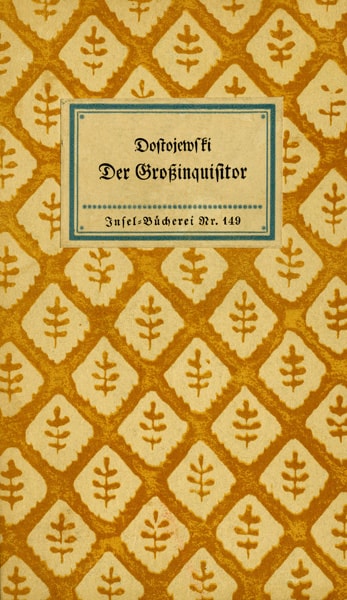
Der Großinquisitor
1880
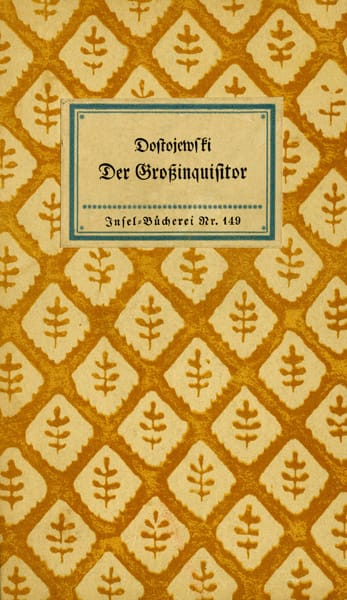
In 16th-century Seville, Christ returns to Earth and is immediately arrested by the Catholic Church. The Grand Inquisitor, a towering figure of institutional authority, condemns Him not for heresy but for an unforgivable sin: giving humanity freedom. In one of literature's most devastating arguments, the Inquisitor contends that humans are too weak, too desperate for certainty, to bear the burden of free choice. The Church, he argues, took up the burden humanity could not carry by imposing miracle, mystery, and authority in place of impossible freedom. Christ listens in silence. His only reply is a kiss. This is not a story with a verdict. It is a philosophical grenade placed at the foundation of every system that promises freedom while demanding obedience. Yet it is also, quietly, a love story: the Inquisitor loves Christ deeply, loves Him enough to damn himself to save humanity from the unbearable weight of His gift. The final kiss is not defeat or vindication. It is the collision of two kinds of love, both of them infinite, both of them impossible.
Editions

X-Ray
“In the end they will lay their freedom at our feet and say to us, Make us your slaves, but feed us.””
— Fyodor Dostoyevsky
“Man is tormented by no greater anxiety than to find someone quickly to whom he can hand over that great gift of freedom with which the ill-fated creature is born.””
— Fyodor Dostoyevsky
“Anyone who can appease a man's conscience can take his freedom away from him.””
— Fyodor Dostoyevsky
“Peacefully they will die, peacefully they will expire in Thy name, and beyond the grave they will find nothing but death. But we shall keep the secret, and for their happiness we shall allure them with the reward of heaven and eternity.””
— Fyodor Dostoyevsky
“Without a clear perception of his reasons for living, man will never consent to live, and will rather destroy himself than tarry on earth, though he be surrounded with bread".””
— Fyodor Dostoyevsky
“In place of the clear and rigid ancient law, You [oh Lord] made man decide about good and evil for himself, with no other guidance than Your example. But did it never occur to You that man would disregard Your example, even question it, as well as Your truth, when he was subjected to so fearful a burden as freedom of choice?””
— Fyodor Dostoyevsky
“That day must come when men will understand that freedom and daily bread enough to satisfy all are unthinkable and can never be had together, as men will never be able to fairly divide the two among themselves. And they will also learn that they can never be free, for they are weak, vicious, miserable nonentities born wicked and rebellious.””
— Fyodor Dostoyevsky
“There exists no greater or more painful anxiety for a man who has freed himself from all religious bias, than how he shall soonest find a new object or idea to worship. But man seeks to bow before that only which is recognized by the greater majority, if not by all his fellow-men, as having a right to be worshipped; whose rights are so unquestionable that men agree unanimously to bow down to it. For the chief concern of these miserable creatures is not to find and worship the idol of their own choice, but to discover that which all others will believe in, and consent to bow down to in a mass.””
— Fyodor Dostoyevsky
“I want to see with my own eyes the hind lie down with the lion and the victim rise up and embrace his murderer.””
— Fyodor Dostoyevsky
Link to this book
Add a free, dofollow link to Lex on your blog, forum, syllabus, or reading list.

<a href="https://lex-books.com/book/der-gro-inquisitor-68c9a33d-53d5-4359-813e-5e61c5ddfffa"><img src="https://lex-books.com/badges/read-on-lex.svg" alt="Read Der Großinquisitor by Fyodor Dostoyevsky free on Lex" width="160" height="40"></a>[](https://lex-books.com/book/der-gro-inquisitor-68c9a33d-53d5-4359-813e-5e61c5ddfffa)[url=https://lex-books.com/book/der-gro-inquisitor-68c9a33d-53d5-4359-813e-5e61c5ddfffa][img]https://lex-books.com/badges/read-on-lex.svg[/img][/url]Read Der Großinquisitor by Fyodor Dostoyevsky free on Lex: https://lex-books.com/book/der-gro-inquisitor-68c9a33d-53d5-4359-813e-5e61c5ddfffaCite this book
Reading this edition for a paper or guide? Copy a citation.
Dostoyevsky, Fyodor. Der Großinquisitor. Lex, lex-books.com/book/der-gro-inquisitor-68c9a33d-53d5-4359-813e-5e61c5ddfffa.Dostoyevsky, F. (1880). Der Großinquisitor. Lex. https://lex-books.com/book/der-gro-inquisitor-68c9a33d-53d5-4359-813e-5e61c5ddfffaDostoyevsky, Fyodor. Der Großinquisitor. Lex. https://lex-books.com/book/der-gro-inquisitor-68c9a33d-53d5-4359-813e-5e61c5ddfffa.