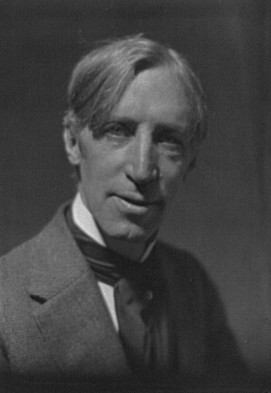
Crowds: A Moving-Picture of Democracy
Written in the shadow of the First World War, Gerald Stanley Lee's 1916 meditation on democracy and the crowd feels startlingly prescient. Beginning with the bustling streets of London, where ancient cathedrals stand beside roaring machines, Lee poses a question that echoes across the century: where is modern civilization heading, and what happens to the individual when swallowed by the collective? This is neither dry sociology nor utopian manifesto, but something stranger: a philosophical moving-picture, a kinetic portrait of how machines, crowds, and human aspiration interweave to reshape identity itself. Lee argues that democracy's true test lies not in institutions but in how individuals preserve their soul within the mass. For readers intrigued by the roots of crowd theory, the anxieties of early modernity, or the tension between individual freedom and collective force, this book offers a strange, wandering, often beautiful meditation on what it means to be human in an age of machines.
Editions
Link to this book
Add a free, dofollow link to Lex on your blog, forum, syllabus, or reading list.

<a href="https://lex-books.com/book/crowds-a-moving-picture-of-democracy-65c446bd-e3c4-4e50-9ec9-f00df9452c56"><img src="https://lex-books.com/badges/read-on-lex.svg" alt="Read Crowds: A Moving-Picture of Democracy by Gerald Stanley Lee free on Lex" width="160" height="40"></a>[](https://lex-books.com/book/crowds-a-moving-picture-of-democracy-65c446bd-e3c4-4e50-9ec9-f00df9452c56)[url=https://lex-books.com/book/crowds-a-moving-picture-of-democracy-65c446bd-e3c4-4e50-9ec9-f00df9452c56][img]https://lex-books.com/badges/read-on-lex.svg[/img][/url]Read Crowds: A Moving-Picture of Democracy by Gerald Stanley Lee free on Lex: https://lex-books.com/book/crowds-a-moving-picture-of-democracy-65c446bd-e3c4-4e50-9ec9-f00df9452c56Cite this book
Reading this edition for a paper or guide? Copy a citation.
Lee, Gerald Stanley. Crowds: A Moving-Picture of Democracy. Lex, lex-books.com/book/crowds-a-moving-picture-of-democracy-65c446bd-e3c4-4e50-9ec9-f00df9452c56.Lee, G. S. (n.d.). Crowds: A Moving-Picture of Democracy. Lex. https://lex-books.com/book/crowds-a-moving-picture-of-democracy-65c446bd-e3c4-4e50-9ec9-f00df9452c56Lee, Gerald Stanley. Crowds: A Moving-Picture of Democracy. Lex. https://lex-books.com/book/crowds-a-moving-picture-of-democracy-65c446bd-e3c4-4e50-9ec9-f00df9452c56.