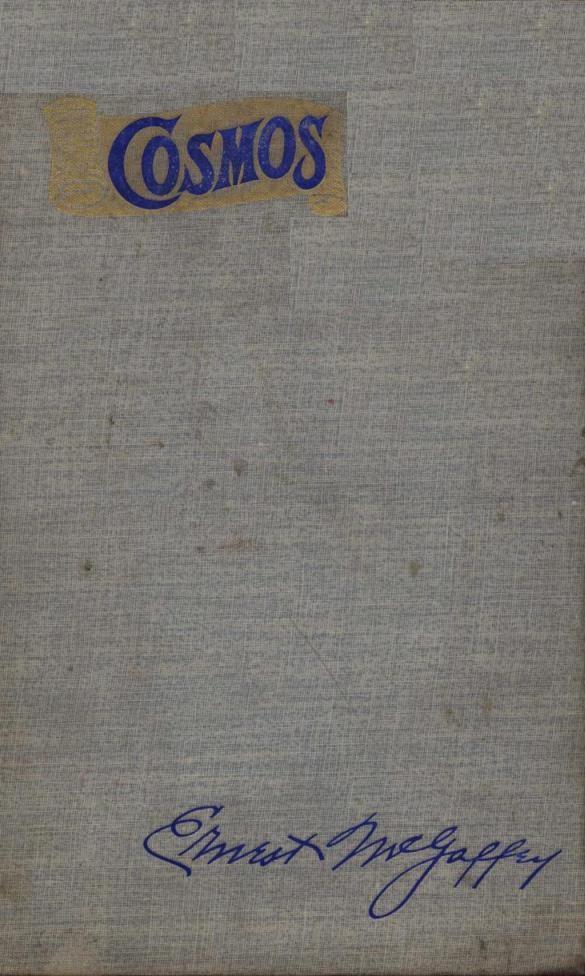
Cosmos
1903
In the autumn of 1977, a golden record aboard the Voyager spacecraft carried a message into the interstellar void: sounds and images representing life on Earth, launched toward stars that might harbor minds capable of receiving them. Carl Sagan conceived this act of cosmic optimism, and Cosmos traces the long intellectual journey that made it possible. Part memoir of a scientist's formation, part panoramic history of civilization's discovery of its place in the universe, the book moves from the ancient Library of Alexandria to the edge of the observable cosmos, from the invention of writing to the possibility of intelligence elsewhere in the galaxy. Sagan writes with lyrical precision about the death of stars, the birth of galaxies, and the emergence of life from chemistry. He introduces figures who expanded human understanding: Aristarchus, who posited a heliocentric universe; Hypatia, murdered by a Christian mob; Champollion, deciphering hieroglyphics from a stone. But the book is most powerful when Sagan turns his gaze outward and then reflects it back on us, seeing Earth as a pale blue dot suspended in a sunbeam, a world of creatures who have begun to wonder about their origins. Cosmos is an argument for science as a profoundly human enterprise, our best tool for navigating the immensity of existence.
Editions
X-Ray
“What a thrilling story of wartime survival!””
— Unknown
Link to this book
Add a free, dofollow link to Lex on your blog, forum, syllabus, or reading list.

<a href="https://lex-books.com/book/cosmos-566f93b8-8f2a-4732-a864-1d78a5b9234d"><img src="https://lex-books.com/badges/read-on-lex.svg" alt="Read Cosmos by Unknown free on Lex" width="160" height="40"></a>[](https://lex-books.com/book/cosmos-566f93b8-8f2a-4732-a864-1d78a5b9234d)[url=https://lex-books.com/book/cosmos-566f93b8-8f2a-4732-a864-1d78a5b9234d][img]https://lex-books.com/badges/read-on-lex.svg[/img][/url]Read Cosmos by Unknown free on Lex: https://lex-books.com/book/cosmos-566f93b8-8f2a-4732-a864-1d78a5b9234dCite this book
Reading this edition for a paper or guide? Copy a citation.
Unknown. Cosmos. Lex, lex-books.com/book/cosmos-566f93b8-8f2a-4732-a864-1d78a5b9234d.Unknown (1903). Cosmos. Lex. https://lex-books.com/book/cosmos-566f93b8-8f2a-4732-a864-1d78a5b9234dUnknown. Cosmos. Lex. https://lex-books.com/book/cosmos-566f93b8-8f2a-4732-a864-1d78a5b9234d.