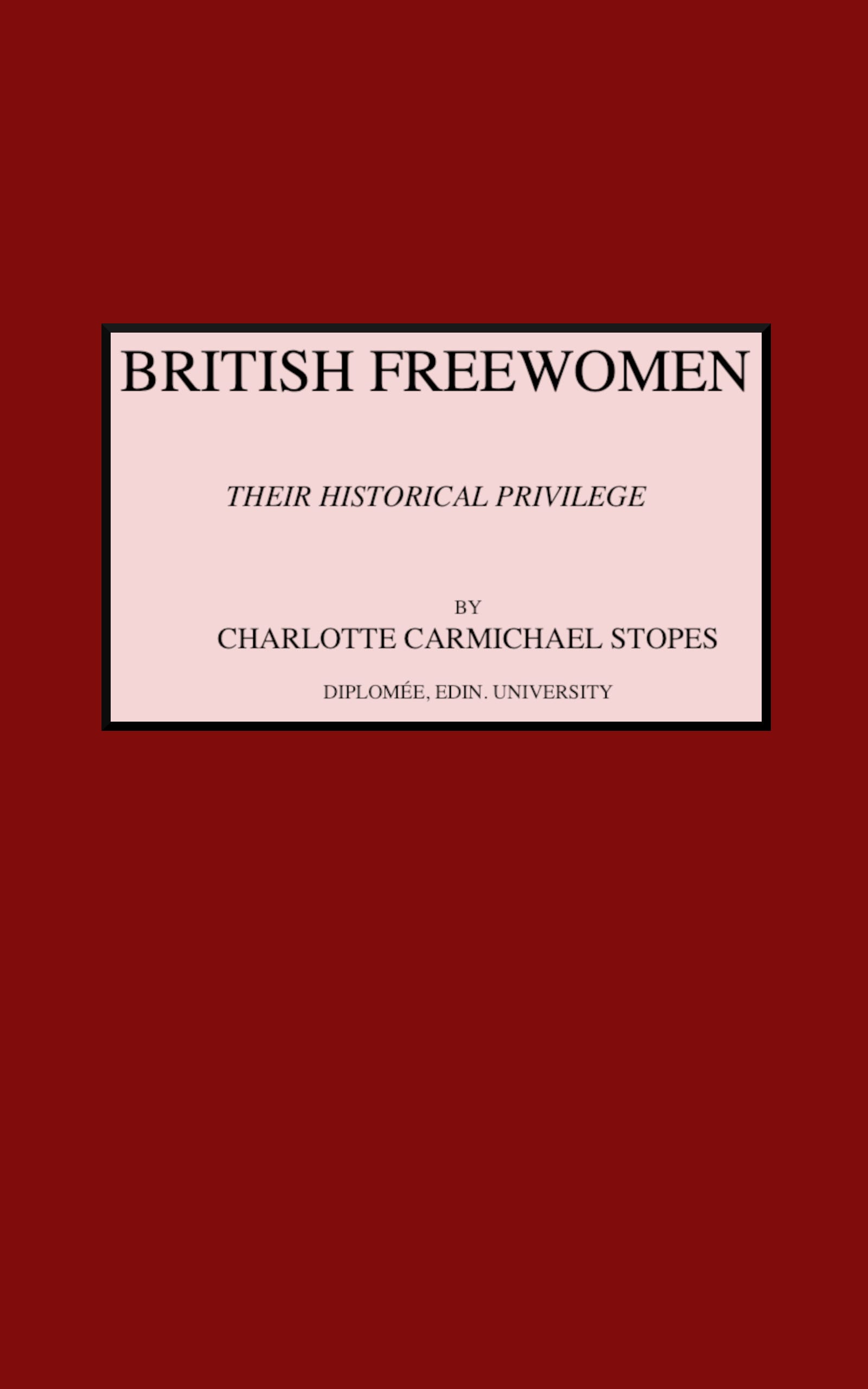
British Freewomen: Their Historical Privilege
1894
British Freewomen: Their Historical Privilege
1894
C. C. Stopes undertook something radical in 1894: she went looking for British women in the historical record and found them everywhere. This meticulously researched work traces the legal rights and social privileges of British women from antiquity through the Norman Conquest, drawing on classical sources like Tacitus and Plutarch to reconstruct a past where women commanded armies, ruled kingdoms, and held legal personhood. Stopes challenges the assumption that women's subjugation is ancient and inevitable, instead revealing how Norman influence gradually eroded the relative equality that existed in early British and Anglo-Saxon society. Through vivid portraits of figures like Boadicea and Cartismandua, she demonstrates that history had recorded powerful women, but patriarchal narratives had buried their significance. Written during the height of the suffrage struggle, this book served as an urgent argument: if British women once possessed freedom, they could claim it again. The scholarship is rigorous, the tone is impassioned, and the stakes could not be higher. For readers interested in feminist history, the roots of women's rights, or recovering the erased voices of the past, this remains a foundational text.
Editions
Link to this book
Add a free, dofollow link to Lex on your blog, forum, syllabus, or reading list.

<a href="https://lex-books.com/book/british-freewomen-their-historical-privilege-38e5078f-37e4-4dfc-bd06-6c66c811cdf1"><img src="https://lex-books.com/badges/read-on-lex.svg" alt="Read British Freewomen: Their Historical Privilege by C. C. Stopes free on Lex" width="160" height="40"></a>[](https://lex-books.com/book/british-freewomen-their-historical-privilege-38e5078f-37e4-4dfc-bd06-6c66c811cdf1)[url=https://lex-books.com/book/british-freewomen-their-historical-privilege-38e5078f-37e4-4dfc-bd06-6c66c811cdf1][img]https://lex-books.com/badges/read-on-lex.svg[/img][/url]Read British Freewomen: Their Historical Privilege by C. C. Stopes free on Lex: https://lex-books.com/book/british-freewomen-their-historical-privilege-38e5078f-37e4-4dfc-bd06-6c66c811cdf1Cite this book
Reading this edition for a paper or guide? Copy a citation.
Stopes, C. C.. British Freewomen: Their Historical Privilege. Lex, lex-books.com/book/british-freewomen-their-historical-privilege-38e5078f-37e4-4dfc-bd06-6c66c811cdf1.Stopes, C. C. (1894). British Freewomen: Their Historical Privilege. Lex. https://lex-books.com/book/british-freewomen-their-historical-privilege-38e5078f-37e4-4dfc-bd06-6c66c811cdf1Stopes, C. C.. British Freewomen: Their Historical Privilege. Lex. https://lex-books.com/book/british-freewomen-their-historical-privilege-38e5078f-37e4-4dfc-bd06-6c66c811cdf1.