A Father's Legacy to His Daughters
1761
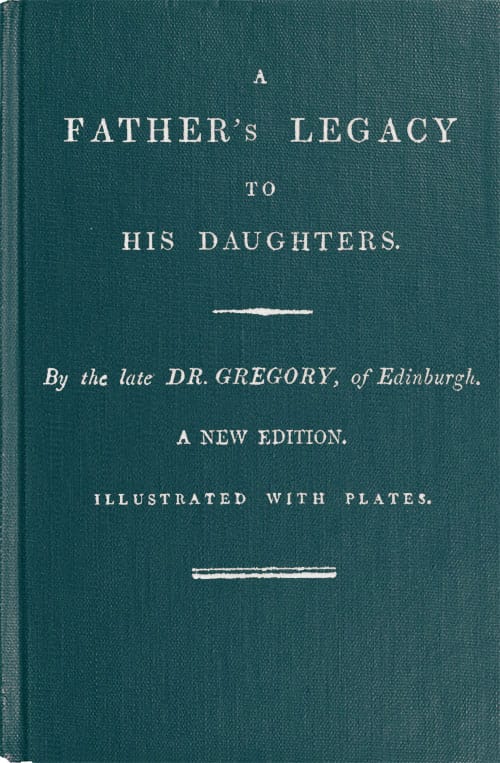
In 1761, Scottish physician John Gregory sat down to write something that would become one of the most influential conduct books in English-language history: a series of letters to his daughters offering guidance on how to navigate a world that measured a woman's worth entirely by her marriage prospects. Gregory had just lost his wife, and this book was meant to preserve her memory and transmit her thoughts on female education. What emerged was a startling document of paternal love yoked to Enlightenment patriarchy: daughters are advised to conceal their learning, to cultivate "modesty" as their chief ornament, to marry not for love but for "esteem." The book became an instant bestseller, running through dozens of editions on both sides of the Atlantic. Its cultural resonance extends far beyond its era: Mary Wollstonecraft directly dismantled Gregory's principles in A Vindication of the Rights of Woman, using his advice as Exhibit A in her argument that women had been educated into servitude. Today, the book functions as both a time capsule and a provocation, revealing the invisible cage that Enlightenment rationality built for women even as it proclaimed itself progressive.
Editions
Link to this book
Add a free, dofollow link to Lex on your blog, forum, syllabus, or reading list.

<a href="https://lex-books.com/book/a-father-s-legacy-to-his-daughters-11d08121-cfaf-4ff7-a0fc-a405c88572a0"><img src="https://lex-books.com/badges/read-on-lex.svg" alt="Read A Father's Legacy to His Daughters by John Gregory free on Lex" width="160" height="40"></a>[](https://lex-books.com/book/a-father-s-legacy-to-his-daughters-11d08121-cfaf-4ff7-a0fc-a405c88572a0)[url=https://lex-books.com/book/a-father-s-legacy-to-his-daughters-11d08121-cfaf-4ff7-a0fc-a405c88572a0][img]https://lex-books.com/badges/read-on-lex.svg[/img][/url]Read A Father's Legacy to His Daughters by John Gregory free on Lex: https://lex-books.com/book/a-father-s-legacy-to-his-daughters-11d08121-cfaf-4ff7-a0fc-a405c88572a0Cite this book
Reading this edition for a paper or guide? Copy a citation.
Gregory, John. A Father's Legacy to His Daughters. Lex, lex-books.com/book/a-father-s-legacy-to-his-daughters-11d08121-cfaf-4ff7-a0fc-a405c88572a0.Gregory, J. (1761). A Father's Legacy to His Daughters. Lex. https://lex-books.com/book/a-father-s-legacy-to-his-daughters-11d08121-cfaf-4ff7-a0fc-a405c88572a0Gregory, John. A Father's Legacy to His Daughters. Lex. https://lex-books.com/book/a-father-s-legacy-to-his-daughters-11d08121-cfaf-4ff7-a0fc-a405c88572a0.