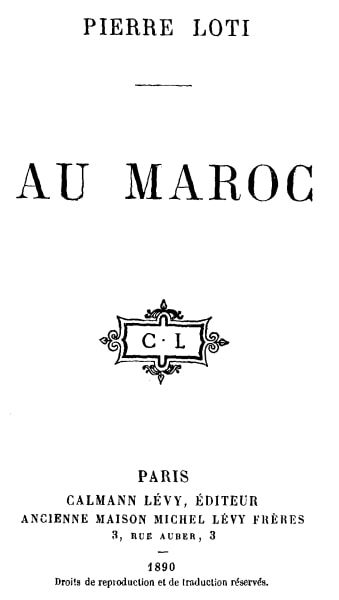
Au Maroc
1890
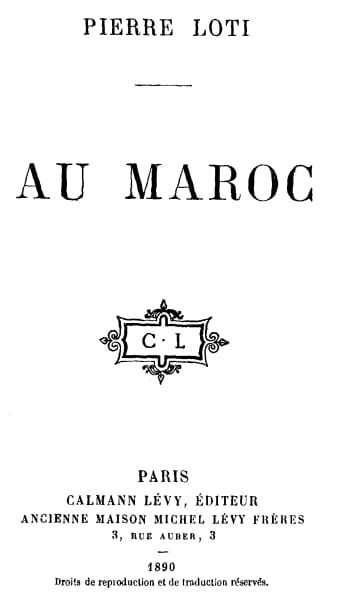
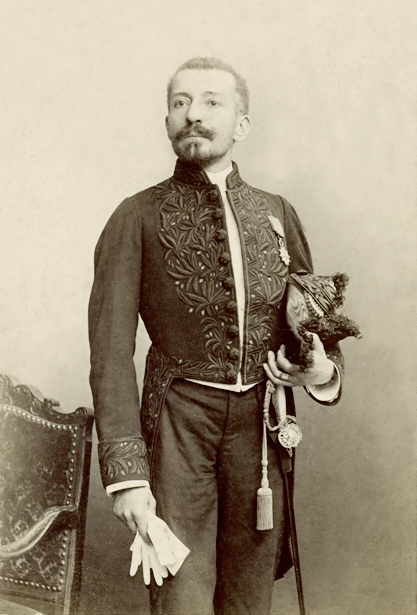
This is a vivid, sensory portrait of Morocco in 1890, before the colonial era reshaped it forever. Pierre Loti arrived in Tangier with a French embassy and continued alone through Fez and Meknez, disguised in native dress. The result is an intimate, often startlingly beautiful account of a world most Europeans would never see: its perfumes and silences, its markets and mosques, the faces of people who had never encountered Western tourists. Loti writes with the eye of a painter and the soul of a poet, capturing a Morocco that existed only briefly before the twentieth century swept it away. The book influenced Matisse, who studied it before his own journey to Morocco, and Edith Wharton, who followed in Loti's footsteps decades later. Yet Loti's gaze is complicated: a European romanticizing an exotic other, with all the fascination and distortion that entails. This is travel writing as sensory immersion, as cultural artifact, as the record of a world now vanished.
Editions
X-Ray
“Her cackle resumed at full volume, and Delbert laughed with her. Life can be a hellish mess, he thought, but these shavings of joy are such an exquisite remedy.””
— Pierre Loti
Link to this book
Add a free, dofollow link to Lex on your blog, forum, syllabus, or reading list.

<a href="https://lex-books.com/book/au-maroc-0edfc8fe-c399-4b61-9662-6898610f967f"><img src="https://lex-books.com/badges/read-on-lex.svg" alt="Read Au Maroc by Pierre Loti free on Lex" width="160" height="40"></a>[](https://lex-books.com/book/au-maroc-0edfc8fe-c399-4b61-9662-6898610f967f)[url=https://lex-books.com/book/au-maroc-0edfc8fe-c399-4b61-9662-6898610f967f][img]https://lex-books.com/badges/read-on-lex.svg[/img][/url]Read Au Maroc by Pierre Loti free on Lex: https://lex-books.com/book/au-maroc-0edfc8fe-c399-4b61-9662-6898610f967fCite this book
Reading this edition for a paper or guide? Copy a citation.
Loti, Pierre. Au Maroc. Lex, lex-books.com/book/au-maroc-0edfc8fe-c399-4b61-9662-6898610f967f.Loti, P. (1890). Au Maroc. Lex. https://lex-books.com/book/au-maroc-0edfc8fe-c399-4b61-9662-6898610f967fLoti, Pierre. Au Maroc. Lex. https://lex-books.com/book/au-maroc-0edfc8fe-c399-4b61-9662-6898610f967f.